
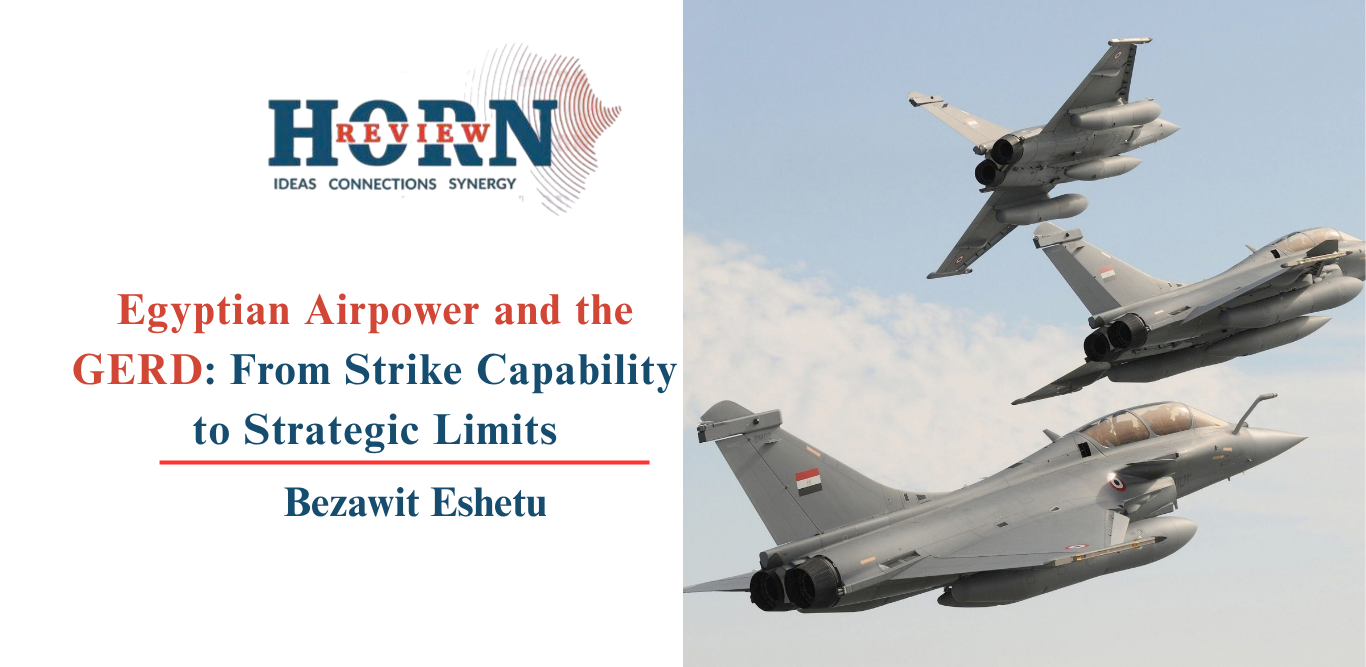
Egyptian Airpower and the GERD: From Strike Capability to Strategic Limits
The Grand Ethiopian Renaissance Dam is within the theoretical reach of the Egyptian Air Force. Egypt possesses a large and increasingly modern combat fleet, including the Dassault Rafale, F-16 and MiG-29M/M2, alongside long-range stand-off weapons associated with its Rafale force. Yet the question of whether Egypt can strike the GERD cannot be answered by aircraft range alone. There is a significant difference between reaching the general target area, conducting a sustained long-range strike and achieving sufficient damage to produce a decisive strategic effect. Egypt has many of the capabilities required for the first two. The third is considerably more uncertain. Since the GERD was inaugurated in September 2025 and reached its planned generation capacity of 5,150 megawatts, it has become functioning national infrastructure with a reservoir of approximately 74 billion cubic metres. A military operation against it would therefore have consequences well beyond the destruction of a conventional fixed target.
Egypt’s combat-aircraft inventory gives Cairo a credible foundation for long-range air operations. The country has 54 Rafales from its confirmed 2015 and 2021 orders, while FlightGlobal’s 2026 inventory lists 168 active F-16s, 31 MiG-29s and seven E-2C airborne early-warning aircraft. In September 2026, Cairo was also reported to have submitted a request for proposals for another 24 Rafales, which would raise the eventual fleet to 78 if a contract is concluded. That request is important as an indicator of Egypt’s continuing investment in long-range and modern air power, but it should not be treated as an existing combat capability because no additional 24-aircraft contract has yet been confirmed. Egypt therefore already possesses a substantial force for distant operations, independent of the prospective expansion.
The distance to the GERD nevertheless creates a demanding operational problem. The dam is more than 1,500 kilometers from southern Egypt by approximate direct distance, and an actual military mission would depend on the route available and the surrounding political and security environment. A fighter operating at that distance must account for the entire mission, including the outward journey, time available in the target area, contingencies and the return journey. This places particular importance on aerial refueling. Egypt does not operate its own dedicated tanker fleet, which limits the degree of independent long-range endurance available to the Egyptian Air Force. The limitation was partly exposed by Egypt’s recent exercises with China. In August 2026, a Chinese YY-20A tanker was photographed refueling an Egyptian Rafale during the Eagles of Civilization exercise. The demonstration shows that Egyptian Rafales can operate with an external tanker capability, but it does not give Egypt an indigenous tanker force. In an actual conflict, reliance on foreign tanker support would introduce a separate political and operational dependency.
A long-range strike would also place demands on command and control, communications, situational awareness and electronic support. Egypt operates E-2C Hawkeye aircraft for airborne early warning, while its recent Chinese exercises have provided experience in operating alongside aircraft such as the KJ-500 airborne early-warning platform, the YY-20 tanker and other specialized support aircraft. Egypt’s Rafale fleet also provides a more sophisticated electronic-warfare and self-protection capability than much of the country’s older combat inventory. These capabilities increase the feasibility of a distant operation, but they do not remove the strategic difficulty of entering another state’s airspace. The central issue is therefore not whether Egypt possesses individual systems that can perform these functions. It does. The issue is whether those systems can be combined into a sufficiently reliable long-range mission under wartime conditions without outside political or military support.
Sudan adds another complication. Geography makes Sudan relevant to any assessment of Egypt’s military options against Ethiopia, but Sudan cannot be treated as dependable strategic depth. Egypt and Sudan developed significant military cooperation during periods of tension with Ethiopia, including the Guardians of the Nile exercises in 2021. Yet Sudanese strategic calculations have not consistently aligned with Cairo’s position on the GERD. In January 2023, Abdel Fattah al-Burhan stated that Sudan and Ethiopia agreed on issues concerning the dam, demonstrating that Khartoum’s position could diverge from Egypt’s even under military rule. The war that began in Sudan in April 2023 has made the problem more serious. Egyptian military personnel participating in exercises at Merowe were caught in the fighting and subsequently evacuated. The episode demonstrated how quickly Sudanese territory can become an insecure environment even for Egyptian forces operating there with the consent of Sudanese authorities.
The GERD itself makes the military calculation substantially different from an ordinary long-range strike against a fixed facility. The main dam is approximately 1.8 kilometres long and 145 metres high, with a saddle dam extending for roughly 5.2 kilometres. Its reservoir has a capacity of about 74 billion cubic metres and covers approximately 1,874 square kilometres at full supply level. The scale matters because the strategic effect of an attack would depend on the nature and extent of the damage, the condition of the reservoir and the functioning of the wider dam system. Physical damage to the project would not automatically produce the kind of catastrophic reservoir failure sometimes assumed in discussions of a strike. At the same time, damage to critical parts of the project could have consequences extending well beyond the immediate site, particularly because the dam now forms part of Ethiopia’s functioning electricity system.
The defensive environment is an important constraint on any Egyptian assessment of a strike against the GERD. Ethiopia has taken measures to protect the dam as a critical national installation, including the acquisition of Israeli-made SPYDER air-defense systems. The precise configuration, deployment and readiness of Ethiopia’s air-defense network are not publicly established, and this uncertainty itself complicates any attempt to plan a long-range operation against the site. Egypt would therefore have to account for the possibility of layered defensive measures whose full disposition would not be known in advance. For Egypt, uncertainty over Ethiopia’s defensive posture increases the operational risk of attempting to penetrate the country’s airspace and reach the dam with sufficient precision to produce a decisive effect.
The more decisive problem is the condition of the GERD itself. The military consequences of striking the project during its construction were fundamentally different from those of striking a completed and functioning dam. During the early construction period, particularly in 2011 and 2013, the reservoir had not yet accumulated the enormous volume of water that it holds today, and the dam had not yet become an operating component of Ethiopia’s national power system. A strike at that stage would still have carried serious military and diplomatic consequences, but it would have presented a different physical and strategic problem. Today, Egypt would be contemplating an attack on a functioning national infrastructure project and a filled reservoir containing approximately 74 billion cubic metres of water. The question is therefore no longer simply whether Egyptian aircraft can reach the GERD, but whether a strike could produce meaningful damage without creating consequences that extend far beyond the military objective itself, most critically, a catastrophic flood wave that would inundate large parts of Sudan (including the near-certain collapse of the Roseires and Sennar dams and the submersion of Khartoum under metres of water) and risk secondary flooding impacts in Egypt itself as the surge reaches Lake Nasser and the Aswan High Dam.
This reality shapes the overall assessment. Egypt possesses credible long-range airpower and the technological components required to place weapons against a distant target. Its Rafale force, stand-off weapons, airborne early-warning capability and experience with aerial refuelling give Cairo a genuine ability to conduct long-range operations. The constraints become more serious at the level of sustained independent operations, especially because Egypt lacks its own tanker fleet and would have to operate across a politically complex regional airspace. The still greater uncertainty concerns the outcome. Publicly available information is insufficient to establish that Egypt could reliably destroy the GERD or produce a catastrophic reservoir failure through an air operation. The central conclusion is therefore that Egypt has the capacity to attempt a strike, but the distance between the capacity to strike and the capacity to achieve a decisive strategic result is substantial.
That gap between capability and decisive effect also helps explain why Egypt failed to act during the earlier period when the physical risks of a strike were lower. The reason was not simply a temporary lack of military capacity, but Egypt’s own political collapse. When Ethiopia began constructing the GERD in 2011, Egypt was consumed by revolution, institutional breakdown and prolonged political transition. Ethiopia continued to advance a legitimate national development project on its own territory, steadily progressing construction even as downstream objections intensified. By the time the Egyptian state regained a measure of coherence under President Abdel Fattah el-Sisi, the dam had already become a far more consequential target, with a growing reservoir and increasing importance to Ethiopia’s electricity system.
That shift fits a broader pattern in Egypt’s approach to the Nile dispute. Egyptian leaders have repeatedly described Nile water as a matter of national survival, but the willingness to invoke force has consistently exceeded the willingness to use it. Sadat warned in 1979 that water could bring Egypt back to war. Amr Moussa issued similar warnings in the 1990s. In 2013, Egyptian political figures publicly discussed military options after Ethiopia began diverting the Blue Nile, and Morsi declared that all options remained open. Sisi subsequently repeated similar warnings in 2020 and 2021. Yet none of these governments crossed into direct war with Ethiopia. The historical record therefore demonstrates a consistent distinction between Egypt’s willingness to threaten force and its willingness to absorb the consequences of using it. The GERD has made that distinction even more important because the military costs of action have increased as the dam has moved from a construction project to functioning strategic infrastructure.
That distinction is best understood through the difference between deterrence and compellence. Before the reservoir was filled, Egypt could threaten Ethiopia in an effort to prevent further construction. After completion, Cairo would have to compel a sovereign state to reverse an established national project. Compellence requires a credible willingness to execute the threat, while execution would produce consequences that deterrence allows the threatening state to avoid. The completion of the GERD therefore raised the threshold for Egyptian military action at precisely the moment when Egypt’s military technology was improving.
The legal dispute reinforces this constraint. Ethiopia’s position rests on its sovereign right to use water within its territory subject to obligations concerning equitable and reasonable utilization and the avoidance of significant harm. Egypt, Ethiopia and Sudan incorporated those principles into the 2015 Declaration of Principles, which also committed the parties to cooperation and peaceful settlement. Egypt continues to contest Ethiopia’s interpretation of these obligations and invokes earlier Nile agreements, including the 1929 and 1959 arrangements. Ethiopia was not a party to those colonial-era agreements. Whatever position one takes on the competing interpretations, an Egyptian strike would create an immediate contradiction between Cairo’s diplomatic strategy and its military conduct. Egypt has spent years presenting Ethiopia as the party violating international obligations. An overt attack would place Egypt itself at the center of the international legal and political controversy.
The environmental consequences would make that contradiction more severe. The GERD sits close to the Sudanese border, meaning that any catastrophic structural failure could have immediate consequences downstream before reaching Egypt. Hydrological modelling has identified potentially severe flooding consequences in Sudan under extreme dam-failure scenarios, although the precise effects depend on assumptions concerning the breach and downstream conditions. Egypt therefore cannot treat the dam as an isolated target. The same infrastructure Cairo views as a threat to Egyptian water security is also a structure whose uncontrolled destruction could threaten Sudanese territory and populations. The strategic paradox is stark. Egypt could attempt to eliminate the physical object of its concern while simultaneously creating the regional humanitarian emergency it has spent years arguing it seeks to prevent.
That broader strategic environment has increased the cost of Egyptian isolation strategies. Ethiopia maintains relationships with the UAE, Saudi Arabia, Turkey and the United States, while China has become a major economic and diplomatic actor in Ethiopia. In August 2026, Ethiopia and the United States agreed to deepen their defense relationship toward what Addis Ababa described as comprehensive strategic cooperation. The UAE has substantial infrastructure and port interests in Ethiopia while remaining one of Egypt’s most important economic partners. The Ras El Hekma investment alone involved approximately $35 billion in UAE investment in Egypt. Cairo would therefore face a serious strategic contradiction if it initiated a war against a country in which one of its most important economic partners has major interests.
Egypt’s own economic position further reduces its freedom of action. The 2026 war involving Iran exposed vulnerabilities in Egyptian energy security, investment flows and Suez Canal revenues. Israel’s interruption of gas supplies affected approximately 15 to 20 percent of Egyptian consumption, while Egypt was already consuming around 6.2 billion cubic feet of gas per day against domestic production of approximately 4.1 billion cubic feet. Foreign portfolio investors withdrew billions of dollars, shipping disruptions affected the Suez Canal and Egypt required additional imported LNG and regasification capacity. These pressures matter militarily because strategic endurance depends upon economic resilience. Opening a major war with Ethiopia would impose another demand on a state already operating under substantial economic and regional pressure.
The result is that Egypt’s most plausible strategy increasingly lies around Ethiopia rather than directly against the GERD. Faced with the prohibitive risks of a direct strike (catastrophic downstream flooding in Sudan and potentially Egypt itself, severe diplomatic isolation, and the exposure of its own fragile economy to retaliation), Cairo has chosen a more calculated course. It has strengthened relations with Eritrea and Somalia, deepened military cooperation with Sudan’s army, and expanded its Red Sea security role, thereby constructing a network of regional pressure points and cultivating proxies around Ethiopia. Egypt has deliberately built relationships across the geographic perimeter surrounding Ethiopia, creating forms of pressure that can impose costs on Addis Ababa without requiring Cairo to initiate an unmistakable interstate war, an option its military, diplomatic and economic constraints have rendered far too costly.
The Sudanese experience illustrates why this approach can be more attractive than an overt strike. Egypt has been accused of conducting drone operations against the Rapid Support Forces, accusations Cairo has denied. Investigative reporting subsequently presented satellite imagery, flight records and video evidence indicating Egyptian drone activity from a base near the Sudanese border. Even if individual elements of that reporting remain contested, the broader strategic distinction is clear. Operations against a non-state armed actor in a neighbouring conflict can preserve ambiguity and allow Cairo to frame its actions through border security. A strike on the GERD would offer no comparable deniability. It would be attributable, politically unmistakable and impossible to contain within a narrow security justification.
Egypt’s Shift to Peripheral Coercion and Proxy Cultivation
With the direct military option against the GERD rendered too costly by Egypt’s own military, diplomatic and economic constraints, Cairo has redirected pressure outward. Unable to compel Ethiopia through overt force, Egypt has cultivated a network of relationships and influence around Ethiopia’s periphery. This approach of peripheral coercion seeks to raise Addis Ababa’s security costs through neighbors and internal actors while keeping Egypt itself outside the frame of interstate war.
The pattern unfolds across four geographic sides. To the north, Eritrea’s President Isaias Afwerki has made repeated visits to Cairo since 2018. Egypt and Eritrea signed a maritime transport agreement in Asmara in May 2026, with Egypt’s foreign minister declaring that Red Sea governance and security remain the exclusive responsibility of littoral states, a formula that excludes landlocked Ethiopia, and describing Horn of Africa stability as a direct extension of Egyptian national security. Addis Ababa has publicly interpreted these moves as an effort to obstruct its sea access.
To the east, Egypt signed a defense pact with Somalia in August 2024, followed by shipments of heavy artillery and armored vehicles, offers of troops for peacekeeping, a trilateral summit and committee with Eritrea in October 2024, and elevation of the relationship with Mogadishu to a strategic partnership in January 2025. To the west, Egypt maintains military cooperation with Sudan’s army, which according to reporting hosts Tigrayan fighters who have fought alongside it against the Rapid Support Forces. Inside Ethiopia itself, longstanding grievances in Tigray, Amhara, and Afar provide potential raw material for external actors.
This alignment is deliberate. Egyptian officials present the partnerships as defenses of Somali sovereignty, Red Sea security, and respect for territorial integrity. Yet the geometry remains consistent. A state that treats the Horn as an extension of its national security, builds frameworks of Red Sea exclusivity with Eritrea and Somalia, and simultaneously frames the GERD as an existential threat has constructed partners whose interests converge with Cairo’s wherever Ethiopia is concerned. The record of cultivation through treaties, summits, arms shipments, and repeated high-level visits constitutes a coherent strategy of pressure from the edges.
Recent events illustrate the substitution in practice. In late September 2026, Ethiopia’s army chief accused Sudan and Egypt of backing armed groups fighting Ethiopian forces. Seven groups, including the TPLF and Amhara Fano militias, formed an alliance aimed at removing Prime Minister Abiy Ahmed, with fighting spreading through Tigray, Amhara, and Afar and threatening the Djibouti supply corridor. Egypt responded with denials of interference and affirmations of respect for sovereignty, while continuing to monitor developments inside Ethiopia. Sudan’s army denied the accusations and leveled counter-charges against Ethiopia. The subsequent expulsion of diplomats and the rupture of Ethiopian-Eritrean relations followed. Regional analysts describe a de facto trilateral arrangement linking Eritrea, elements of the opposition coalition, and Sudan’s army command, with Cairo connected through its established ties to both Asmara and Khartoum, while noting that Cairo’s precise operational role remains unclear and that direct Egyptian combat support appears unlikely.
The documented record shows Egypt in strategic partnership with Eritrea and Somalia and in military partnership with a Sudanese army that shelters Tigrayan fighters. The allegation of active backing comes from Ethiopian authorities and meets Egyptian denial. The inference supported by the pattern is that the conditions Ethiopia now confronts, simultaneous pressure along multiple frontiers and the reactivation of internal armed groups, are precisely those peripheral coercion would be expected to generate. Whether any Egyptian official directs any particular unit is secondary to the strategic effect. A neighbor distracted by internal conflict possesses reduced capacity to resist a sustained diplomatic and political campaign over the Nile.
Egypt’s shift from direct military threats to peripheral coercion reflects a pragmatic adaptation to insurmountable strategic constraints. While Cairo possesses the hardware to strike the GERD, the catastrophic humanitarian and diplomatic blowback has rendered overt confrontation unusable. By encircling Ethiopia with a network of proxy alignments and military pacts, Egypt has transformed a localized water dispute into a broader regional contest. This asymmetric strategy giave Cairo to exploit Ethiopia’s internal fractures while preserving plausible deniability. Ultimately, the physical reality of the completed dam has forced Egypt to redefine its power projection, proving that cultivating targeted instability along an adversary’s borders serves as a far more viable lever than long-range airpower.
By Bezawit Eshetu, Researcher, Horn Review

RELATED
Posts

4
Oct
Eritrea's Buffer is Collapsing: What Comes Next?
Ethiopian National Defense Force’s capture of Mekelle, if sustained, may...
4
Oct
Hassan Sheikh’s Sea Access Remarks: The Ankara Formula Restated, Not a Concession
President Hassan Sheikh Mohamud’s remarks on 3 October 2026 that...
4
Oct
Is Washington Miscalculating on Eritrea?
The United States is attempting a precarious balancing act in...
3
Oct
How Should Saudi Arabia Approach the Conflict in Northern Ethiopia?
Saudi Arabia’s position toward the renewed conflict in northern Ethiopia...

2
Oct
The possibility of Sudan’s War Converging with Ethiopia’s Renewed Conflict
Ethiopia’s renewed conflict has changed the security significance of its...
2
Oct
Government-Humanitarian Coordination for Effective Humanitarian Response in Northern Ethiopia
Humanitarian assistance in a conflict environment depends not only on...
2
Oct
Al-Shabaab's Monitoring of Ethiopian Politics and Why the TPLF's Moves Matter
The emergence of a coalition of armed and political...
2
Oct
Egypt’s Denial of Intervention in Ethiopia Does Not Survive Scrutiny
Egypt’s Foreign Ministry has answered Ethiopian charges of external...

2
Oct
Ethiopia and Libya Rebuild a Bilateral Channel
In late September, Ethiopian Ambassador Zerihun Abebe Yigzaw met Libya’s...