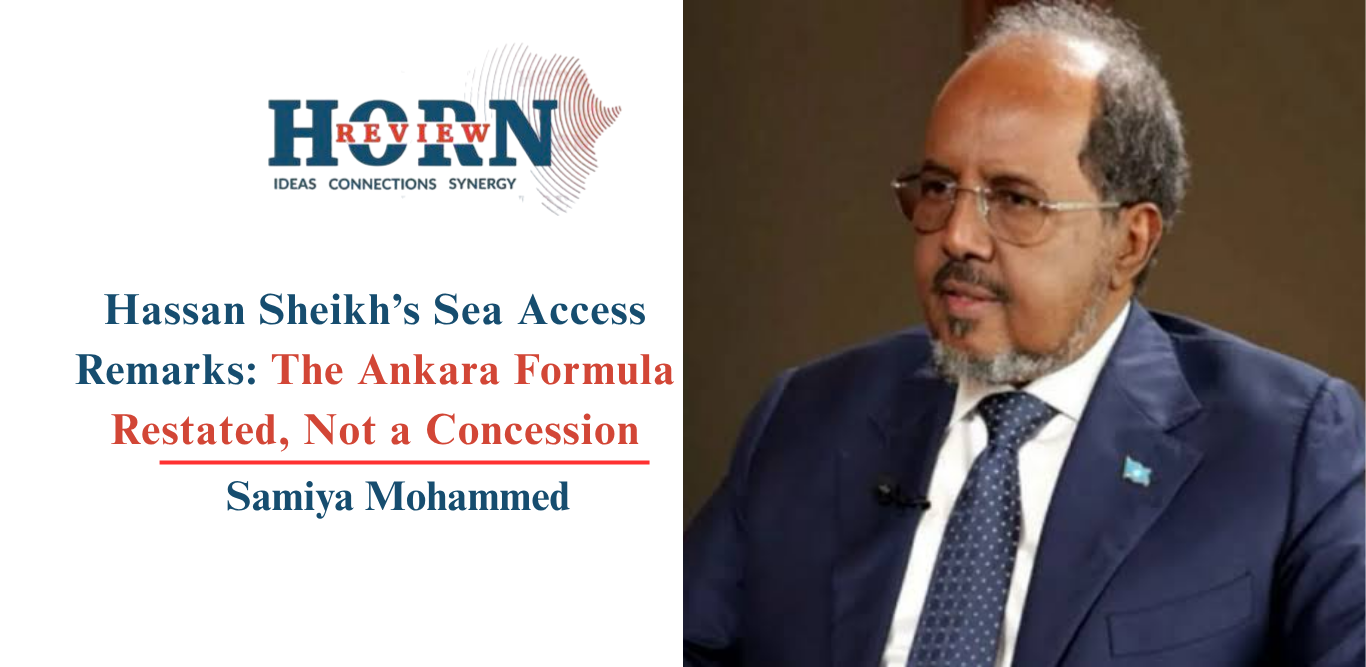
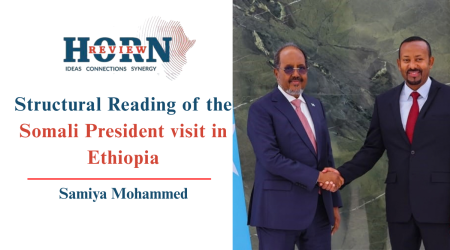
President Hassan Sheikh Mohamud’s remarks on 3 October 2026 that Somalia does not object to Ethiopia obtaining access to the sea should not be interpreted as a new Somali concession nor as an indication that Somalia has accepted a sovereign Ethiopian outlet to the coast. Rather the statement is better understood as a restatement of the framework already established through the Ankara process in which Ethiopia’s legitimate need for reliable maritime access can be accommodated through commercial arrangements but such access remains subject to Somalia’s sovereign authority.
That distinction is the central point. Mohamud’s formulation opens space for commercial engagement without reopening the question of territorial sovereignty. Somalia is effectively saying that Ethiopia can use Somali maritime infrastructure for international trade, negotiate the relevant fees and operating conditions and establish reliable transport arrangements through one or more Somali ports. It is not saying that Ethiopia should possess sovereign territory on the coast establish an autonomous military presence or create a maritime arrangement outside the authority of the Somali federal government.
In that sense we do not object is narrower than it may initially sound. It means that Somalia does not regard Ethiopian commercial access to the sea as inherently illegitimate. It does not mean that every form of Ethiopian maritime presence is acceptable. The difference between access and sovereignty and between commercial use and military presence remains fundamental.
The no war language is diplomatically costless. It is expressed an expectation of no conflict stated that Somalia would not support violence or violations of sovereignty and advocated settlement of differences through dialogue. Following a working visit, this constitutes the appropriate public posture between neighbors sharing both a border and a security environment. It reduces tension without conceding any substantive position.Dialogue however is a mechanism not a deliverable. A berth entails custody of a quay, a road, a customs post and a political arrangement durable enough to survive the next crisis in Mogadishu. The first can be offered at no cost and the second cannot.
Custody is the element the legal claim omits. The coastline Ethiopia would actually utilize is not administered as a single system from the capital. Somaliland has independently managed its ports and external relations for decades. Asserting Somali land asserts title in which title is not an operator. A state committing vessels, insurance and corridor capital is entitled to distinguish between the two and to decline a contract with a party unable to deliver the asset being sold. Such refusal reflects the standard of a serious logistics power not a deficiency in its position. Somalia may reiterate the unity claim indefinitely however repetition does not staff a port.
Commercial access is a conventional landlocked state problem and is resolvable without altering a border. The relevant Convention already provides for transit by arrangement. Diversification within that framework concerns price, dwell time and avoiding dependence on a single corridor. Somalia has stated repeatedly that it can accept this. Acceptance establishes both a floor and a ceiling and it forecloses the argument that transit is illegitimate but it goes no further than transit. What has obstructed further progress is politics and capacity not principle. The negotiable terms remain unspecified which quay, which road, what fee, what duration and what remedy applies when the coastal authority does not control the coast it has invoiced.
A naval facility is a categorically different object. It constitutes a permanent force on foreign territory positioned on the Gulf of Aden adjacent to Bab el-Mandeb entailing basing, sustainment, and a shift in who can act on a congested approach. It is not a discount on container traffic. Coastal capitals and other Red Sea states interpret it as a balance of power move because that is what it is.
Ethiopia’s position is frequently permitted to slide between these two registers. The commercial claim is precise in a country of this size and trade volume should not have its external economy priced and routed through a single foreign port system if additional corridors can be developed. Contracts can satisfy that claim. The naval claim is doctrinal in which a country in this position does not accept permanent absence of a naval instrument on the Red Sea and the Gulf of Aden as a natural condition. A port use contract cannot satisfy that claim and should not be expected to. Conflating the two allows Mogadishu to reject the contract in order to reject the base and allows Ethiopia to present a fee schedule as an answer to a strategic ambition. Separating them does not diminish the doctrine however it prevents the doctrine from burdening the cargo.
The same interview already established this distinction, irrespective of whether the commercial statement is quoted in isolation. Hassan sheike characterized the Red Sea as strategic to Somalia’s economy and security urged littoral states and states with security concerns to understand one another and rejected external military designs on coast he claims. Trade is negotiable ,foreign force is not on his terms. Framing customs access as a precursor to a base will invariably be answered in the second register. Treating corridors as corridors leaves the naval question in a separate file with a higher consent threshold. Ethiopia can maintain both files without subordinating one to the other.
A temporal factor also applies and This is late tenure language. A principle articulated by an outgoing presidency binds the succeeding government only if that government reiterates it and only if a contract exists however No contract exists. The statement represents a ceiling the current office is willing to describe not an instrument that can be presented to a port operator. Ethiopia’s leverage in any subsequent negotiation derives from the cargo, the border and the security relationship that Somali federal politics continues to require. That is a position of weight and It is not strengthened by treating a restated formula as a breakthrough.
If the file is commercial, it has a definable structure where a designated port controlled by the signatory, a corridor, a tariff, a duration sufficient to justify the road and a clause governing custody failure. The Convention is the framework the speaker himself invoked so it is available without any party ceding territory. The naval file belongs elsewhere. Merging the two allows a single refusal to cover both and permits an incomplete customs discussion to be presented as an answer to the sea. A customer contract will not satisfy a navy and a navy should not be permitted to veto a customer contract. Hassan Sheikh offered the first withheld the second and left the application unsent. That is the entirety of the event.
By Samiya Mohammed, Researcher, Horn Review