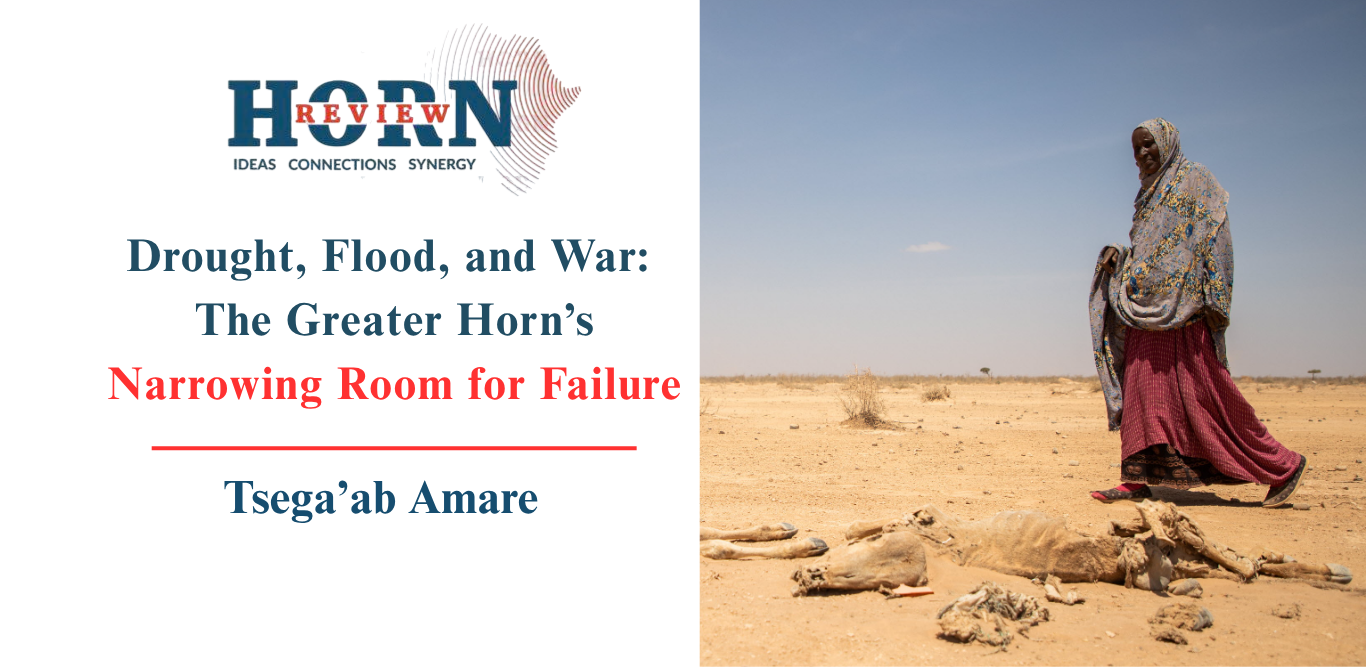
A moderate to strong El Niño is now settling over East Africa at the worst possible moment. The World Meteorological Organization’s latest seasonal update puts the Pacific sea-surface anomaly at roughly 2.9°C for August–October 2026 with high model confidence, still intensifying.
In an ordinary year, this would be a matter for agronomists and meteorologists. In the contemporary realities of the Horn of Africa, however, it becomes a matter for the region’s broader security architecture, because the region has less capacity to absorb climate shock than at almost any point in the past two decades.
Sudan’s civil war is in its fourth year and has produced famine conditions in Darfur and Kordofan. South Sudan is sliding toward a contested election with its main opposition leader on trial for treason. Ethiopia is fighting an internal insurgency in Amhara while managing an unresolved and increasingly militarized standoff with Eritrea over Tigray. Each of these crises would strain a functioning humanitarian system on its own. Together, alongside a climate anomaly bringing drought to some areas and destructive flooding to others, they describe a Horn in which the next eighteen months carry real risk of compounding catastrophes not seen since the 1980s.
The seasonal outlook issued by the IGAD Climate Prediction and Applications Centre in May 2026 found a sixty to eighty percent probability of below normal rainfall during the June to September season across central, northeastern and northwestern Ethiopia, southern Sudan and northern Uganda, with the evolving conditions described as closely resembling the strong El Niño years of 1997 and 2023. That is the drought half of the picture, and it falls disproportionately on Ethiopia’s northern highlands, the same geography that hosts the Amhara insurgency and the Tigray-Eritrea flashpoint.
The second half of the picture runs the opposite way. The October to December short rains, which supply up to seventy percent of annual rainfall in parts of Ethiopia, Kenya, and Somalia, are now forecast to be wetter than normal across most of the Greater Horn, reinforced by a positive Indian Ocean Dipole developing alongside the El Niño.
The World Food Programme’s Somalia office forecasts a prolonged dry spell running through October followed by an elevated risk of extensive flooding in the Deyr season, a sequence that leaves communities no time to recover between one hazard and the next, with water-borne disease flagged as a secondary risk of the wetter scenario.
South Sudan illustrates this duality with unusual clarity, and it is worth dwelling on because it is frequently missed in Horn of Africa climate coverage that defaults to a drought narrative. Its dominant flood driver is Lake Victoria’s level far to the south, which feeds the White Nile into the Sudd wetlands. Peer-reviewed hydrological work found that the 2019 positive Indian Ocean Dipole (IOD) triggered a multi-year propagation of excess storage that produced record flooding through 2024, with Lake Victoria peaks and downstream wetland extent now tightly coupled at a nine-to-thirteen-month lag.
Researchers from the University of Reading warn that more frequent positive IOD events could make the Sudd’s expansion permanent, turning seasonal flooding in Jonglei, Unity, and Upper Nile into irreversible displacement, in what may be the first case of a wetland’s climate-driven growth permanently unhousing a population. Meanwhile the most recent regional hazards monitoring from the US Climate Prediction Center shows drought conditions already declared in southern South Sudan even as Sudd inundation persists elsewhere in the same country.
The government’s political calendar could scarcely be worse timed. Elections are set for December 22, 2026, a date reaffirmed even as the government excluded the opposition SPLM-IO from the consultations that set it. Riek Machar remains on trial in Juba on treason and murder charges in a process UN experts say is dismantling the 2018 peace agreement, and SPLM-IO’s leadership has warned that anyone registering voters in its territory “will be a prisoner of war.” The IPC’s April 2026 update found 7.8 million people, 56 percent of the population, facing high acute food insecurity, with credible famine risk concentrated in the same Upper Nile and Jonglei counties most exposed to the Sudd’s flood dynamics.
South Sudan is not choosing between drought and flood this year; both hazards are hitting different provinces at once, inside a state with neither the fiscal capacity nor the political cohesion to manage either.
Sudan enters this cycle in a condition that makes “drought year” almost academic. WFP needs $579 million to sustain operations through October 2026, against roughly 20 million people, almost half the population, facing acute hunger, with famine already confirmed in parts of the country. That follows the formal famine classification of El Fasher and Kadugli last September. Through mid-2026 the RSF intensified drone and ground attacks on El Obeid, where roughly half a million people remain, raising fears of a repeat of El Fasher. Sudan’s agricultural heartland in Kordofan and the Gezira depends on the same rains now forecast to arrive below normal, at precisely the moment when planting, harvesting and market access in those states are already interrupted by frontline movement. A wetter Blue Nile later in the season would complicate military logistics on both sides and raise dam-safety questions downstream of the GERD.
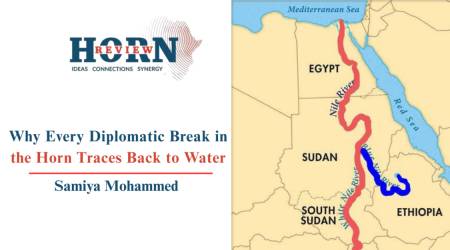
Ethiopian officials have argued, and Sudanese officials have at times echoed, that GERD’s regulation of Blue Nile flow could in principle reduce the kind of flood risk that threatened Khartoum’s own dams in exceptionally wet years. Whether that benefit can be realized during an active war, when the institutions needed to coordinate dam safety and flood warning across the Sudan-Ethiopia border are barely functioning, is a fair question, and one regional planners should be asking now rather than after the fact.
The Amhara region has experienced sustained fighting between federal forces and the Fano militia since the government’s 2023 attempt to disarm regional special forces, and ACLED has recorded more than 7,400 attacks nationwide between January 2022 and May 2026. This fighting disrupted voter registration and campaigning ahead of the June 1 federal elections in dozens of constituencies across Amhara and Tigray.
It would nonetheless be a mistake to read Ethiopia’s 2026 crisis as a simple story of domestic misrule. The most consequential recent development was the August 1 incursion into Tigray from Sudanese territory at Sherarina, attributed to the TPLF-hardliner faction known as Army 70. Ethiopian forces repelled the incursion within hours. Analysts have pointed to a potential coordination among Army 70 remnants, elements of the Sudanese Armed Forces and the Eritrean regime, suggesting a level of external sponsorship well beyond what an internal insurgency could sustain alone. The International Crisis Group’s February assessment placed the risk of renewed Ethiopia-Eritrea hostilities squarely on the fragility of a settlement that both Asmara and TPLF hardliners have incentives to unsettle.
The deeper danger is that these conflicts are no longer separable. Horn Review’s analysis describes Eritrea cultivating relationships with Sudanese armed groups, TPLF hardliners and Fano-sympathetic networks, not to build a formal alliance but a buffer defined by armed relationships across eastern Sudan and northern Ethiopia. Egypt’s use of the GERD dispute and its bilateral defense arrangements with Somalia adds a fourth interested state. This regionalization matters for climate too, since displacement and collapsing rural livelihoods expand the recruitment pool available to whichever faction offers food or protection in exchange for loyalty, as happened with al-Shabaab during the 2011 Somalia famine and again, more modestly, in 2016 to 2017. Climate shock and armed mobilization are feeding each other this year, not running in parallel.
This regionalization meets a humanitarian system gutted at the wrong moment. Famine researchers describe the closure of USAID and cuts to Western aid budgets through 2025 as stripping the infrastructure the region once relied on. WFP’s Somalia support fell from 2.2 million people assisted in early 2025 to just over 600,000 by 2026. There is no evidence of a scale-up comparable to the one that averted famine in Somalia in 2022; no comparable effort arrived in time during the 2011 famine, when an estimated quarter of a million people died, most of them children.
Avoiding the worst outcome requires two tracks at once. On climate, donors should trigger anticipatory financing against ICPAC and FEWS NET forecasts rather than waiting for famine confirmation, protect corridors into El Obeid, Jonglei and Amhara through commitments from the warring parties, and plan for flood and drought response simultaneously in South Sudan rather than assuming one hazard. Technical cooperation on Nile dam safety, kept separate from the unresolved GERD legal dispute, could turn shared climate exposure into a rare point of coordination among Addis Ababa, Khartoum and Cairo. On security, back-channel diplomacy among Addis Ababa, Asmara and the TPLF’s compliance-oriented leadership should target the specific triggers hardliners exploit, while the AU, IGAD, Gulf states and Turkey press Eritrea to stop hosting armed formations operating across the Sudan-Ethiopia frontier, since Ethiopian restraint alone cannot de-escalate that architecture. IGAD and the AU should treat South Sudan’s election as a process whose credibility depends on SPLM-IO’s genuine re-inclusion, not a deadline defended for its own sake. The Horn is not condemned to repeat the 1980s or 2011. But its agency lies in de-escalation and anticipatory action now, before the short rains peak and the South Sudan vote arrives, not in waiting, as the region too often has, for famine to confirm what the forecast already predicted.
Tsega’ab Amare, Researcher, Horn Review