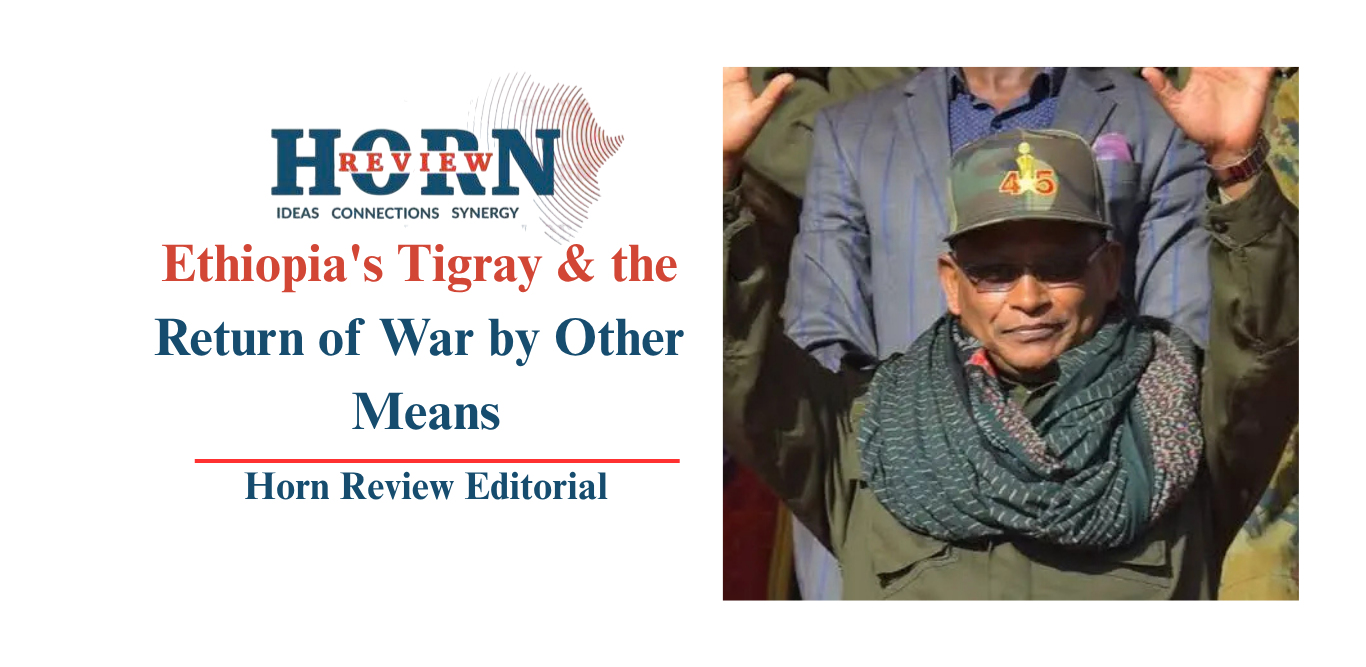
The attempted incursion of August 1, 2026, originating from Sudanese territory at Sherarina and attributed to TPLF-aligned forces commonly referred to as “Army 70,” marks a critical inflection point in the post-Pretoria security architecture of Ethiopia and the wider Horn of Africa. While militarily repelled within hours by the Ethiopian National Defense Forces (ENDF), the operation’s strategic significance lies less in its battlefield outcome than in what it reveals about the evolving configuration of alliances, coercive signaling, and the fragility of the current peace framework.
At the operational level, the attack demonstrates a degree of planning, coordination, and logistical preparation inconsistent with a purely insurgent or fragmented force. The deployment of mechanized capabilities and heavy weaponry, combined with the use of cross-border staging grounds, indicates access to state-level support infrastructures reportedly from Sudan’s SAF, the Egyptian establishment and the Eritrean regime. This transforms the incident from a localized breach into a manifestation of a broader geopolitical contest in which sub-state actors function as instruments within a layered regional confrontation. The alleged triangulation between TPLF hardliners, elements within the Sudanese Armed Forces (SAF), and Eritrean state actors suggests the emergence of a fluid but consequential alignment whose strategic objective extends beyond tactical disruption toward systemic destabilization of the Ethiopian state.
This development must be situated within the incomplete and increasingly contested implementation of the Pretoria Agreement. Designed as a cessation-of-hostilities framework, Pretoria was predicated on mutual de-escalation, disarmament, and reintegration under federal authority. However, its durability has always depended on asymmetrical compliance incentives and the internal cohesion of the parties involved. The resurgence of militarized rhetoric among TPLF hardliners, coupled with reported mass mobilization and forced conscription, underscores a factional divergence within Tigrayan political-military structures. It is increasingly evident that Pretoria has bifurcated the TPLF into compliance-oriented actors and rejectionist elements, the latter seeking to renegotiate the balance of power through coercion rather than dialogue.
The rhetorical posture adopted by senior figures within this hardline bloc is particularly revealing. Public invocations of regime change in Addis Ababa, alongside explicit references to external alliances, signal a shift from defensive posturing to offensive revisionism. This is not merely political theater; it constitutes strategic signaling aimed at multiple audiences: internal constituencies in Tigray, external patrons or partners, and the Ethiopian federal government itself. Such rhetoric reduces the bargaining space for negotiated settlement by elevating maximalist objectives and embedding them within identity-driven mobilization narratives. And this is a repitition of what TPLF did exactly during the 2020_2022 war that resulted from TPLF’s unprovoked attack against the Ethiopian National Defense Forces Northern Comman that had stationed in Tigray for nearly two decades.
Equally significant is the regionalization of the conflict space, both then and now. What has chabged now is Sudan’s western frontier, in recent years, evolving into a zone of strategic ambiguity, where state authority is more uneven, contested and fragile The utilization of this territory as a launch point for cross-border operations introduces a new layer of complexity to Ethiopia’s security calculus. It raises questions regarding command and control within Sudan, the degree of institutional coherence within the SAF, and the potential instrumentalization of borderlands as proxy theaters. When coupled with Eritrea’s longstanding adversarial posture toward the TPLF and its historical willingness to engage in asymmetric interventions, the result is a multi-vector threat environment that challenges conventional deterrence frameworks.
In this context, the Ethiopian federal government’s policy of restraint warrants careful analytical attention. From a purely tactical perspective, restraint may appear as a vulnerability, particularly when confronted with recurrent provocations. However, at the strategic level, it functions as a legitimacy-preserving mechanism. By adhering to the Pretoria framework and avoiding precipitous escalation, Addis Ababa reinforced its position as the principal custodian of the peace process, thereby consolidating diplomatic capital with external stakeholders, including the United States and the European Union. This is not a passive posture but a layered strategy aimed at isolating rejectionist actors while preserving the normative and legal architecture of the agreement.
Nevertheless, restraint is not without its risks, neither without limits. The persistence of low-intensity provocations, if left unaddressed beyond immediate tactical responses, can gradually erode deterrence credibility. The August 1 incident illustrates the fine balance Ethiopia must maintain between demonstrating sufficient coercive capability to deter future incursions and avoiding actions that could trigger a broader regional conflagration. The ENDF’s rapid and effective repulsion of the attack serves as a critical signal in this regard, reaffirming state capacity without crossing escalation thresholds.
The role of external actors further complicates the strategic landscape. The apparent ineffectiveness of recent U.S. sanctions and European calls for de-escalation highlights the limitations of conventional diplomatic tools in influencing non-compliant factions embedded within hybrid state–non-state networks. Sanctions, in particular, may fail to alter behavior when targeted actors derive their ambivalence from alternative support structures or when their strategic calculus prioritizes ideological rigidity over politically sensible considerations. This suggests the need for a more integrated approach that combines diplomatic pressure with a targeted financial sanction against compliant factions to reinforce incentives for peace.
Looking forward, the central question is whether the Pretoria Agreement can be reinforced to address the evolving threat environment without collapsing under the weight of TPLF’s unceasing military adventurism or any sort of renewed militarization of the region. This will require a dual-track approach. First, a reinvigoration of the political dialogue process, with a focus on re-establishing credible pathways for implementation and dispute resolution. Second, a parallel strengthening of Ethiopia’s defensive posture along vulnerable border regions, particularly those susceptible to cross-border infiltration and proxy operations. Such a strategy must be underpinned by improved intelligence fusion, enhanced civil-military coordination, and sustained diplomatic engagement with neighboring states and distant partners to mitigate the risk of territorial instrumentalization.
That said, the August 1 incursion is emblematic of a broader transition from post-conflict stabilization to a contested peace characterized by hybrid threats and shifting alliances. While the immediate military outcome favors the Ethiopian state, the underlying dynamics point to a protracted struggle over the terms of political order in northern Ethiopia and the regional balance of power in the Horn. The durability of peace will ultimately depend not only on the enforcement of existing agreements but on the Ethiopian state’s demonstrated capacity – just as it has been over the past two years – to navigate this complex environment through a calibrated synthesis of strategic restraint, credible deterrence, and sustained political engagement.
By Horn Review Editorial



Comment (1)
[…] was the August 1 incursion into Tigray from Sudanese territory at Sherarina, attributed to the TPLF-hardliner faction known as Army 70. Ethiopian forces repelled the incursion within hours. Analysts have pointed to a potential […]