
The Saudi-Led Red Sea Coalition and the Prospects for Ethiopia’s Red Sea Strategy
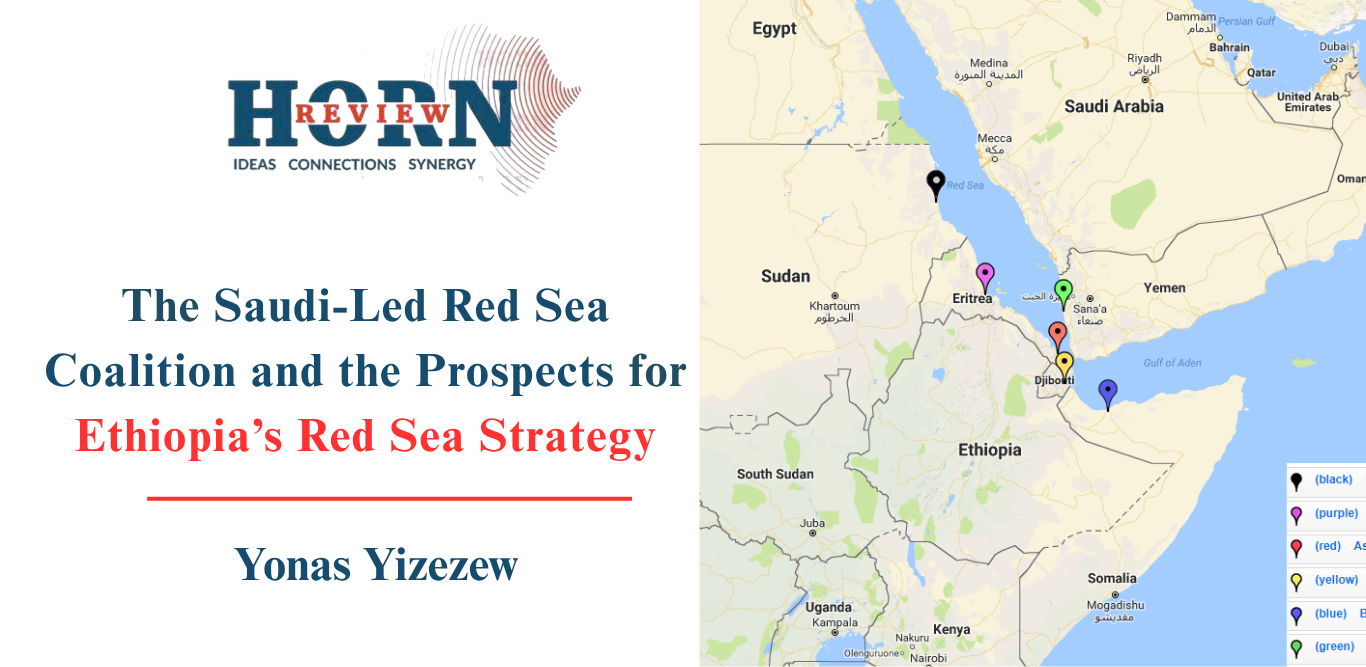
The Houthi declaration of a maritime blockade against Saudi Arabia in July became the immediate catalyst for Riyadh’s formation of a new defensive maritime coalition. The announcement, however, was not merely a reaction to a single security incident. It reflected broader changes in the geopolitical and security landscape of the Red Sea, where maritime trade, energy flows, and regional influence increasingly intersect. Saudi Arabia’s decision to establish a multinational maritime coalition also departs from the membership and political logic that shaped the Red Sea Council established in 2020 and the 2015 Saudi-led intervention. The Council of Arab and African Coastal States of the Red Sea and Gulf of Aden was formally established in Riyadh in 2020 after being proposed two years earlier. Saudi Arabia led the effort, bringing together Jordan, Yemen, Sudan, Djibouti, Somalia, Eritrea, and Egypt, the littoral countries of the Red Sea.
The council was presented as a vehicle for coordination on piracy, smuggling, and maritime security, while fostering wider cooperation among the states that actually border the waterway. For Riyadh, the deeper purpose was to assert its regional influence in the region and define the Red Sea as a space managed by littoral countries, and thereby constrain the role of external actors, especially rivals such as Turkey, Qatar, and Iran at that time. Membership itself became a boundary that excluded those states from formal influence over the corridor. In practice, the body stayed largely consultative. It produced occasional joint exercises, but never developed strong operational capacity, and it was hampered by the regional conflicts and rivalries it was intended to manage.
Unlike the 2015 Saudi-led military intervention in Yemen, which was a combat coalition aimed at reversing Houthi territorial gains, the 2026 Multinational Defensive Maritime Coalition is structured as a defensive maritime security framework focused on protecting commercial and energy shipping. In institutional terms, it more closely resembles an operational upgrade of the 2020 Red Sea Council, while departing from that body’s strict littoral membership rules. That earlier framework provided the conceptual base for the multinational maritime defense coalition that Saudi Arabia launched at the end of July.
The sequence of events unfolded rapidly as the Houthis declared a naval blockade against Saudi Arabia and Saudi-linked shipping in the Red Sea and Bab el-Mandeb on 20 July, citing Riyadh’s years-long involvement in the Yemen conflict. In the following days, the group claimed attacks on tankers and on energy infrastructure near Yanbu and Jizan. These moves occurred while wider conflict involving the United States, Israel, and Iran had already disrupted the Strait of Hormuz and forced greater reliance on Red Sea export routes for Saudi oil. Shipping traffic through Bab el Mandeb fell sharply, insurance rates rose, and oil prices increased. Saudi Arabia answered with air strikes on what it described as Houthi military facilities used to threaten commercial shipping, and then moved to assemble a broader defensive response. Representatives from roughly 43 of the 51 invited countries, together with a European Union delegation, met in Riyadh. At the conclusion of the meeting, approximately 14 countries issued a joint statement supporting the creation of a Multinational Defensive Maritime Coalition. Saudi Arabia was designated the founding and leading state, with permanent headquarters in the kingdom. The Saudi defense ministry said the new coalition is “part of ongoing efforts to enhance maritime security, protect international maritime corridors and counter threats targeting maritime navigation and global trade.” The distinction between the new coalition and the European Union’s existing Aspides operation, established to safeguard Red Sea shipping, remains unclear. The effort was described as purely defensive, and not directed against any particular country. The initial group of supporters included Turkey, Egypt, Pakistan, Jordan, Kuwait, Bahrain, Qatar, the internationally recognized Yemeni government, Sudan, Djibouti, Somalia, Bangladesh, Nigeria, and others, with minor variations in reporting. Some reports list the Comoros in place of Nigeria, while others also include Eritrea. The statement left the door open for additional members once national procedures were completed. Saudi Arabia also extended invitations to European countries and the United States to participate in the new coalition, although some Western officials remained hesitant, seeking greater clarity on the nature of membership and additional time to consult with their respective governments.
The composition of the coalition reveals a set of realignments that stand in clear contrast to the process and the political map of the 2020 council or the intervention coalition of 2015. At the time the Red Sea Council was formed, Saudi-Turkish relations remained strained by disagreements over regional politics, the Muslim Brotherhood, and the aftermath of the Khashoggi case. Turkey was viewed in Riyadh as an external actor whose influence in the Red Sea and Horn of Africa needed to be limited. A few years ago, the relationship had undergone substantial repair for a variety of reasons, including high-level diplomatic engagement, economic agreements, and the convergence of some shared strategic interests. Turkey’s presence among the founding supporters of the new coalition marks a practical outcome of that rapprochement, and expands the group beyond a purely Arab, littoral or Gulf circle.
A parallel shift occurred with Qatar. The 2017 to 2021 blockade had placed Doha firmly outside the Saudi led camp, and the original Red Sea Council design had treated Qatar as part of the external influence to be contained. The Al Ula reconciliation of early 2021 restored diplomatic and economic ties. By the time of the 2026 coalition, Qatar appeared among the supporting states, indicating that the earlier rupture had given way to functional cooperation on at least this security file. These inclusions of former rivals demonstrate that Saudi strategy has become more pragmatic and coalition oriented when faced with acute maritime threats.
The same period has produced a different trajectory with the United Arab Emirates. In 2020, the two countries still operated as close partners in Yemen and in parts of the Horn of Africa. Over the subsequent years, differences over the future of southern Yemen, divergence in regional policies, competition for influence in Sudan, Somalia, and port infrastructure hardened into open strategic friction. Currently, that rivalry had become a defining feature of Red Sea geopolitics. The UAE did not join the founding group of the new coalition, despite shared exposure to shipping and other risks. Oman also remained outside, consistent with its preference for neutrality and balanced relations, including with Iran. The resulting pattern is one in which Saudi Arabia has drawn in Turkey, Qatar, Pakistan, Bangladesh, and Nigeria, while key Gulf partners of the previous decade have stood apart. Pakistan’s participation rests on long standing security and economic ties with Riyadh, and adds military weight. Bangladesh and Nigeria represent further outreach to non-littoral states with interests in global trade routes and energy security. Their inclusion marks a deliberate expansion beyond the strict coastal criteria of the 2020 council. Jordan, which possesses a short coastline at Aqaba, sits at the margin of the littoral definition, yet was included. Turkey, Pakistan, Bangladesh, and Nigeria, by contrast, have no Red Sea or Gulf of Aden shoreline at all. Their presence shows that operational need and political alignment can override the earlier geographic purity when the threat level rises.
These realignments and membership choices carry direct consequences for Ethiopia’s long term Red Sea strategy. Ethiopia remains outside both the 2020 Red Sea Council and the current coalition. Its exclusion from the 2020 council reflected not only its lack of a coastline but also the opposition of Egypt and Eritrea to its participation even for an observer status, while the reasons for its absence from the 2026 coalition remain unclear, though Egypt’s influence and broader regional political dynamics maybe plausible factors.
The littoral and non-littoral distinction advanced most consistently by Egypt continues to structure the formal architecture. This is evident from Egypt’s regional engagements especially following Ethiopia’s announcement of its pursuit of sovereign sea access, where the principle of “littoral states’ exclusivity” has been repeatedly emphasized, a position widely viewed as directed against Ethiopia’s ambitions. Yet besides being in close proximity to the Red Sea, Ethiopia’s economy, and its food and energy security, depend heavily on Red Sea trade routes and on reliable access through neighboring ports. The country’s long-term approach has centered on pursuing sovereign sea access while diversifying commercial access arrangements, improving overland transport corridors, and avoiding dependence on any single outlet. Even though the new coalition does not alter that basic necessity, it changes the environment in which the strategy must operate. Saudi Arabia’s improved ties with Turkey and Qatar, and its outreach to other non-littoral partners, create a wider set of potential interlocutors for Addis Ababa. The coalition’s focus on defending shipping against Houthi attacks protects routes that Ethiopian cargo also uses, yet decisions about operations, intelligence, and crisis response will be taken without a formal Ethiopian seat at the table.
The practical implication is that Ethiopia must continue to advance its access goals largely through bilateral and commercial channels, while monitoring the evolution of the Saudi led framework. Prolonged exclusion risks leaving Ethiopian interests exposed to rules and priorities set by others. It also reinforces the perception among some coastal states that hinterland powers can be managed at a distance. At the same time, the very fact that the coalition has already incorporated non littoral states such as Turkey, Pakistan, Bangladesh, and Nigeria demonstrates that the strict coastal boundary is not absolute when strategic calculations require broader participation. Ethiopia can, therefore, treat the current architecture as unfinished, and can pursue structured partnership, observer arrangements, or parallel coordination mechanisms that link its hinterland logistics to the security of the sea lanes. Success will depend on internal stability, consistent investment in corridors, and careful navigation of the Saudi-Turkish-Qatari realignment on one side and the Saudi-UAE competition on the other. The trajectory of rising militarization and commercial disruption in the Red Sea leaves little room for a purely inland posture. Ethiopia’s long-term strategy must, therefore, combine the pursuit of diversified physical access with active diplomacy aimed at preventing its permanent erasure from the governance of the waterway on which its future depends.
By Yonas Yizezew, Researcher, Horn Review

RELATED
Posts
15
Oct
Why Every Diplomatic Break in the Horn Traces Back to Water
Analysis of instability in the Horn of Africa and...

15
Oct
The AU’s Uneven Geography of Urgency
Since Mahmoud Ali Youssouf assumed leadership of the African Union...

15
Oct
The Aswan Dam and Ethiopia’s Longstanding Rejection of Egypt’s Nile Veto
On 29 May 1956, before construction of the Aswan High...

15
Oct
Why Somalia’s Hedge between Ethiopia and Egypt Cannot Last
The public position articulated by Somalia’s Deputy Foreign Minister Hassan...

15
Oct
Ethiopia Somaliland Defence Ties and the Practice of Keeping the Door Ajar
The recent meeting between Brigadier General Nimcaan at the...

15
Oct
Ethiopia’s Right to Self-Defence and the Strategic Fallacy of Symmetrical De-escalation
The growing calls for de-escalation to the Ethiopia–Eritrea crisis risks...

12
Oct
The Recurring Script of Eritrea’s Invasion-Victim Cycle
In the Horn of Africa, history under Isaias Afwerki does...

12
Oct
Under the Banner of Red Sea Security, Egypt Encircles Ethiopia
Reports of Egyptian naval movements toward the southern Red...

12
Oct
Egypt's Attack on Sudan's Gold Mines and the Long Road That Led to It
The airstrikes that tore through the artisanal gold mining...
9
Oct
Where Somalia’s Federal and Regional Fight Is Going
The 2012 federal settlement was less a constitutional order...