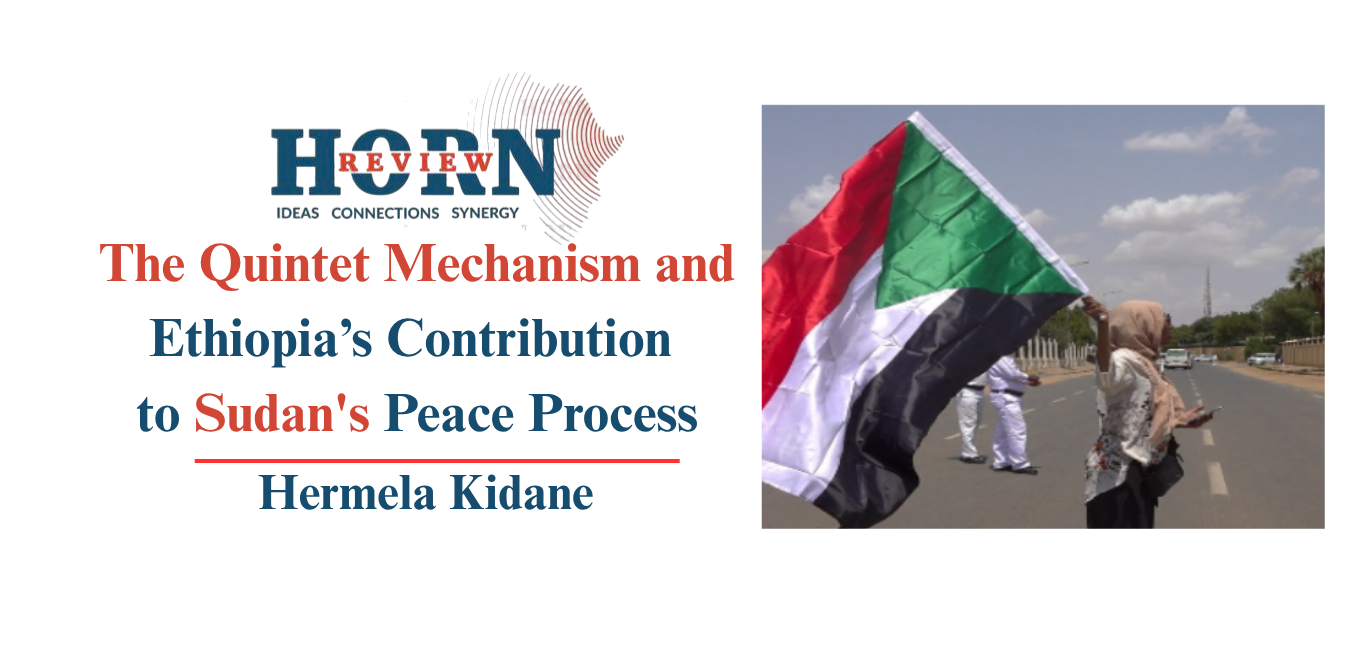
The war in Sudan now entering its fourth year has produced the world’s largest displacement emergency with millions internally displaced and hundreds of thousands seeking refuge in neighboring countries. The conflict has dismantled state institutions undermined regional security systems and generated instability extending from the Red Sea to the Sahel. In response the international community has deployed various diplomatic initiatives however the most structured multilateral effort remains the Quintet Mechanism. Comprising the African Union, Intergovernmental Authority on Development, United Nations, League of Arab States and European Union this compact has designated Addis Ababa as the primary venue for advancing a Sudanese led and Sudanese owned political dialogue. The recent postponement of the second round of in person consultations from late July to September 2026 presents a recalibration rather than failure.
The structure of the Quintet converging on Addis Ababa testifies to Ethiopia’s unique geopolitical and diplomatic capital. As headquarters of both the AU and IGAD the Ethiopian capital serves not only as a passive host but as an active gravitational center for African peacemaking. This institutional density is invaluable for coordinating organizations with divergent mandates from the EU’s normative frameworks and conditionality to the LAS’s regional prerogatives and the AU and IGAD’s continental ownership. A unified operational base in Addis Ababa ensures logistical and coherence preventing the parallel mediation tracks that have historically fragmented Sudanese peace efforts. Ethiopia’s contribution constitutes diplomatic stewardship grounded in the country’s legacy of pan Africanism and multilateralism. This legacy imparts legitimacy that single nation or ad hoc mediators might lack. The principle that peace and stability in Ethiopia and Sudan are inextricably linked is a critical axiom grounded in shared geography, history and destiny.
The two nations share porous borders, intertwined ethnic and social networks and hydrological interdependence via the Blue Nile. Sudanese instability translates directly into challenges such as cross border arms flow, militia activities and large scale population movements. Ethiopia’s engagement in the Quintet is thus driven by a clear recognition that its national security and long term development objectives are intimately tied to the restoration of a stable, legitimate and democratic order in Sudan. This existential commitment creates a depth of commitment surpassing conventional external mediation positioning Addis Ababa as motivated and credible convener. Ethiopia brings both institutional authority and practical insight enhancing the multilateral endeavor’s overall effectiveness.
Central to this credibility is Ethiopia’s ability to offer what is Where trust between factions is scarce and external patrons often viewed with suspicion. The Quintet’s approach facilitated through Ethiopian coordination deliberately avoids the pitfalls of previous elite driven transitions by prioritizing broad societal inclusivity. This has attracted nontraditional actors including women’s and youth coalitions and civil society groups such as the Sumood alliance. For these constituencies often marginalized by armed actors Ethiopia provides a sanctuary from coercion and violence. The platform enables them to express visions for a post war Sudan free from immediate pressures by warring parties or their backers.
As the conflict has intensified Ethiopia has hosted numbers of Sudanese refugees, particularly in Benishangul-Gumuz and Amhara regions with many also in Addis Ababa. This occurs alongside efforts to support its own internally displaced citizens. The simultaneous management of these responsibilities demonstrates logistical resilience and a deep commitment to shared humanity. This lived solidarity creates a powerful people to people dimension that complements high level diplomacy. Ethiopian statements on inseparable peace carry the weight of tangible engagement forming a foundational layer of trust that sustains the Addis Ababa process.
The postponement to September informed by consultations is a step to address two vital contentions. The first concerns potential inclusion of elements linked to the former National Congress Party of Omar al-Bashir. Broad segments of Sudanese civil society and revolutionary forces oppose this citing the NCP’s legacy of corruption, ethnic division and militia sponsorship that helped create the current political economy of violence. Such inclusion risks historical revisionism and alienation of key constituencies integral to transition. For pro democracy forces it remains a fundamental red line.
The second fault line involves the Coordination of Civilian Democratic Forces or also named as the Taqaddum and Tasis. This coalition’s attempt to chart a third way independent of both the Sudanese Armed Forces and Rapid Support Forces has provoked hostility from certain SAF quarters which accuse it of RSF alignment. These tensions highlight deeper clashes between traditional military authority and civilian political formations. Resolving them requires nuanced diplomacy that distinguishes legitimate civilian voices from destabilizing actions. Virtual consultations and shuttle diplomacy offer space to broaden representation, deconstruct binaries and refine participation criteria for fairness and balance.
While Ethiopia manages these internal Sudanese activities the broader geopolitics remains relevant. Regional powers pursue parallel tracks reflecting their interest. Egypt’s focus on Nile security and preference for predictable governance in Khartoum alongside Eritrea’s emphasis on security oriented stability illustrate challenges posed by competing interests. The Quintet coordinated from Ethiopia embodies multilateralism and institutional coordination as a counterweight to unilateralism. It aggregates continental and international weight behind a Sudanese owned process capable of transcending narrow agendas.
The September consultations represent both challenge and opportunity. They allow the Quintet under Ethiopian coordination to address foundational questions of participation, historical accountability and transitional legitimacy. From Sudan’s road a clear process compromising justice and revolutionary demands for expediency tend to fail. The Ethiopia framework emphasizing civilian inclusion and root causes offers potential for a paradigm shift toward governance based on citizenship, accountability and democratic principles. Ethiopia carries important responsibility in maintaining neutrality while safeguarding outcome integrity. Success would advance Sudanese prospects and contribute to wider Horn of Africa stability.
By Hermela Kidane, Researcher, Horn Review