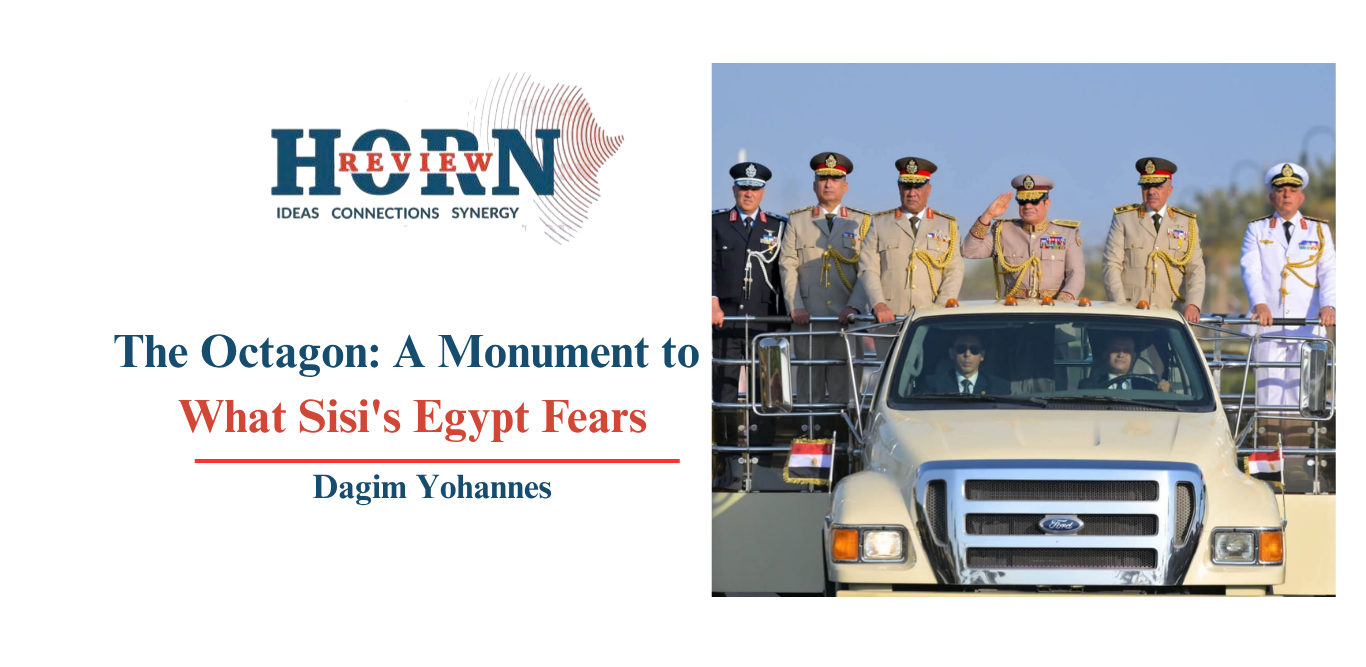
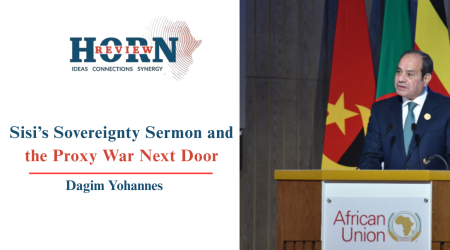
When Abdel Fattah el-Sisi inaugurated Egypt’s new State Strategic Command Headquarters on July 4, he did something his own government’s talking points could not: he told the truth about why it exists. The “Octagon” is marketed as a command-and-control marvel, the technological brain of a modernizing military. It is that. But Sisi’s own words at the ceremony, departing from his prepared remarks, gave away the deeper logic, this is a monument to regime survival, engineered around the memory of 2011 rather than the requirements of 2026.
The scale is real. Egyptian state media place the complex at roughly 22,000 acres, organized around eight interlinked octagonal buildings and thirteen specialized zones for command, cybersecurity, data management, and crisis response, sited inside the New Administrative Capital some 45 kilometers east of Cairo. By floor area it now exceeds the Pentagon several times over. The inauguration came with the full register of Sisi-era spectacle: Apache flyovers, an eleven-gun salute, a uniformed president touring the grounds in an open-top vehicle for one of the only times in more than a decade.
It is what Sisi said next that matters more than the architecture. Recalling the 2011 uprising, he told the audience that the Constitutional Court, the Cabinet, the Ministry of Defense, and the state’s media production complex had all been besieged by protesters, and that the state “had to leave the capital” to make sure that could never happen again. Fifteen years after Egyptians demanded bread, freedom, and social justice, that demand is still the organizing threat in the regime’s own account of itself.
This is not a new argument within Egypt’s political elite, but it is now supported by unusually clear evidence. The relocation is fundamentally about regime security above all else. The road network and spatial design of the New Administrative Capital have been constructed to enable rapid security deployment against potential protesters. The underlying logic can only be described as dystopian, not in terms of aesthetics, but in function. Official statements have effectively confirmed what critics long suspected, that the layout is deliberately engineered to prevent citizens from gathering in front of government institutions. Such gatherings, a peaceful and constitutionally protected act, are otherwise routine in functioning democracies.
This design reflects a broader pattern that has unfolded over more than a decade: the systematic criminalization of peaceful dissent, the marginalization of representative institutions, and the concentration of authority in a system that is insulated from judicial, media, and public accountability. In this context, the Octagon stands as a stark symbol of that transformation. It marks a reversal of the 2011 slogan that “the people and the army are one hand.” The military no longer positions itself alongside the public, but governs from a deliberate distance, removed from the society it claims to represent.
More importantly, a system built to centralize power and insulate it from society may strengthen control at home, but it also creates a critical vulnerability by concentrating military decision-making in one place, turning a tool of domestic security into a potential strategic target for external adversaries.
This logic of insulation is not uniquely Egyptian. It reflects a broader authoritarian design principle, one that has been tested elsewhere under far more extreme conditions. Myanmar’s junta ran the same experiment two decades earlier with Naypyidaw, an inland capital built explicitly to be indefensible to protest and defensible against invasion at once, wide highways designed to prevent crowds from massing, ministries physically separated from the population they governed. The model was tested in 2021: when the junta’s coup triggered nationwide urban uprising, Naypyidaw itself remained undisturbed, insulated exactly as its planners intended. That is a working precedent, not a metaphor, and it cuts in an unexpected direction. In Myanmar the junta’s physical security gave it enough confidence to risk limited political liberalization it would never have attempted while exposed in Yangon insulation as a precondition for controlled opening, not only for repression. Nothing in Sisi’s record suggests that impulse, but the mechanism itself, does distance entrench a regime or eventually free it to loosen its grip, is the more interesting question the Octagon poses, and one the coverage so far hasn’t asked.
That tension is worth taking seriously precisely because Egypt’s military posture elsewhere is not purely defensive theater. Israeli security apparatus have flagged that Egyptian troop deployments in Sinai now run well above the limits set by the 1979 peace treaty’s demilitarized-zone framework; Israeli sources put it at roughly four times the agreed force levels, alongside sustained investment in underground infrastructure and missile stockpiles. Egyptian-Israeli security cooperation against jihadist groups in Sinai continues, and neither side has an interest in rupture, but the Octagon lands inside a broader pattern of Egyptian military buildup that regional observers are watching for reasons that have nothing to do with Tahrir Square. A command center built primarily to survive its own population may not be optimized for the adversary it should actually be worried about.
The timing carries its own signal. Sisi used the inauguration to thank Donald Trump by name for the Sharm el-Sheikh framework ending the Gaza war and for brokering an end to the Iran war, situating the Octagon inside a moment of unusually warm US-Egypt alignment rather than treating it as a purely domestic statement. Egypt remains the second-largest recipient of US military aid after Israel. The Octagon is as much a message to Washington and the region about Egypt’s reclaimed stature as it is a message to Cairo’s own population about what happens if they move against the state again.
None of this comes cheap, and Sisi knows it. He has repeatedly framed 2011 as a source of catastrophic economic loss, at one point putting the cost of that instability and the subsequent war on terror in the hundreds of billions of dollars. Egypt’s fact-checking platform Matsda2sh has consistently disputed that framing, noting that official data does not support attributing the current debt crisis to the uprising alone. The New Administrative Capital project as a whole is estimated at roughly $60 billion, built during years of currency devaluation, IMF-mandated austerity, and shrinking real incomes, while the military’s footprint in the civilian economy has expanded rather than contracted under the same privatization program that was supposed to shrink it.
The cost figures obscure a more structural fact: the military is not merely spending on the Octagon, it is profiting from it. The Administrative Capital for Urban Development company, the vehicle constructing the New Administrative Capital, is 51 percent owned by the armed forces, which stands to sell or lease the prime downtown-Cairo real estate vacated by relocating ministries. At the same time, the Armed Forces Engineering Authority’s expansion into civilian construction has driven a substantial share of Egypt’s private contracting firms out of business, by industry accounts affecting several hundred companies since 2018. The fortress built to insulate the regime from economic grievance is thus financed and constructed by the same institution whose economic expansion helps generate that grievance in the first place, a closed loop in which regime security and military enrichment are not separate objectives but one and the same project, dressed in different justifications depending on the audience.
Fifteen years on, the durability of Egypt’s counterrevolution is not in serious doubt. Protest has been criminalized, opposition dismantled, and public space redesigned around the assumption that citizens are a threat to be managed rather than a constituency to be represented. What the Octagon ultimately reveals, however, is not just the strength of that system, but its underlying logic of fear. A state that invests billions to relocate its command structure away from its own population is making a strategic choice about what it considers its primary risk. In doing so, it may be solving one problem while creating another. The concentration of military authority in a single, highly visible node, optimized for internal control, risks becoming a liability in a regional environment defined less by mass protest than by precision threat. The real question, then, is not whether the Octagon can protect the regime from a repetition of 2011. It is whether a system designed to survive its own people is adequately prepared for the conflicts it cannot distance itself from. If the answer is no, the Octagon may come to stand not as a symbol of restored control, but as a monument to a strategic miscalculation, one that confuses insulation with security in a region where the two are no longer the same.
By Dagim Yohannes, Researcher, Horn Review