Throughout 2024 and 2025, assessments of Red Sea security focused primarily on the threat to commercial shipping. Houthi attacks against merchant vessels transformed one of the world’s busiest maritime corridors into a high-risk transit route, forcing shipping companies to reroute around the Cape of Good Hope, increasing freight costs and disrupting global supply chains. International responses correspondingly focused on protecting commercial navigation and freedom of movement through naval deployments, maritime security operations and defensive interceptions of missiles and drones.
The strategic environment began to change as the wider Iran-US-Israel confrontation intensified in 2026. The Houthis signalled that they would join the conflict if further US and Israeli military action against Iran escalated, reinforcing their role as part of Tehran’s broader regional network of partners. On 16 July, Houthi-linked actors were preparing possible measures against maritime traffic through the Bab el-Mandeb Strait in response to potential US military escalation against Iran. This development suggested that the chokepoint itself was increasingly becoming a strategic pressure tool rather than simply an operational area for attacks against individual vessels.
This development does not represent a replacement of maritime coercion but rather its expansion. The Houthis appear to be broadening their target set from individual commercial vessels towards the critical infrastructure that enables regional trade and global energy flows. In addition to commercial shipping, ports, oil terminals, energy export facilities, and maritime logistics networks have increasingly become targets, reflecting a broader and more complex threat landscape. Its significance lies not only in the location of potential targets but also in the wider economic systems they support.
The broadening became evident on 20 July 2026. Following earlier signalling around the Bab el-Mandeb, the Houthis announced restrictions targeting Saudi maritime traffic, declaring that Saudi vessels and maritime interests would become subject to military action, marking an expansion of their coercive strategy beyond earlier targeting criteria focused largely on vessels associated with Israel. On the same day, Houthi authorities warned international shipping companies that vessels loading or unloading cargo at Saudi ports could face attack, even if they were not Saudi-owned. This was significant because it expanded the risk calculation beyond a vessel’s flag or ownership to its commercial connections with targeted infrastructure. By extending pressure towards Saudi maritime interests and the commercial networks supporting Saudi Red Sea ports, the Houthis sought not simply to disrupt maritime traffic but to undermine confidence in the security and reliability of strategic maritime infrastructure within the regional economy.
The escalation continued on 22 to 23 July, when Houthi forces claimed attacks against Saudi-linked vessels in the Red Sea. These incidents marked a further expansion of the targeting framework, moving beyond Israel-linked shipping towards Saudi maritime and energy interests. The significance of these incidents extended beyond the direct threat to individual vessels. They revealed that commercial shipping with operational or logistical ties to strategic infrastructure could face heightened vulnerability, regardless of ownership.
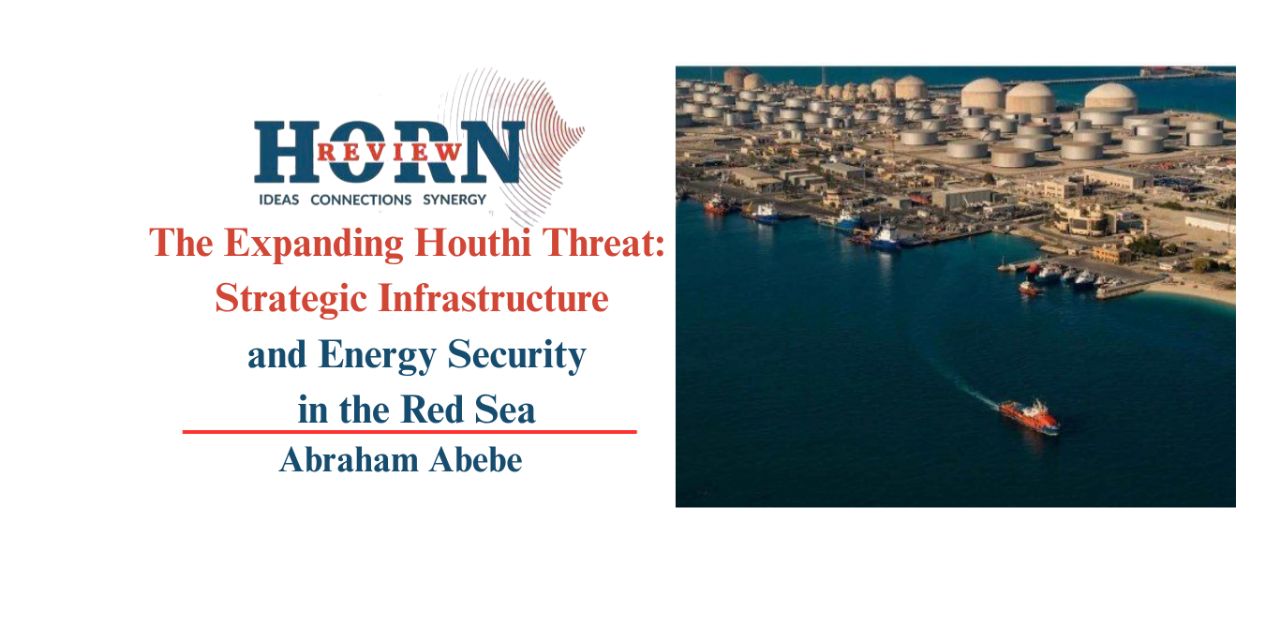
The most consequential escalation came on 25 July, when Houthi forces launched attacks against Saudi energy-related facilities at Yanbu and Jizan on the Red Sea coast. Yanbu is one of Saudi Arabia’s most important energy hubs, serving as a major outlet for crude exports transported through the East-West Pipeline, reducing dependence on routes vulnerable to instability around the Strait of Hormuz. Jizan is also a significant industrial and energy complex supporting Saudi economic activity. By targeting these facilities, the Houthis extended their coercive strategy beyond merchant vessels to the infrastructure that enables energy exports and regional economic connectivity.
This evolution carries important strategic implications. Strategic infrastructure presents a different category of vulnerability because fixed assets such as ports, storage facilities, export terminals and pipeline connections cannot easily be relocated or replaced. Their strategic value stems not just from the risk of physical damage, but also from the potential to cause broad economic disruption through even limited military action. Even unsuccessful attacks can create prolonged uncertainty as insurers, investors and commercial operators reassess the risk environment. Insurance markets respond to anticipated disruption, energy traders evaluate vulnerabilities in export routes, and shipping companies reconsider schedules and transit decisions. The impact therefore extends beyond physical damage; uncertainty itself becomes a form of strategic leverage.
By 27 July, the effects were visible beyond the immediate targets. Maritime activity through the Bab el-Mandeb declined as shipping operators reassessed risks following threats and attacks against Saudi-linked maritime and energy interests. Vessel movements through the chokepoint reportedly fell sharply, demonstrating that the strategic impact of Houthi operations does not depend on a complete blockade. The reduction in traffic highlighted how perceptions of insecurity can influence shipping decisions, insurance assessments and commercial planning.
The consequences extend beyond Saudi Arabia. Disruptions around the Bab el-Mandeb chokepoint can generate wider regional effects by increasing shipping costs, delaying supply chains and intensifying economic pressures on states that rely on maritime access. The Suez Canal’s operation depends on continued confidence in safe and reliable navigation through the Red Sea. Gulf energy exporters have invested in Red Sea infrastructure as an alternative export pathway, reducing their vulnerability to instability around the Strait of Hormuz. Threats to these facilities affect not only maritime transport, but also undermine regional energy resilience, jeopardise economic security, and disrupt the stability of global supply chains.
The widening target set also complicates international security responses. Multinational maritime operations have primarily focused on protecting commercial vessels from missile, drone and small-boat attacks while maintaining freedom of navigation. Protecting dispersed coastal infrastructure presents a different challenge. Energy terminals, ports, storage facilities, and logistics centres may require integrated air and missile defences, enhanced intelligence sharing, sophisticated early warning systems, and more effective coordination between military forces and civilian operators.
The political significance of this strategy is equally important. By placing infrastructure supporting regional commerce at risk, the Houthis seek to increase the political and economic costs for governments involved in military operations against them and for actors supporting pressure on Iran. The approach reflects a broader pattern in contemporary conflict, where coercion increasingly targets economic systems and critical infrastructure rather than only conventional military assets.
This evolution demands a corresponding adjustment in strategic assessment. Focusing exclusively on the number of ships attacked in the Red Sea risks overlooking the broader evolution of the security threat. A decline in sustained assaults against commercial vessels should not automatically be interpreted as a reduction in strategic risk. Greater attention must therefore be directed towards the resilience of ports, export terminals, logistics hubs and energy infrastructure that sustain maritime commerce.
The Red Sea conflict is therefore evolving into a broader phase. Earlier stages were defined primarily by attempts to disrupt freedom of navigation through attacks on commercial shipping. The emerging phase features a shift in coercive pressure, increasingly targeting the infrastructure that supports regional trade and global energy flows. This evolution does not replace maritime coercion; it amplifies it. By extending pressure from individual vessels to the economic architecture behind international commerce, the Houthis have expanded both the strategic reach and potential consequences of the Red Sea conflict.
By Abraham Abebe, Researcher, Horn Review