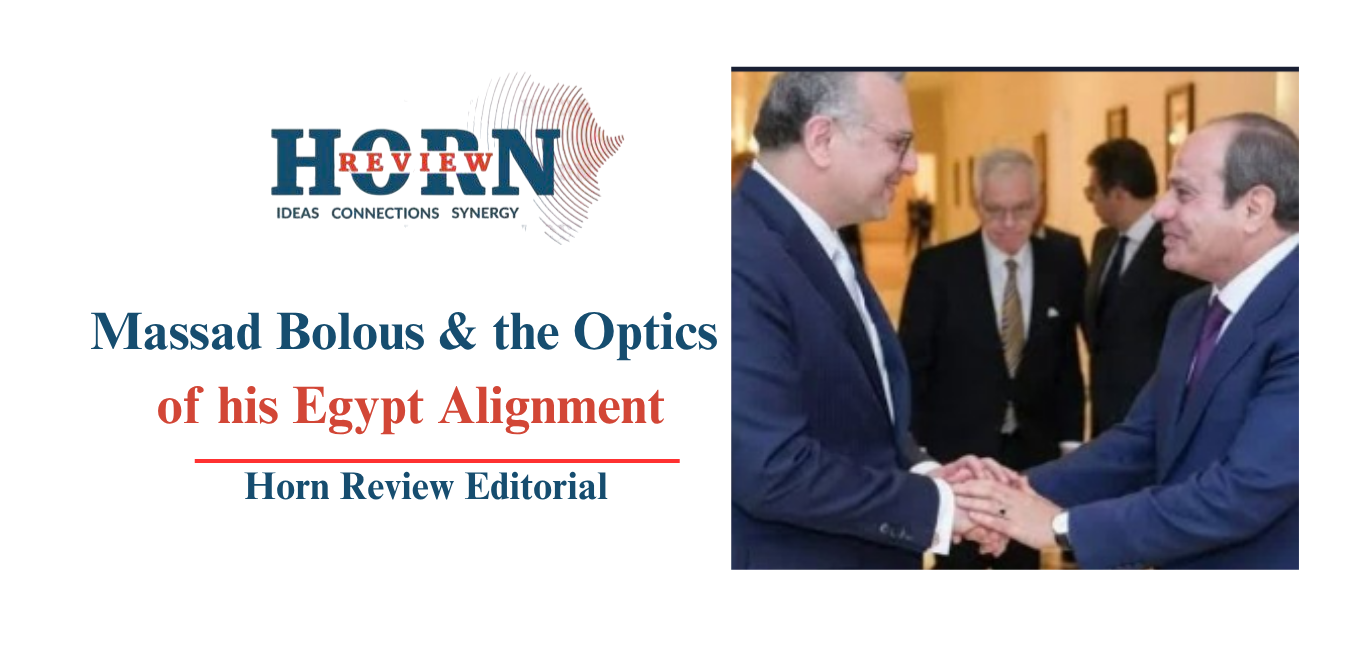
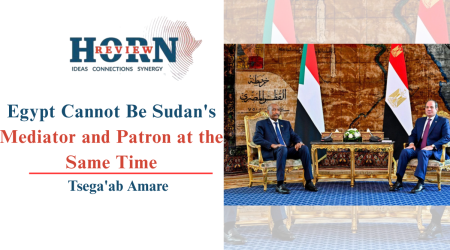
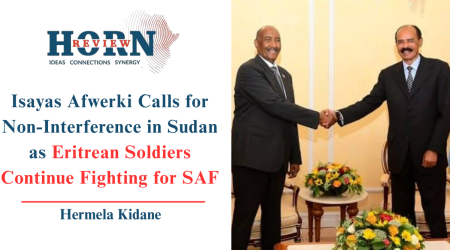
These days, in diplomacy, alignment is rarely declared; it is inferred. It emerges not from formal treaties alone but from patterns – of meetings, priorities, silences, and selective urgency. Images are not perceived as supplementary to policy; they are policy. The staging, the seating, the sequencing of meetings, and the visual projection of who stands with whom often communicate more clearly than official statements. Among other things, it is in this visual and symbolic domain that the conduct of Massad Bolous, the U.S. President Trump’s Senior Advisor on Arab and African Affairs, acquires its most consequential meaning. His recent visit to Cairo demands scrutiny not for what it proclaims, but for what it operationalizes. His public denials of any anti-Ethiopian alignment coexist uneasily with a diplomatic trajectory that, whether by design or omission, reinforces precisely such a configuration.
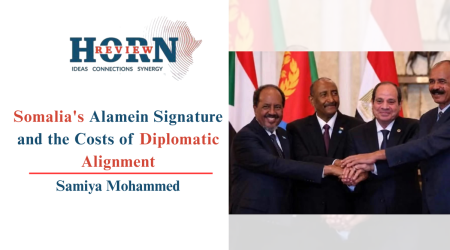
The Cairo engagements involving Bolous alongside Egyptian, Somali and Eritrean foreign ministers illustrate how diplomatic optics can blur the line between neutrality and alignment: by participating in a highly visible, Egypt-hosted sequence of meetings with actors widely perceived as sharing converging interests against Ethiopia, and allowing those interactions to be projected as a coherent regional consultation, Boulos – whether by intent or insufficient sensitivity to context – helped create the impression of a U.S.-tolerated or even U.S.-enabled bloc dynamic, one that not only reinforces Egypt’s convening authority in the Horn but also signals to international observers a subtle reorientation of American engagement away from balancing and toward a configuration that risks marginalizing Ethiopia in discussions central to its own strategic environment.
At the formal level, Boulos has rejected claims that Washington is pursuing arrangements with Eritrea or Egypt directed against Ethiopia. Yet diplomacy is not adjudicated by statements of intent; it is assessed through material engagement. Over the past months, Boulos has advanced a policy line centered on re-engagement with Eritrea, including discussions around the lifting of sanctions and normalization of relations. This initiative has not occurred in isolation. It has been mediated, facilitated, and in part politically framed through Cairo, with Egypt acting as a convening node for discussions involving Eritrea and Somalia. Reports indicate that these engagements have unfolded through coordinated meetings in Cairo focused on regional security and political alignment.
This sequencing is not neutral. Egypt, Eritrea, and Somalia have, since at least 2024, demonstrated converging strategic interests in counterbalancing Ethiopia’s regional posture. The emergence of a trilateral alliance among these states – explicitly oriented around constraining Ethiopian influence – forms the structural backdrop against which Boulos’s diplomacy now operates. To engage one component of this triangle through the political architecture of another is not a passive act; it is a choice that shapes regional perception and strategic reality. The question, therefore, is not whether Boulos intends to support an anti-Ethiopian bloc. The more analytically rigorous question is whether his approach, regardless of intent, produces outcomes indistinguishable from such support. In this regard, three dimensions are particularly salient.
First is the issue of diplomatic sequencing. The repositioning of Eritrea within Washington’s Horn of Africa strategy – the most opaque and militarized actor in the Horn – signals a recalibration of U.S. regional hierarchy. The proposal to ease sanctions on Asmara, despite the absence of meaningful internal reform, introduces asymmetry into the regional order. It effectively rewards a state whose strategic posture has often been adversarial toward Ethiopia, while simultaneously signaling to Addis Ababa that its national and regional security concerns are secondary to broader Red Sea calculations.This is not merely perception; it is policy signaling. Yet any regional security architecture that sidelines Ethiopia’s legitimate interests is inherently fragile, because the stability of the Red Sea and the Horn cannot be sustainably achieved while disregarding the security perceptions of the region’s largest geopolitical actor.
Second is the geography of engagement. Cairo’s role as an intermediary is not incidental. Egypt’s longstanding contestation with Ethiopia over the Abay/Nile waters, combined with its historical coordination with Eritrea, renders it a deeply interested party rather than a neutral facilitator. By embedding U.S. diplomacy within Cairo-centered consultations, Boulos risks importing Egyptian strategic preferences into American policy execution. This creates a structural bias – one in which Ethiopia engages not with a detached mediator, but with a diplomatic process already filtered through a rival’s strategic lens.
Third is the question of omission. Boulos’s engagements have emphasized regional stability, maritime security, and Red Sea coordination – legitimate priorities in an era of heightened geopolitical competition. Yet the conspicuous absence of Ethiopia as a central anchor in these conversations is itself consequential. Ethiopia is not a peripheral actor; it is the demographic, economic, and military center of gravity in the Horn. To construct regional frameworks that engage its rivals in clustered formats while engaging Ethiopia in parallel or reactive terms is to invert the natural hierarchy of the region. Such inversion, even if bureaucratically convenient, carries strategic cost.
Defenders of Boulos’s approach may argue that U.S. policy is driven by global imperatives: securing Red Sea shipping lanes, countering Iranian influence, and preventing regional spillover from Sudan. These considerations are legitimate. The Red Sea has indeed become a critical theater linking Middle Eastern conflict dynamics with African geopolitics. From this perspective, engagement with Eritrea may not sound like it is about Ethiopia at all, but geography – coastlines, chokepoints, and maritime access. However, this argument, while compelling, does not negate the regional consequences of such engagement. In geopolitics, actions taken for one theater inevitably reverberate across another.
This brings the analysis to the core dilemma: intent versus effect. There may be insufficient evidence to conclude that Boulos is deliberately engineering an anti-Ethiopian alliance; however, the pattern of his diplomatic engagement and official statements raises serious questions about an apparent asymmetry in his regional approach – one that has consistently elevated Egypt’s perspectives and strategic priorities while insufficiently accounting for Ethiopia’s legitimate security concerns. His diplomatic pattern aligns – functionally and perceptually – with the interests of Egypt.. In strategic terms, this is the distinction between agency and outcome. A policy need not be designed as hostile to be experienced as such; it need only consistently advantage one side of a regional equation. Negligence, in this context, is not a minor failing. It is a structural condition.
When a senior advisor in the administration of a major power underestimates the symbolic and practical implications of its diplomatic choreography, it does not remain neutral – it redistributes leverage. By attempting to elevate Eritrea’s diplomatic standing, validating Cairo as a convening hub, and marginalizing Ethiopia’s centrality in regional frameworks, Boulos’s approach risks consolidating a geopolitical environment in which anti-Ethiopian coordination becomes easier, more legitimate, and more institutionally embedded.
Hence the key question, therefore, is not whether the United States seeks to undermine Ethiopia, but whether it fully grasps the strategic ecosystem it is reshaping. Ethiopia remains indispensable to any durable architecture of stability in the Horn of Africa. Boulou’s policy tendencies that appear to circumvent or dilute this centrality – however well-intentioned – carry the risk of strategic miscalculation. Perception in diplomacy is not secondary to reality; it is part of reality. And in the current configuration, the perception of Massad Boulou’s bias towards Egypt – rooted in observable patterns of engagement and statements – is becoming increasingly difficult to separate from its material effects.
By Horn Review Editorial