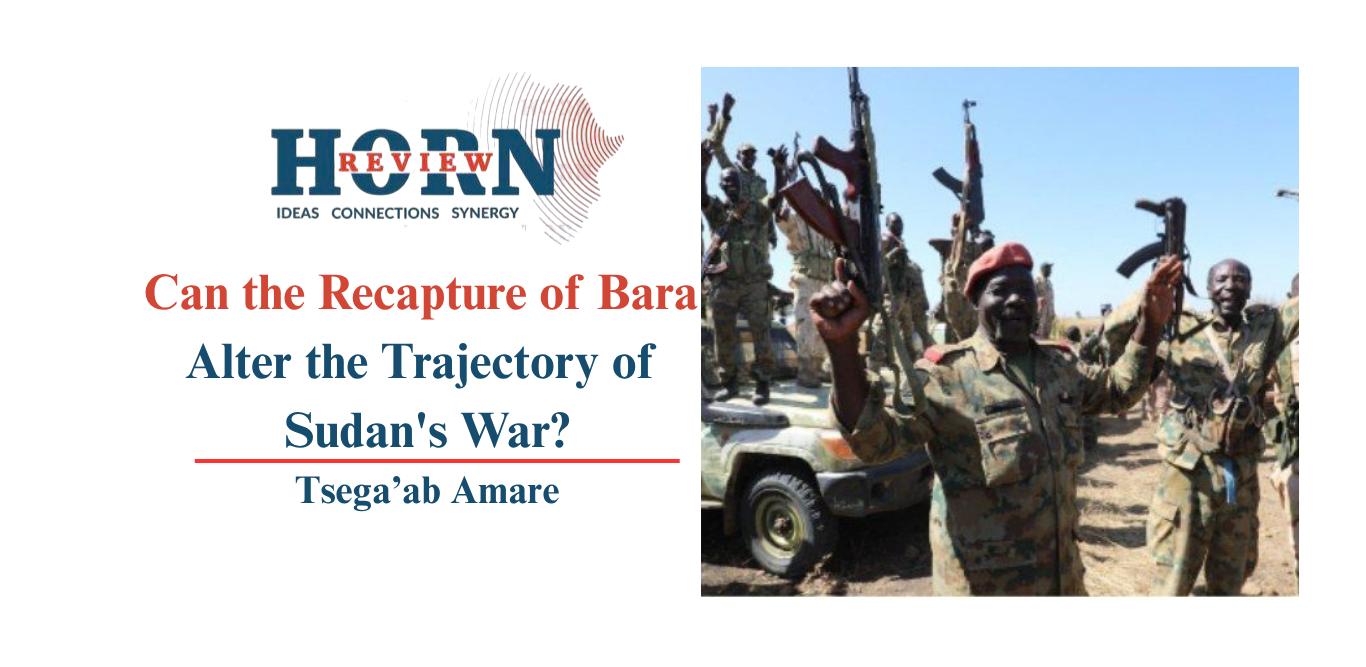
The Sudanese army’s recapture of Bara, Al-Baraka, and Um Sayala, along with Um Qurfa and Jabrat Al-Sheikh, restores a critical supply corridor into El Obeid. The SAF and allied forces retook the North Kordofan towns on July 25 after heavy clashes with the RSF, with the Joint Force spokesperson confirming that army units, the Joint Force, Qashan forces, and supporting troops secured all five locations. Military officials reported that fighting destroyed 73 RSF vehicles, with additional vehicles seized and a number of RSF combatants and officers killed.
Bara sits roughly 45 kilometers east of El Obeid, while Um Sayala lies near the export road connecting North Kordofan to Omdurman, the capture gives the army a new supply route into El Obeid and its importance lies chiefly in what it does for the siege now closing around the city.
The corridor eases pressure on a garrison that has spent months under a siege modeled closely on the one that preceded El Fasher’s fall in October 2025. The parallels are close enough to be analytically useful rather than merely rhetorical. El Fasher endured an eighteen-month siege documented in more than sixty reports by Yale’s Humanitarian Research Lab before falling to the RSF in an assault that the UN Fact-Finding Mission concluded in February 2026 amounted to genocide against the Fur, Zaghawa, and other non-Arab communities of Darfur, with several thousand people reportedly killed within the first three days.
El Obeid has faced a similar pattern of encirclement, and its fall would hand the RSF its first continuous corridor linking Darfur, the southern oil fields seized in December 2025, and the approaches to Khartoum. Bara’s recapture forestalls that outcome without reversing it. The town has changed hands repeatedly since 2023, and nothing about the current operation guarantees permanence.
Khartoum’s rhetoric has moved well beyond that limited operational reality. Assistant Commander-in-Chief Yasir al-Atta announced on July 26 that army chief Abdel Fattah al-Burhan had ordered a sweeping offensive to clear the country to the Central African Republic border, following the weekend’s ground operation that secured the Omdurman-Bara export road. Al-Atta said army forces and allied groups would advance in successive waves toward Um Dafuq on the southwestern border, giving RSF fighters and foreign mercenaries the choice of surrendering or fleeing the country. Read against the actual scope of the Kordofan gains, this represents a reach considerably beyond what the battlefield has delivered. Bara strengthens the army’s defensive position and its bargaining leverage at the margins. However, it does not establish the capability for a westward offensive of the kind now being described, and it has not moved the RSF’s negotiating posture yet.
On July 14, the RSF submitted its response to the U.S.-facilitated peace proposal, outlining conditions for a political settlement while rejecting any requirement to withdraw from territory it has captured, days after Sudan’s own Security and Defense Council submitted its response to mediators on July 12. That deadlock has since hardened rather than shifted. A senior presidential adviser, Amgad Fareid Eltayeb, said this week that Sudan’s political leadership rejects any proposal that could legitimize RSF territorial control and will only accept a ceasefire that includes the group’s complete withdrawal from civilian areas, while ruling out any scenario resembling Libya’s partition. Eltayeb identified El Obeid as the focal point of the conflict and accused the RSF of attempting to repeat the tactics used at El Fasher. Bara marginally strengthens Khartoum’s hand in that argument. However, it does not resolve the deadlock over withdrawal that has stalled every mediation track since the war’s fourth year began.
Military developments have also been accompanied by continued allegations of violations against civilians, underscoring the widening humanitarian costs of the campaign. The rights group Emergency Lawyers said that an army drone struck a gathering of displaced people in the southern Badia area of Blue Nile State on July 23, with preliminary reports indicating dozens killed or injured, including women and children. The group has called for an independent investigation and warned the strike could amount to a war crime if it is established that civilians were deliberately targeted or that the attack was carried out indiscriminately, though the claim, like most reporting on drone strikes in this war, remains unverified pending independent confirmation. Reports of civilians used as shields in contested areas have continued to circulate around the Kordofan and Darfur fronts more broadly, though these too rest on accounts that have not been independently corroborated and could not be treated as established facts.
Against this, the displacement data suggests a more genuinely mixed picture than either the battlefield rhetoric or the atrocity reporting alone would indicate. The International Organization for Migration said on July 23 that nearly 4.65 million displaced people have returned to their areas across Sudan, based on surveys conducted at close to 13,000 locations across 185 localities in all 18 states, while the number of people still internally displaced has fallen to roughly 8.69 million, a 25 percent decline from the conflict’s peak. Yet the geographical distribution of these returns matters more than the aggregate figures. Most returns have occurred around Khartoum, whereas communities displaced from Kordofan and Darfur continue to face insecurity, destroyed infrastructure, and limited access to basic service, and IOM’s own reporting elsewhere has consistently flagged that many returnees face destroyed infrastructure and minimal services even in areas long since retaken.
Sudan’s dispute with Washington over chemical weapons allegations adds a further layer to an already deteriorating relationship with Western partners at exactly the wrong moment for any renewed diplomatic push. A second round of U.S. sanctions took effect on July 20 after Washington determined Sudan had failed to meet conditions under the Chemical Weapons Convention, prompting Sudan’s Foreign Ministry to reject the measures as unilateral and illegal and to call on Washington to present evidence. Khartoum has argued that it offered technical cooperation to verify the allegations but that the U.S. bypassed the mechanisms set out under the Convention before imposing sanctions, while Washington has rejected Sudan’s national technical committee as a substitute for independent international verification through the OPCW. Whatever the merits of either position, the exchange underscores how far diplomatic channels between Khartoum and Washington have deteriorated at the precise moment U.S. leverage might otherwise be brought to bear on the broader Quad mediation.
Taken together, these developments reinforce rather than alter the trajectory established since Khartoum’s recapture in March 2025. The SAF has demonstrated an increasing capacity to reopen supply corridors and prevent further strategic collapse, but not yet to reverse the RSF’s broader territorial position. The RSF, meanwhile, continues to absorb localized setbacks without conceding its negotiating demands, while regional and international actors remain unable or unwilling to alter the incentives that sustain the conflict. Until one of those underlying conditions changes, Sudan’s war is likely to continue as a contest of incremental advances, humanitarian deterioration, and deepening de facto partition rather than decisive military victory or meaningful political settlement.
By Tsega’ab Amare, Researcher, Horn Review