Malik Agar’s request last week for Ethiopian-mediated talks with Abdelaziz al-Hilu is being read in Khartoum and Addis Ababa as a tactical opening, a bid to peel al-Hilu’s forces away from the Rapid Support Forces at a moment when the Sudanese Armed Forces need every front quieted. That reading is too narrow. The two men are not negotiating a wartime alliance shift. They are revisiting an argument they never finished in 2017, one that has since been re-litigated at every subsequent stage of Sudan’s collapse, the December 2018 uprising, the 2019 Constitutional Declaration, the Juba Peace Agreement, and now the civil war itself. The verdict this piece argues for is blunt: the SPLM-N split was not a subplot of Sudan’s post-2019 fragmentation. It was the template for it, and any reconciliation that does not resolve the original quarrel over the character of the state will reproduce the same failure a third time.
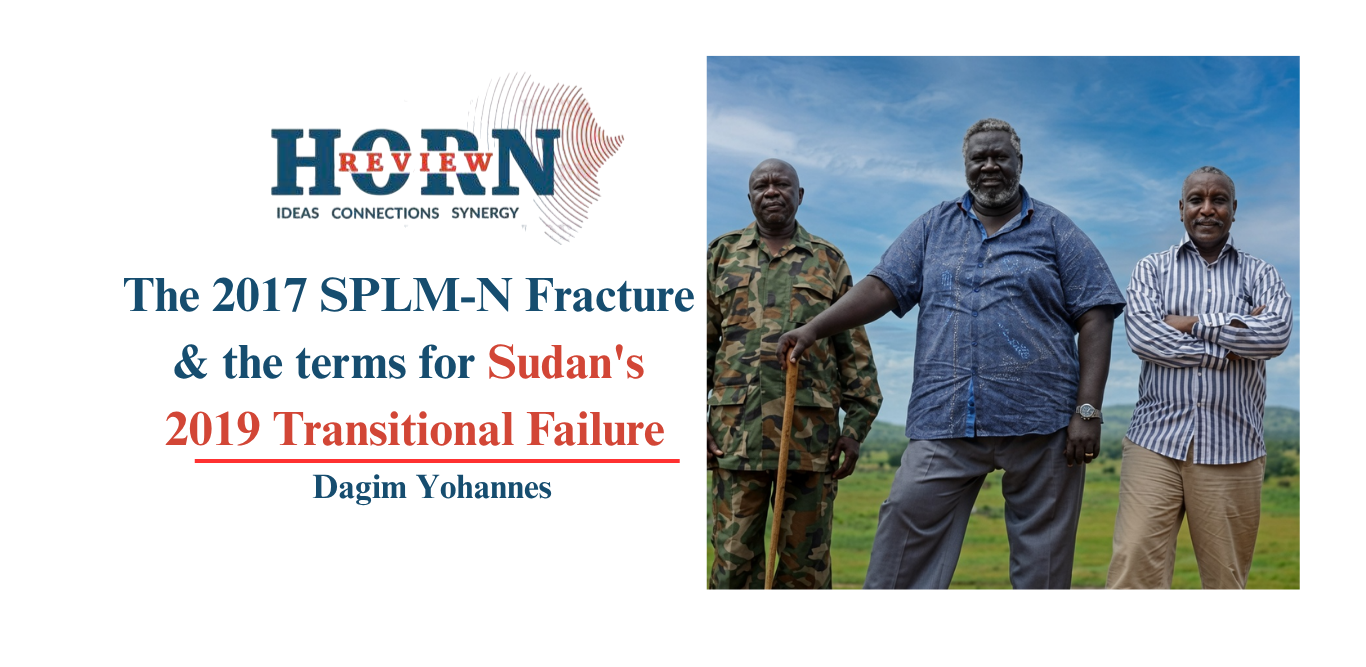
The break itself is well documented but routinely under-read. In March 2017, al-Hilu resigned as SPLM-N deputy chairman, citing organizational failures, no manifesto, no constitution, no functioning decision-making body, and a deeper political grievance: that Agar and then-negotiator Yasir Arman were prepared to enter talks with the Bashir government without a binding commitment to a secular state, and without guarantees on self-determination for the Nuba Mountains and Blue Nile. Agar’s camp countered that al-Hilu’s insistence on secularism as a precondition, rather than a negotiating objective, was unworkable against an Islamist government, and that his demand to preserve an independent SPLA-North for twenty years before any final settlement amounted to permanent parallel sovereignty. Both readings contain real material. But the framing that matters for what came after is this: the split was fundamentally, a disagreement over whether Sudan’s marginalized peripheries should negotiate incremental accommodation within the existing state, or hold out for a structural reconstitution of it. That is precisely the fault line that reopened, unresolved, across the entire 2019 transition.
Consider the sequence. When the Forces of Freedom and Change coalition negotiated the August 2019 Constitutional Declaration with the Transitional Military Council, it inherited an armed-movement landscape already split along exactly this line. Al-Hilu’s faction refused to fold into the FFC’s civilian umbrella on the terms offered, holding out instead for the same secularism guarantee he had demanded in 2016, a guarantee the Declaration’s drafters eventually wrote in, but as aspirational text rather than as a condition enforced on the security services that would go on to violate it. Agar’s faction, meanwhile, found itself increasingly marginalized in the mediation architecture: African Union-led talks from 2018 onward treated the Agar wing as a diminished negotiating partner precisely because it lacked al-Hilu’s territorial control in South Kordofan and Blue Nile. The practical result was that Sudan’s most important non-Khartoum political demand, the terms on which the historically marginalized peripheries would rejoin the state entered the transition already represented by two competing, mutually hostile delegations, each able to accuse the other of illegitimacy. A transition that badly needed a unified peripheral bloc to counterbalance the military got a divided one instead, at the exact moment unity would have mattered most.
The Juba Peace Agreement then formalized this division rather than resolving it. By negotiating separate framework agreements with Agar’s SPLM-N in January 2020 and with al-Hilu’s faction on a distinct track later that year, one that al-Hilu did not fully sign onto until 2021 in Juba, and only after extracting the secularism and single-army provisions Agar’s side had resisted, the transitional government effectively wrote the 2017 schism into the constitutional architecture of the peace process itself. Each faction received its own seats, its own quota, its own institutional foothold. That looked at the time like conflict-sensitive flexibility. In practice it meant the state never had to choose between the two visions of political order the split represented; it accommodated both, indefinitely, at the cost of forcing neither side toward genuine reconciliation with the other. The unresolved question of 2017 was not answered. It was postponed and structurally embedded.
That embedding is what makes the current war alignment legible rather than surprising. When the SAF-RSF war broke out in April 2023, Agar’s faction had already been absorbed into the Sovereignty Council under Burhan, giving it an institutional stake in the SAF-led state; al-Hilu’s faction, still outside the settled order and still carrying the unresolved secularism demand, calculated that an SAF victory would entrench the same Islamist-inflected military establishment his movement had fought since the 1980s, and aligned with the RSF instead. There is a tendency to treat this as an opportunistic wartime choice. It reads more coherently as the final expression of a divergence that was locked in place by 2017 and then hardened by every subsequent institutional decision that followed from it, the AU’s differential treatment of the two factions, the FFC’s failure to integrate al-Hilu’s bloc, and Juba’s decision to formalize parallel tracks rather than force a common one.
This is the context in which Agar’s outreach through Addis Ababa has to be judged, and it is why the odds against it are structural rather than merely circumstantial. A reconciliation confined to security arrangements, a ceasefire in Blue Nile, a battlefield understanding to ease pressure on the SAF’s southern flank would replicate the same error the 2019-2021 transition made: treating a constitutional disagreement as a security problem solvable through accommodation rather than resolution. Al-Hilu has given no indication that his baseline demand has moved; if anything, his alliance with the RSF under the Tasis charter’s explicit secular-federal language suggests he now judges his position stronger than at any point since 2017, not weaker. Agar, for his part, has no mandate from Burhan’s Sovereignty Council to concede the secularism question, since doing so would fracture the SAF’s own Islamist-aligned support base. Ethiopian mediation can produce a meeting. It cannot manufacture the concession that both 2019 and Juba avoided making.
The lesson for whoever mediates Sudan’s next comprehensive settlement, whether the AU, IGAD, or Ethiopia, is not procedural, but political. The SPLM-N split should be treated as a diagnostic, not a footnote. Parallel-track peace processes that allow rival factions to each claim partial legitimacy do not neutralize fragmentation; they institutionalize it. Sudan’s 2019–2021 experience demonstrates that such arrangements do not resolve conflict, but relocate it to the next crisis.
Any renewed al-Hilu–Agar dialogue that is not explicitly anchored to a single, binding settlement on secularism and the constitutional status of the Two Areas will not move Sudan toward political consolidation. It will reproduce the same deferral that has already once translated into war. At this stage, repetition would not be a failure of implementation, but a failure of design.
By Dagim Yohannes, Researcher, Horn Review