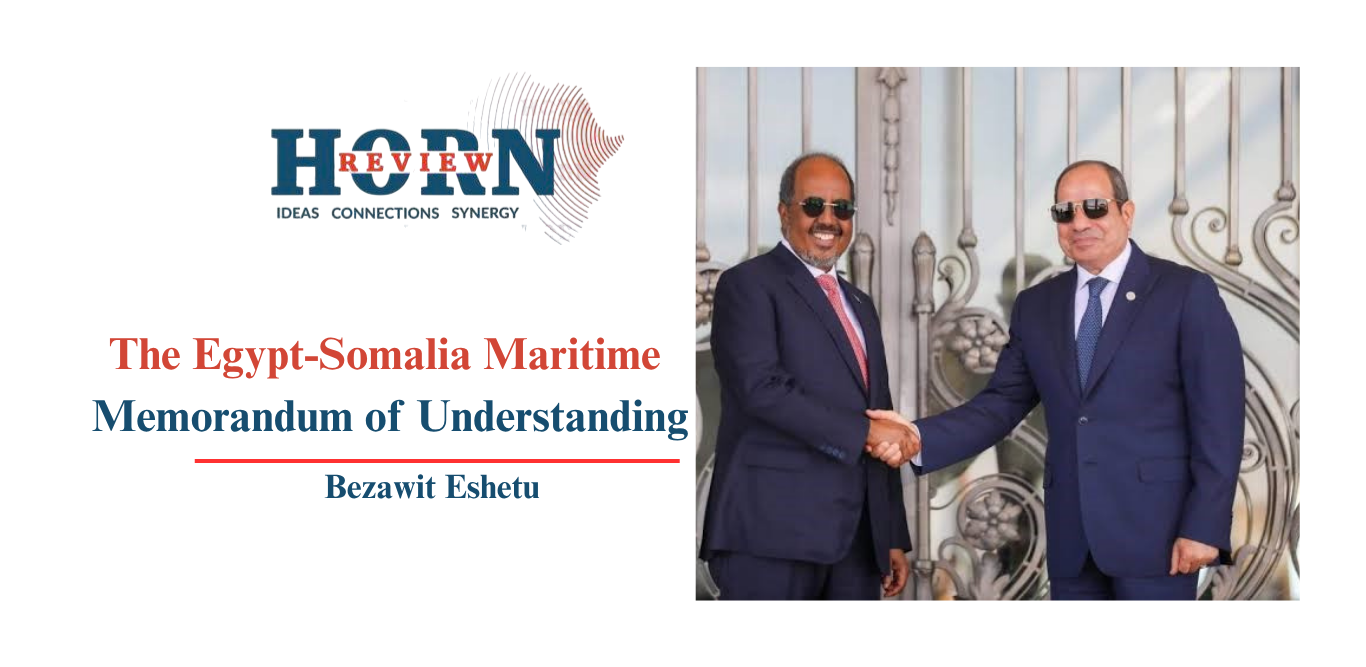
Egypt’s Red Sea diplomacy over the past year has followed a consistent architecture: a bilateral port or maritime instrument with each state bordering Ethiopia’s access routes, paired with a shared doctrinal claim that governance of the sea belongs exclusively to the states that touch it. The memorandum of understanding Somalia’s Council of Ministers approved, establishing a framework for cooperation between Egypt’s Ministry of Transport and Somalia’s Ministry of Ports and Marine Transport, is the third and most consequential application of that architecture, following comparable instruments concluded with Eritrea in May and with Djibouti in December. Read in isolation, the Somalia agreement is a modest technical document. Read against the sequence that produced it, it completes a set of bilateral arrangements that now touches every coastal state adjoining Ethiopia’s historic transit corridors.
Somlia’s Minister of Ports and Marine Transport, Mohamed Nur, described the agreement as advancing cooperation in port development, technical expertise exchange, institutional capacity building, and the modernization of maritime transport, tying it explicitly to Somalia’s National Transformation Plan. Nothing in the public text addresses troop deployments or basing rights. That harder track runs on a separate, parallel channel: Egyptian and Somali officials have also been discussing a proposed tripartite security arrangement with Saudi Arabia focused on Red Sea security cooperation, and Egypt already sits inside the African Union Support and Stabilization Mission in Somalia as a troop contributor. The distinction matters for assessing what the MoU itself does, but it does not erase the fact that the commercial and security tracks have advanced in the same period and between the same two governments.
Egypt’s military footprint in Somalia has grown well beyond its formal AUSSOM allocation. The mission’s authorized strength of close to 11,800 uniformed personnel is distributed among Uganda, Ethiopia, Djibouti, Kenya, and Egypt, with Cairo’s declared contribution set at 1,091 troops against Ethiopia’s 2,500. Reporting on the relationship has also described a second, bilateral track running alongside that AU allocation, built on a defense agreement the two countries signed in August 2024, under which Egyptian personnel are said to operate with greater independence from AU command, including in Hiiraan, a region bordering Ethiopia. The February 2026 military parade in Cairo, held for Somali President Hassan Sheikh Mohamud and accompanied by advancing Egyptian troop deployments, marked the first time since the 1970s that Egyptian military hardware had moved into Somalia.
That precedent is worth stating. Egypt’s last sustained military relationship with Mogadishu was the arms and training support Cairo extended to Siad Barre’s government in the years before Somalia’s 1977 invasion of Ethiopia’s Ogaden region. The current buildup does not repeat that episode, and no evidence points to Egypt encouraging a comparable conflict today. But the fact that Cairo’s only prior period of military engagement with Somalia preceded a Somali war against Ethiopia gives the current relationship a specific reference point, distinct from the generic language of encirclement that regional commentary tends to reach for.
The Somalia MoU did not emerge from a bilateral vacuum. Egypt and Eritrea signed a maritime transport agreement in Asmara on May 16, establishing a direct shipping line and committing both governments to port development at Assab, Massawa, and Marsa Fatima. Three weeks later, President Isaias Afwerki traveled to Cairo for a summit at which he and President Abdel Fattah el-Sisi jointly affirmed that Red Sea governance and security rest exclusively with the sea’s littoral states, a formulation that by its own terms excludes landlocked Ethiopia from any formal role.
Djibouti, for its part, had already concluded its own arrangement with Cairo the previous December, when Deputy Prime Minister Kamel El-Wazir signed agreements covering a new container terminal at the port of Doraleh and a logistics zone inside the Djibouti International Free Trade Zone. By the time Somalia’s cabinet acted in July, Egypt held active bilateral port or maritime instruments with all three states through which the large majority of Ethiopian trade physically moves.
The timing of the Somalia MoU also intersects with a consequential decision in Washington. On July 1, the United States informed the African Union Commission that it would not support any renewal of AUSSOM’s mandate beyond December 2026 if that renewal continued to rely on the United Nations Support Office in Somalia for logistics, the mechanism that supplies fuel, rations, medical evacuation, and transport to the mission on a budget of close to half a billion dollars. The move builds on an August 2025 reduction that had already stripped close to a quarter of that office’s funding.
Eight days after the July 1 notice, Mogadishu’s cabinet approved the Egypt agreement. Somali officials have kept their public description of the MoU strictly commercial, and nothing in the available record shows the two decisions were formally linked. The proximity of the dates nonetheless invites scrutiny of a federal government facing the prospect of losing its principal logistics guarantor at the same moment it deepened its most consequential foreign security relationship outside that guarantor’s framework.
Egypt and Eritrea’s littoral states doctrine sits uneasily against the African Union’s own maritime framework. The 2050 Africa’s Integrated Maritime Strategy, adopted in 2014, treats landlocked states not as excluded parties but as “landly-connected” members of the continental maritime domain, echoing the transit provisions of the UN Convention on the Law of the Sea. Ethiopian officials have invoked that framework directly in defending Addis Ababa’s sea access ambitions. Cairo and Asmara’s insistence that governance authority belongs to coastal states alone carries no binding force over Ethiopia’s transit rights, but it establishes a competing normative position that Egypt can invoke in regional and multilateral settings where Ethiopia has no seat as a matter of geography.
The MoU also lands on a Somali federal government whose authority over its own southern states is itself unsettled. Jubaland’s president, Ahmed Madobe, has fought Somali National Army units on several occasions since December 2024, including at Dolow, Ras Kamboni, and Beled Hawo. South West state, where Ethiopian troops maintain a substantial presence, has previously voiced its own discomfort with Mogadishu’s warming ties to Cairo. A federal government that cannot fully enforce its writ in the regions hosting the foreign troops at the center of this dispute is negotiating security arrangements on behalf of a state whose internal cohesion is itself contested, a condition that leaves ample room for al-Shabaab to exploit any operational confusion produced by a change in troop composition or logistics.
None of this activity is separable from the unresolved dispute over the Nile. Egypt’s claim to a fixed share of the river’s flow rests formally on the 1959 Agreement it concluded with Sudan, an arrangement Ethiopia has never recognized as binding since it was negotiated without Ethiopian participation despite the river’s Ethiopian origin. The Grand Ethiopian Renaissance Dam’s inauguration in September 2025 closed off the leverage Cairo held during the years of construction, and no binding trilateral agreement on filling and operation was concluded before that point. Denied a renegotiated settlement on the water itself, Egypt has shifted the point of pressure toward the logistics and connectivity infrastructure that Ethiopia’s economy depends on, a redirection that does not resolve the underlying dispute but changes the terrain on which it is contested.
Ethiopian officials have already characterized this pattern in explicit terms. Foreign ministry spokesperson Nebiat Getachew accused Egypt of attempting to obstruct Ethiopia’s Red Sea access within days of the Eritrea agreement, and Addis Ababa has treated Cairo’s outreach to each of its coastal neighbors as a coordinated element of the same dispute and not as unrelated bilateral developments. What Ethiopia stands to lose in practical terms is not abstract: its own troop presence in Somalia, formally 2,500 personnel under AUSSOM concentrated in Gedo, Bay, Bakool, and Hiiraan, has so far been preserved through the Ankara-mediated framework that eased the standoff over the Somaliland MoU, even as Mogadishu has never withdrawn its objection to that 2024 agreement.
Egypt’s maritime and security agreements with Eritrea, Djibouti, and Somalia represent a calculated relocation of the Nile dispute from the river basin to the Horn of Africa coastline. By advancing a maritime governance doctrine restricted to littoral states, Cairo is constructing a regional containment architecture that maximizes Ethiopia’s geographical limitations. For Addis Ababa, this trend translates into acute structural vulnerability, as its primary trade corridors and regional security interests are increasingly subjected to Egyptian influence. Navigating this environment necessitates a complete departure from Ethiopia’s current foreign policy approach.
Historically, Ethiopia has functioned as a reactor to regional developments, whereas Egypt consistently operates as the primary agenda setter. To neutralize this containment strategy, Addis Ababa must establish comprehensive security buffer zones across all its borders, insulating its domestic stability from adjacent geopolitical friction. Beyond securing its immediate periphery, Ethiopia must adopt a proactive diplomatic posture, shaping multilateral frameworks and defining regional security parameters rather than merely responding to conditions engineered by its competitors.
By Bezawit Eshetu, Researcher, Horn Review