

From Al Fashaga to Mandera: Why the Greater Horn’s Borderlands Are Becoming the Region’s Real Battleground
The Horn of Africa is still too often read from its capitals. Addis Ababa is treated as the diplomatic brain of the region, Nairobi as its commercial nerve center, Mogadishu as the long struggle between state rebuilding and insurgency, Asmara as the closed security state, Djibouti as the port capital, and Port Sudan as the wartime refuge of a broken Sudanese state. These places matter. No serious reading of the region can ignore them. But the map of power in the Greater Horn is no longer explained by capitals alone. The pressure is increasingly forming at the edges, in places that appear peripheral until a crisis makes them impossible to ignore. Al Fashaga, Mandera, Kassala, Gedaref, Sool, Sanaag, Gambella, Moyale, Garissa, Berbera, and the Red Sea coast are not background spaces. They are where the official map meets the lived map, where sovereignty meets clan identity, where armies meet pastoral movement, where refugees cross, where smugglers operate, where ports and roads become political weapons, and where regional rivals learn how to hurt one another without always declaring war.
This is the quiet shift that defines the current moment. The Greater Horn is entering an age of frontier geopolitics, where borderlands are not merely the edges of state authority but the places where power is tested, negotiated, and often broken. These frontier spaces are rarely empty. They are crowded with history, identity, trade, suspicion, and survival. They are crossed by herders in search of pasture, families divided by colonial borders, merchants who trust informal routes more than official customs posts, armed groups that use the weakness of the state as cover, and governments that see every movement across the line as a possible threat. The Horn of Africa Initiative describes borderlands as territorial margins where the national border shapes social, political, and economic life. It also notes that many such areas are tied together by trade routes, transhumance, shared resources, and social relations while also facing climate vulnerability, weak infrastructure, poor services, illicit activity, and conflict. That description is not only developmental. It is geopolitical. It tells us why the border is no longer a line on a map. It is a political environment of its own.
In much of the Greater Horn, the state imagines the border as an instrument of sovereignty. Local communities often experience it as an obstacle, a market, a refuge, or a passage. That gap between the state’s map and society’s map is where instability grows. Many borders in the region cut through older worlds of movement. Pastoral communities have long moved across dryland zones that predate modern states. Traders have long linked markets across frontiers that officials later tried to formalize. Clan and ethnic networks often reach across more than one country. The problem is not that borders exist. Every state needs borders. The problem is that many governments try to govern these borderlands as if they were ordinary administrative spaces, when in reality they are hybrid zones where the state is one actor among many. A soldier at a checkpoint, a clan elder, a smuggler, a rebel commander, a livestock trader, a refugee family, and a foreign intelligence service may all be operating in the same corridor, but with entirely different definitions of order.
Al Fashaga is one of the clearest examples of this frontier condition. On paper, the dispute is about fertile agricultural land along the Ethiopia Sudan border. In diplomatic language, it is a disagreement over demarcation, cultivation, and sovereignty. But on the ground it is more than that. It is about farmers, local communities, military deployments, refugee flows, national pride, and the wider rivalry between Ethiopia, Sudan, and Egypt. Reuters reported in December 2020 that Sudan said it had regained control of 60 to 70 percent of disputed border land, noting that the dispute centered on Al Fashaga, a fertile area recognized within Sudanese boundaries but long cultivated by Ethiopian farmers. The same report placed the tensions in the context of the Tigray war and the arrival of more than 50,000 Ethiopian refugees into Sudan. That is the key point. Al Fashaga did not become sensitive only because of a border line. It became sensitive because war, displacement, agriculture, and sovereignty collided in one place.
For Sudan, Al Fashaga became a test of state authority at a time when the country was already politically fragile. A government that cannot control its claimed territory looks weak at home and abroad. For Ethiopia, the area was tied to local communities, Amhara political sentiment, and the fear that Sudanese pressure could be used by actors hostile to Ethiopia’s wider regional position. For Egypt, any Ethiopia Sudan tension sits inside the shadow of Nile politics and the dispute over the Grand Ethiopian Renaissance Dam. This is how a farm frontier becomes a regional issue. The land itself matters, but the symbolism matters almost as much. A local clash can be read in Khartoum as sovereignty, in Addis Ababa as encirclement, in Cairo as leverage, and in nearby villages as a question of livelihood. That is what makes frontier politics so difficult to contain. It speaks many political languages at once.
The Sudan war has made that frontier even more volatile. The conflict between the Sudanese Armed Forces and the Rapid Support Forces has not stayed neatly inside Sudan’s internal political frame. It has produced refugee flows, cross border accusations, arms concerns, and suspicion among neighboring states. In February 2026, Ethiopia was accused of hosting a camp in Benishangul Gumuz to train fighters for the RSF, an allegation tied to fears that Sudan’s war was spreading across borders. The political significance of the claim is important because it shows how quickly the frontier becomes a theater of suspicion. Even when allegations are contested, they can still harden perceptions. Sudanese actors begin to read Ethiopia through the war. Ethiopian actors read Sudan through spillover, Egyptian pressure, Eritrean positioning, and the vulnerability of the western flank. The frontier becomes less a border and more a nervous system, carrying fear from one political body into another.
Eastern Sudan reveals another face of the same problem. It is not only a land frontier. It is a maritime gate, a military rear area, a humanitarian corridor, and a buffer space between Sudan, Eritrea, Ethiopia, Egypt, and the Red Sea. Kassala and Gedaref connect Sudan to Eritrea and Ethiopia. Red Sea State connects Sudan to global shipping routes. Port Sudan, once important mainly as Sudan’s principal port, became much more than that after the war devastated Khartoum. Diplomats, aid agencies, displaced families, commercial networks, and army aligned authorities moved toward the coast because it appeared safer and more functional than the capital. For a time, many observers treated the east as the place where Sudan’s state could still breathe. Then drone attacks showed how fragile that assumption was.
In May 2025 drone strikes hit Port Sudan’s container terminal and surrounding infrastructure, causing fires, power disruption, GPS interference, and concern over aid access through the country’s main seaport. The attack mattered because it showed that distance no longer protected the east. The war could reach the port without a conventional battle for the city. Fuel depots, electricity infrastructure, port facilities, and administrative sites could all be targeted from afar. That changes the meaning of Eastern Sudan. It is no longer simply the army’s safer rear. It is a strategic target, because whoever can disrupt Port Sudan can disrupt the army aligned state’s connection to aid, imports, diplomacy, and the Red Sea. In a country where so much has already collapsed, the port is not just infrastructure. It is the state’s remaining doorway to the world.
The local politics of Eastern Sudan are just as important as the military geography. The Beja and other eastern communities have long complained about marginalization, underdevelopment, and exclusion from the wealth and decision making connected to the region’s ports and trade routes. Past protest blockades around Port Sudan are worth remembering because they prove something central about borderland power. A community that is treated as peripheral can still hold a national artery in its hands. The east does not need to become a full battlefield to shape Sudan’s future. A blocked road, a militia dispute, a drone strike, or a breakdown in local bargains can be enough to shake the whole system. That is the uncomfortable lesson of Eastern Sudan: the region’s power comes from the fact that it joins together local grievances, maritime access, wartime logistics, and regional anxiety.
Eritrea’s interest in Eastern Sudan is rooted in this same logic of frontier security. For Asmara, the Sudanese east is a buffer on its western side. Disorder there can mean refugees, armed networks, smuggling, hostile groups, or rival external actors approaching Eritrea’s border. Ethiopia sees the same space through a different anxiety, because Gedaref and the Sudan Ethiopia border connect to its own western security environment. Egypt reads Sudan through the Nile, the Red Sea, and the need for a predictable partner against uncertainty to the south. Gulf states read the Red Sea coast through maritime security, ports, food security, and military access. Eastern Sudan therefore becomes a place where local marginalization, Sudan’s civil war, Eritrean security thinking, Ethiopian frontier concerns, Egyptian strategy, and Gulf interests all touch. It is a borderland, but not a backwater. It is a hinge.
The Kenya Somalia frontier offers a different but equally revealing case. Here the issue is not a classic dispute over where the international border should be drawn. The issue is that the border is formally recognized but operationally porous. Mandera, Garissa, Wajir, and the wider northeastern Kenyan frontier sit inside a social and security geography that does not stop neatly at the line between Kenya and Somalia. Clan networks, trade routes, pastoral movement, and family ties cross the border. So do militants. In March 2025 Somali militants attacked a Kenyan police reservist camp in Garissa County near the border, killing six police reservists and seizing weapons. AP also reported earlier violence in Mandera, including an explosion near a police station that killed four people, among them three officers.
Mandera matters because it shows how an insurgency can turn the border into a weapon. Al Shabaab does not need to conquer northeastern Kenya to make the frontier unstable. It only needs to move through weakly governed rural spaces, exploit fear, punish cooperation with the state, attack police and transport routes, and make ordinary administration expensive. Kenya responds with police deployments, military operations, intelligence work, border control, and local security partnerships. But there is a trap here. If the state sees every cross border movement as suspicious, it risks alienating the very communities whose cooperation it needs. If it treats the border as a purely military problem, it may miss the livelihood systems that make movement necessary. Yet if it ignores security threats, armed groups can exploit local trust, terrain, and economic neglect. That is the hard truth of the Kenya Somalia frontier: the same social networks that sustain life can also be used by violence.
The Somaliland, Puntland, Sool, and Sanaag dispute adds another layer because it shows that borderlands are not only about internationally recognized states. They can also be about contested statehood, layered sovereignty, and local rejection of distant authority. Somaliland claims independence and territorial control. Puntland claims historical and clan based links to parts of Sool and Sanaag. SSC Khatumo emerged from local resistance to Somaliland’s rule and from demands to be aligned with Somalia’s federal framework. Somalia’s federal government views the whole question through the principle of national unity. The result is a frontier where the issue is not only the location of a boundary but the identity of the authority that has the right to draw one.
The Las Anod conflict made this crisis visible. AP News reported in 2023 that fighting in Las Anod, a disputed city in Somaliland, killed at least 145 people and wounded more than 1,000 after local elders expressed a desire to reunite with Somalia. Another report noted that bodies and wounded people continued to be collected amid clashes between Somaliland security forces and clan militias supporting integration with Somalia, while many civilians fled the area. These numbers are not just a humanitarian detail. They show that recognition politics can become battlefield politics. Somaliland’s case for recognition has long depended partly on its image of stability. The violence in Sool exposed the fragility beneath that image, especially when local communities reject the authority that claims to govern them.
The Ethiopia Somaliland memorandum of understanding in January 2024 then turned the sovereignty question into a regional crisis. Somalia rejected Ethiopia’s plan to establish a naval base in Somaliland and said it would never accept such an arrangement, arguing that Somaliland remained part of Somalia’s territory. The deal reportedly involved Ethiopia leasing a stretch of coastline in exchange for possible recognition of Somaliland, which Mogadishu saw as a direct violation of sovereignty. Somalia later sent Ethiopia’s ambassador home for consultations and closed consulates in Puntland and Somaliland amid the dispute. This episode shows how a port agreement can ignite wider questions of recognition, sovereignty, military access, and regional alignment. A coastline becomes more than a coastline. It becomes a test of whether borders in the Horn are settled or merely waiting for the next crisis to reopen them.
Climate pressure makes all of these frontier problems sharper. In the drylands of the Horn, climate is not a background issue. It determines where people move, where livestock survive, where water can be found, where markets function, and where conflict becomes likely. In May 2026, Somalia was again facing severe drought, with crop failures, dry rivers, livestock deaths, rising food and fuel prices, and millions facing crisis levels of food insecurity. And in other reports parts of Somalia were at risk of famine for the first time since 2022, with insecurity, failed rainy seasons, and shrinking aid all worsening the crisis. These are not only humanitarian facts. They are geopolitical facts because hunger and drought push people across borders, strain host communities, create competition over water and pasture, and make armed recruitment easier.
Pastoral mobility is often misunderstood by states that prefer fixed borders and fixed populations. For many communities, movement is not lawlessness. It is adaptation. When rain fails in one area, livestock must move. When pasture disappears, families search elsewhere. When water dries up, the border becomes less important than survival. IGAD’s Protocol on Transhumance recognizes this reality by treating cross border pastoral movement as something to be regulated and supported rather than simply criminalized. The protocol says member states should allow safe seasonal cross border mobility of livestock and herders in search of pasture and water as an adaptation and survival mechanism. That approach matters because a state that blocks mobility without providing alternatives can turn a survival strategy into a security crisis. A herder who crosses a border for pasture is not the same as a smuggler or an insurgent. Yet in tense frontier zones, governments often blur these categories. Once that happens, ordinary movement becomes politicized, and communities begin to experience the state as another danger.
The economic future of the Greater Horn depends on these same borderlands. That is the paradox. The areas most exposed to insecurity are also the areas through which the region’s biggest dreams of integration must pass. Roads, ports, railways, pipelines, and trade corridors are supposed to connect landlocked economies to the sea, link producers to markets, and reduce dependence on single routes. The cross border infrastructure and trade corridors linking places such as Kenya, Somalia, Ethiopia, Djibouti, and South Sudan, including routes through Mandera, Moyale, the Djibouti Addis corridor, and coastal corridors involving Kismayo, Lamu, and Mogadishu. These projects promise growth, but they also raise the stakes of frontier instability. A road is never just a road in the Horn. It can move goods, soldiers, smugglers, refugees, or political influence. A port can be commercial infrastructure one day and a sovereignty dispute the next.
This is why corridor politics has become one of the most important forms of regional competition. Ethiopia’s dependence on Djibouti, its search for additional sea access, Kenya’s interest in Lamu and northern corridors, Somalia’s sensitivity over Somaliland, Sudan’s reliance on Port Sudan, and South Sudan’s dependence on export routes through Sudan all reveal the same reality. Access is power. Routes are power. Ports are power. A state that controls a corridor can charge, delay, pressure, or protect. A state that lacks reliable access becomes vulnerable to the politics of neighbors. In this sense, infrastructure does not sit outside geopolitics. It is one of geopolitics’ main instruments.
External actors understand that very clearly. The Gulf states, Egypt, Turkey, Iran, Western powers, and China do not engage the Horn only through formal diplomacy in capitals. They engage through ports, military agreements, aid packages, investment, mediation, arms flows, training, and recognition politics. Sudan’s war has shown this with particular force. There have been multiple reports on the growing role of drones in Sudan’s conflict, including a United Nations warning in May 2026 that drone attacks were driving a surge in civilian deaths and threatening to intensify fighting. There are also the added Iranian made drones strengthening the Sudanese army and on allegations that the UAE has backed the RSF, which the UAE denies. The details of each case differ, but the pattern is clear. Foreign influence often enters through logistical routes, weapons supply, ports, and local allies rather than through open occupation.
In Horn, the outside actor does not always need to own the frontier. It only needs access to it. A port agreement, a military training relationship, a drone supply route, an aid corridor, a mediation role, or a partnership with local elites can all create leverage. This is one reason borderlands are so attractive to external powers. They offer influence at lower visibility. A capital city is watched. A frontier is easier to work through. A formal alliance invites scrutiny. A local partnership can be denied, reframed, or hidden. A government may say it is supporting stability while quietly shaping the balance of power in a disputed border zone. This is not unique to the Horn, but the Horn’s geography makes it especially potent because the region sits between the Red Sea, the Nile Basin, the Gulf of Aden, the Indian Ocean, and the wider Middle East.
The policy mistake would be to imagine that more soldiers alone can solve this problem. Soldiers may be necessary in some places, especially where armed groups attack civilians or state institutions. But militarization without political settlement usually hardens the frontier rather than stabilizing it.
The Greater Horn’s future will be decided as much in these borderlands as in the capitals that claim to govern them. Addis Ababa, Mogadishu, Nairobi, Asmara, Djibouti, and Port Sudan will continue to host negotiations, produce communiques, welcome envoys, and announce strategies. But the pressure that forces their decisions is increasingly forming elsewhere. It is forming where Ethiopian and Sudanese farmers, soldiers, and refugees meet in Al Fashaga. It is forming where Port Sudan links a civil war to the Red Sea. It is forming where Al Shabaab tests Kenya’s northeastern frontier. It is forming where Las Anod challenges Somaliland’s territorial claims. It is forming where drought pushes pastoralists across state lines. It is forming where corridors promise integration but expose old wounds. These are not peripheral stories. They are the new grammar of Horn politics.
If the region’s leaders continue to treat borderlands as distant margins, they will keep being surprised by crises that were visible long before they reached the headlines. The frontier is where the warning signs appear first: a blocked road, a failed rainy season, a militia recruitment drive, a disputed checkpoint, a port protest, a sudden refugee flow, a clan meeting that rejects distant authority, a drone strike on infrastructure thought to be safe. By the time these signals reach the capital, they have often already become part of a larger conflict. The lesson is simple but difficult to accept. In the Greater Horn, power does not only flow from the center outward. Increasingly, it moves from the edges inward. The frontier is no longer the edge of politics. It is becoming the place where the region’s future is being decided.
By Makda Girma, Researcher, Horn Review

RELATED
Posts

9
Oct
Eritrea’s Post-Pretoria Strategy and the Escalation in Ethiopia
Our latest report examines Eritrea’s post-Pretoria trajectory and how selective...
8
Oct
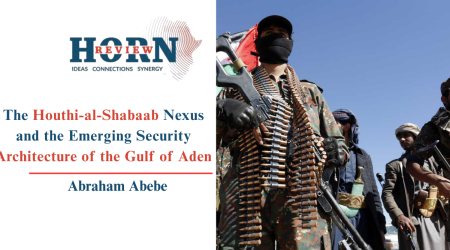
The Houthi-al-Shabaab Nexus and the Emerging Security Architecture of the Gulf of Aden
The growing relationship between Yemen’s Houthi movement and Somalia’s al-Shabaab...
7
Oct
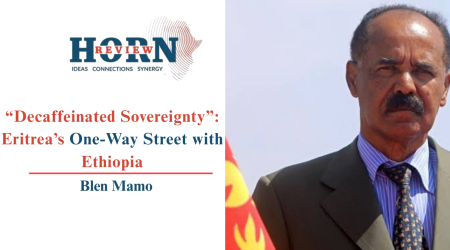
“Decaffeinated Sovereignty”: Eritrea’s One-Way Street with Ethiopia
There is a peculiar contradiction at the heart of Eritrea’s...
7
Oct
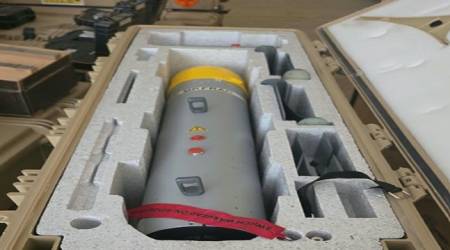
Leaked Documents Allege Sudanese Army Weapons Pipeline to TPLF-Aligned Forces as Tigray War Reignites
Leaked documents alleging a Sudanese army weapons pipeline to TPLF-aligned...
7
Oct
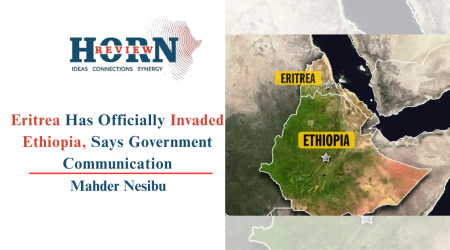
Eritrea Has Officially Invaded Ethiopia, Says Government Communication
Ethiopian Government Formally Condemns Eritrean Territorial Incursion as Its Forces...
7
Oct
Turkey, Somalia and the Transactional Reading of Alamein
The Alamein Declaration functions less as a coherent framework...
7
Oct
Somalia's Alamein Signature and the Costs of Diplomatic Alignment
The Alamein Declaration between Egypt, Sudan, Eritrea and Somalia...
6
Oct
Egypt's Nile for All, the Red Sea for Some - Except Ethiopia
The contradiction was laid out almost perfectly at El Alamein....
6
Oct
Isaias Afwerki has Long Wanted to Rule Ethiopia, Why He will Never
President Isaias Afwerki is among the most enduring figures in...
6
Oct
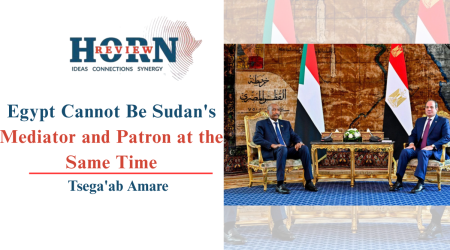
Egypt Cannot Be Sudan's Mediator and Patron at the Same Time
Abdel Fattah el-Sisi received Abdel Fattah al-Burhan in New...