There is a persistent representation in policy and academic circles to treat transitions as technical bridges between two political orders. In reality, transitions are not bridges; they are battlegrounds. They are the moments when rules are rewritten, power is renegotiated, and the future trajectory of the state is set, often irreversibly. Sudan’s current crisis cannot be understood without returning to its transitional period after 2019. What unfolded then was not simply a flawed attempt at reform. It was a formative process that produced the very fractures now tearing the country apart.
The central argument is straightforward: Sudan did not collapse despite its transition; it is struggling because of how that transition was structured, contested, and ultimately hollowed out. The gaps that exist today between civilian and military authority, between competing armed actors, between state and society were not incidental. They were embedded in the transitional design and deepened through its implementation.
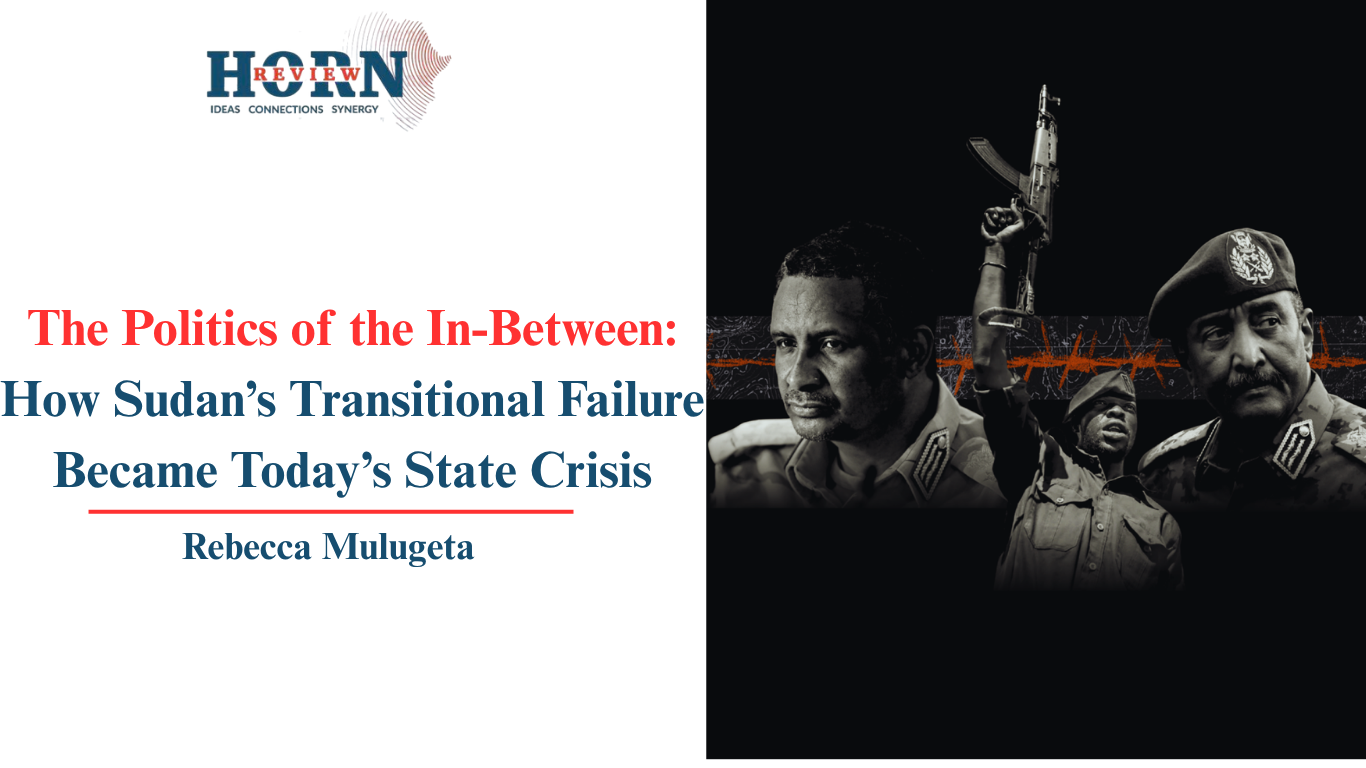
Following the 2019 uprising that removed long-time ruler Omar al-Bashir, Sudan entered what was widely celebrated as a historic transition. The power-sharing agreement between civilian forces and the military was framed as a pragmatic compromise, a necessary step to avoid immediate instability. Yet from the outset, this arrangement rested on a fragile and ultimately contradictory premise: that two fundamentally different sources of authority, popular legitimacy and coercive power could coexist without a clear hierarchy.
The Sovereign Council, designed as a hybrid body, symbolized this ambiguity. Civilians were expected to guide the political transition, while the military retained significant control over security and strategic decision-making. This was not a neutral balance; it was a system of dual sovereignty. And dual sovereignty, in transitional contexts, rarely produces stability. It produces competition.
The transitional framework functioned more as a strategic delay than a definitive resolution of governance. This created a profound structural rift where competing factions operated under contradictory motivations: civilians prioritized systemic reform and global recognition, while the military focused on safeguarding institutional independence and financial assets. In the absence of a formal mechanism to bridge these diverging agendas, the transition devolved into a theater for tactical positioning rather than a collaborative effort to rebuild the state.
One of the most consequential failures of Sudan’s transition was its inability to unify the instruments of force. The presence of multiple armed actors created a fragmented security landscape that no transitional arrangement could sustainably manage. Security sector reform was recognized as essential but treated as negotiable. Instead of being front-loaded and enforced through clear timelines, it was deferred. This deferral was not neutral; it allowed parallel chains of command to consolidate. The result was a state that did not monopolize violence, but rather hosted competing centers of armed power.
Sudan’s transition proves that failing to resolve coercive fragmentation early only serves to institutionalize it. Armed actors exploited the transitional window to consolidate resources and alliances, ensuring that when confrontation finally occurred, they were stronger rather than weaker. Consequently, the eventual breakdown was not a sudden rupture but the logical culmination of unresolved security tensions hardening into open rivalry.
While the military remained cohesive, the civilian front, specifically the Forces of Freedom and Change (FFC) , was defined by fragmentation. Internal ideological rifts and leadership rivalries significantly eroded their bargaining power against the military and undermined their public credibility. Ultimately, the transition lacked the necessary coordination to restructure the state, as the civilian camp devolved from a transformative coalition into a collection of competing, easily sidelined actors.
The transition’s failure was rooted in a lack of protective political strategy and inconsistent international backing. Locally, economic reforms lacked social safety nets or a compelling narrative, causing legitimacy to crumble as living conditions worsened. This hardship, paired with weak institutions, allowed disillusioned citizens to favor “order” over reform. Simultaneously, the inability to turn demands for accountability into concrete justice signaled that the new order wasn’t truly transformative, hollowing out the transition from within.
External involvement often made an already fragile situation more complex. Although international partners offered support, their approach leaned toward preserving short-term stability rather than pushing for meaningful structural reform. In practice, this meant tolerating military dominance while publicly endorsing civilian leadership. That contradiction sent a clear signal: ignoring the terms of the transition would carry little real cost. Domestic actors quickly understood they could sidestep the agreed roadmap without facing serious consequences, accelerating the breakdown of the entire process
The cumulative effect of these dynamics was the creation of multiple, reinforcing gaps: a gap between formal authority and real power, a gap between political agreements and security realities, and a gap between public expectations and institutional performance. These gaps did not remain static. They widened over time, eventually converging into systemic breakdown.
The current crisis in Sudan marked by violent confrontation, institutional paralysis, and humanitarian distress can be traced back to these unresolved contradictions. The transition did not collapse because it was challenged; it collapsed because it lacked the internal coherence to withstand those challenges.
Sudan’s experience is not unique. Other countries have faced similar dynamics, where transitional periods failed to establish a stable foundation. In Libya, the post-2011 transition following the fall of Muammar Gaddafi was marked by the proliferation of armed groups and the absence of a unified security framework. Like Sudan, Libya institutionalized fragmentation during its transition. Competing governments and militias emerged, and the state’s inability to monopolize force led to prolonged instability.
Similarly, Yemen’s transition after Ali Abdullah Saleh’s departure in 2012 attempted to balance competing elites without fundamentally restructuring power. The result was a fragile arrangement that unraveled into conflict, as unresolved tensions resurfaced. In South Sudan, independence in 2011 marked the beginning of a transition rather than its end. The failure to build inclusive political institutions and unify armed factions led to internal conflict within a few years. Again, the pattern is clear: transitions that defer core questions of power and security tend to reproduce conflict.
These cases highlight a broader principle. Transitions are not neutral periods; they are formative processes. When they institutionalize ambiguity, fragmentation, and exclusion, they create conditions for future crises. What makes Sudan’s case particularly instructive is the extent to which the transition itself generated the fault lines of the current crisis. The coexistence of rival armed actors, the weakness of civilian institutions, and the erosion of public trust are not external shocks. They are outcomes of a transitional process that failed to align authority, incentives, and expectations.
Had the transition been structured differently with clearer lines of authority, a more unified civilian coalition, and an earlier focus on security integration the trajectory might have been less volatile. This does not imply that Sudan’s deep structural challenges would have disappeared. But it suggests that the scale and intensity of the current crisis could have been mitigated.
Sudan serves as a sobering reminder that a transition is more than just a bridge to the future; it is the foundational phase of state-building itself. To succeed, we have to move past the vague language of compromise and focus on rock-solid institutional clarity and rules that actually stick. Practically speaking, this comes down to four essentials. First, authority must be crystal clear: there can’t be any guesswork about who is in charge or the conditions under which they govern. Second, controlling the force is non-negotiable: bringing armed groups under a single, subordinate command is the only way to ensure stability. Third, coalition coherence is a must: political leaders need to build a united front that is actually capable of negotiating and leading. Finally, public legitimacy is the backbone: if economic and justice policies don’t actively build trust with the people, the entire effort will eventually crumble.
Sudan’s experience demonstrates what happens when these elements are weak or absent. The transition becomes a space where unresolved tensions accumulate, eventually overwhelming the system. We often judge transitions by their high hopes and noble intentions. In that regard, Sudan’s journey was undeniably ambitious, inclusive in its spirit, and backed by a massive wave of public support. However, good intentions aren’t what drive results; success depends on design, sequencing, and actual execution.
The Sudanese transition made the fatal mistake of kicking the bucket down the road. By deferring critical decisions like how to restructure the security sector or clearly defining who held authority it left too much to chance. It also failed to keep the political coalition united. These unresolved issues created cracks that only grew deeper with time, eventually fueling the very dynamics that lead to state failure.
For countries facing similar moments, the lesson is not that transitions are inherently doomed. It is that they demand seriousness equal to their stakes. They are not periods to manage uncertainty but to resolve it. The cost of failing to do so, as Sudan illustrates, is not temporary instability. It is the prolonged unraveling of the state itself.
By Rebecca Mulugeta, Researcher, Horn Review