Mediation in civil conflicts is conventionally understood as a practice requiring at least an entrance commitment to impartiality or at minimum a credible performance thereof. However, the empirical record of internationalised civil wars indicates that states frequently pursue dual strategies where they participate in mediatory forums while simultaneously furnishing one with the material and political resources necessary to avoid meaningful negotiation.
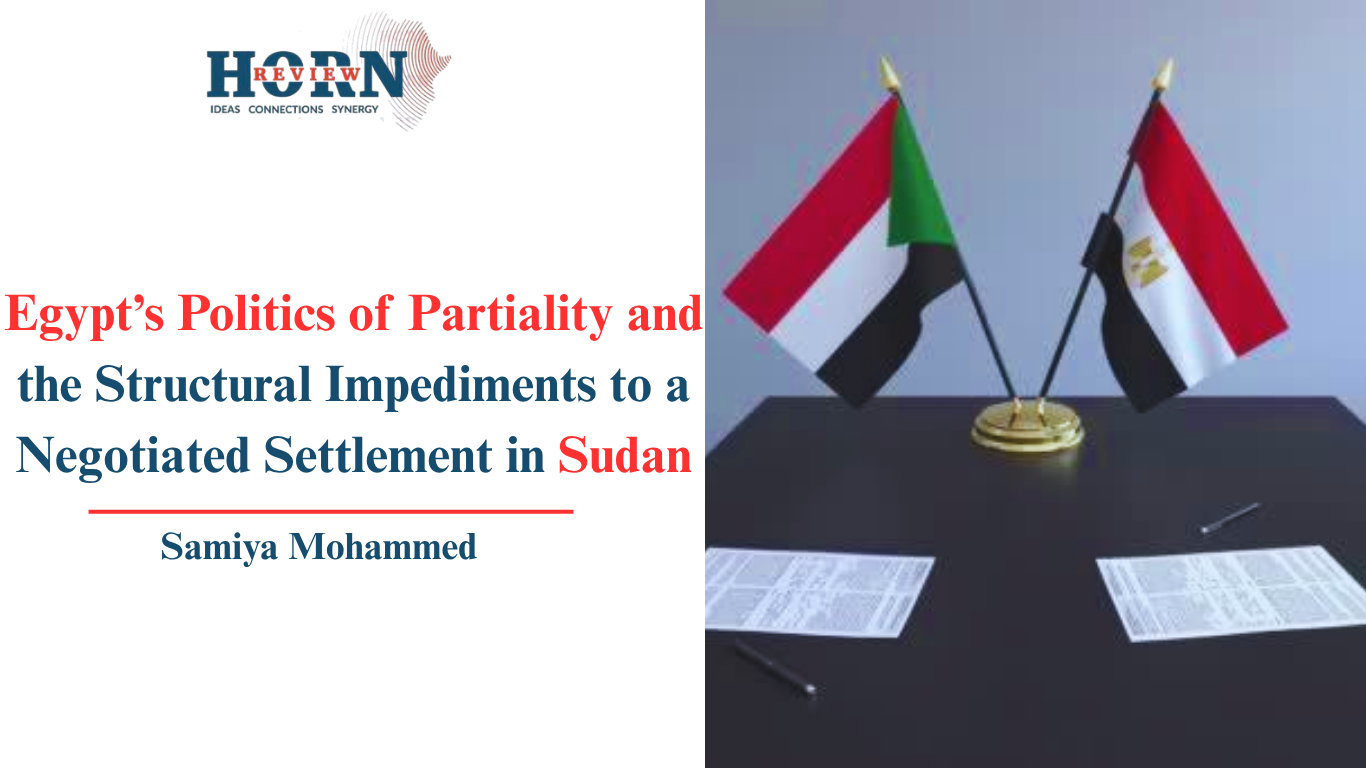
The Sudanese context provides a particularly instructive case of this phenomenon. Since hostilities commence Egypt has positioned itself as a central diplomatic actor while maintaining and deepening ties to one party to the conflict. The coherence of that dual strategy contends that the available evidence spans doctrinal statements, institutional choices and constitutes a pattern of partiality that erodes the foundations of balanced negotiation. In doing so, it substitutes a victory oriented conception of peace defined by the preservation of a specific military institutional archetype for a power sharing model predicated on mutual accommodation. The discussion is organized around three interconnected dimensions with the discursive construction of non negotiable principles, the instrumental engagement with competing diplomatic formats and the direct provision of military capabilities.
A foundational element of the Egyptian approach has been the articulation of a set of principles that, while framed in the universalist language of state preservation, function to predetermine the acceptable parameters of any political settlement. Official statements from Cairo have consistently emphasized the protection of what are termed national institutions, the rejection of parallel entities and the imperative of maintaining territorial integrity. These principles elevated to the status of explicit red lines following high level consultations with the leadership of the military government, warrant careful scrutiny not for their superficial content few would openly advocate for institutional dissolution or territorial fragmentation but for their operational implications within a context of contested sovereignty.
The invocation of national institutions betrays a conceptual move in which a historically contingent configuration of military power is equated with the state apparatus itself. This discursive strategy delegitimizes any attempt to reconstitute or reform the security sector through negotiated integration casting such efforts not as political compromise but as an assault on the constitutional order.
Similarly the rejection of parallel entities functions to render illegitimate any administration or governance structure erected by parties challenging the military authority irrespective of territorial control or popular support in those regions. By establishing these parameters as antecedent to rather than subject to negotiation, Egypt’s doctrinal framework precludes precisely the kind of constitutional refounding that comparative experience suggests is necessary for resolving conflicts grown in contests over the character of the state. The posture of neutrality is thus sustained while the substantive scope of permissible outcomes is narrowed to the point of alignment with the strategic interests of one belligerent. This represents not a facilitation of dialogue between equals but a pre-conditioning of the diplomatic field to render certain outcomes unintelligible.
Cairo’s engagement with the international diplomatic machinery surrounding the Sudanese conflict exhibits a pattern of strategic forum selection that further illuminates the instrumental character of its involvement. The Egyptian government has participated in multiple platforms including the Quad mechanism comprising the United States, Saudi Arabia and the United Arab Emirates.
However, The subsequent turn toward reinvigorating an alternative diplomatic track, specifically the Jeddah process in which the co-mediating power shares Cairo’s reservations about the regional ambitions of the Gulf must be understood in this light. A meeting in April 2026 between the Egyptian leadership and the senior American adviser for Middle Eastern and African affairs confirmed this recalibration with official statements reaffirming Egyptian support for a plurilateral framework while signalling a preference for formats more congenial to its computations.
This behavior is consistent with the theoretical expectation that states engaged in mediation with preferences will migrate toward venues where the institutional configuration maximizes their influence while minimizing that of actors aligned with their adversaries. The movement is not random or dictated by assessments of which format is most likely to yield a durable settlement however it is governed by an evaluation of which format offers the most permissive environment for advancing a predetermined substantive agenda. When combined with the doctrinal red lines outlined above the effect is to construct a diplomatic ecosystem in which the function of mediation shifts from the resolution of a dispute between contending parties to the international legitimation of one party’s consolidation.
While the discursive and institutional dimensions provide evidence of a strategic orientation, the material dimension offers the most tangible demonstration of the operational implications of partiality. The relationship between Cairo and the military leadership extends well far off political solidarity into the domain of direct logistical, intelligence and combat support. The presence of Egyptian military personnel on Sudanese territory at the outset of hostilities officially described as participants in joint training exercises established an initial condition of embeddedness that has since deepened considerably.
The timing of this escalation is analytically important. The intensification of material support corresponded not with the initiation of hostilities but with a period of strategic gains by the forces arrayed against the government particularly the consolidation of territorial control in the western region and advances toward the border area.
From a negotiation theory perspective this pattern is consequential. The provision of enabling military support to a party at moments of vulnerability alters the expected utility calculus of continuing combat. Rather than confronting a situation in which mounting costs compel a reassessment of bargaining positions, the recipient of external reinforcement can sustain a strategy predicated on eventual military recovery.
The negotiating parties zone of possible agreement already narrow due to the zero sum framing of the doctrinal red lines, contracts further as the military balance becomes a variable manipulable through external patronage. The structural consequence is the prolongation of the conflict not as an unintended byproduct of well meaning but flawed policy but as the logical outcome of a strategy that substitutes the enabling of military consolidation for the promotion of political compromise.
The evidence assembled across the doctrinal and institutional domains reveals a coherent pattern of state behavior that defies characterization as either neutral mediation or just diplomatic posturing. Rather Egypt’s engagement with the Sudanese conflict represents a distinct mode of external intervention that can be termed consolidationist mediation. In this mode, the language of peace processes and the machinery of diplomatic forums are deployed not to resolve the underlying dispute between contending military political organizations but to secure the institutional survival and territorial writ of an allied incumbent. The proclamation of non negotiable principles defines the acceptable outcome in advance and the selection of diplomatic venues ensures that competing preferences encounter institutional friction and the provision of military capability underwrites the capacity of the preferred party to resist pressures for compromise.
By Samiya Mohammed, Researcher, Horn Review