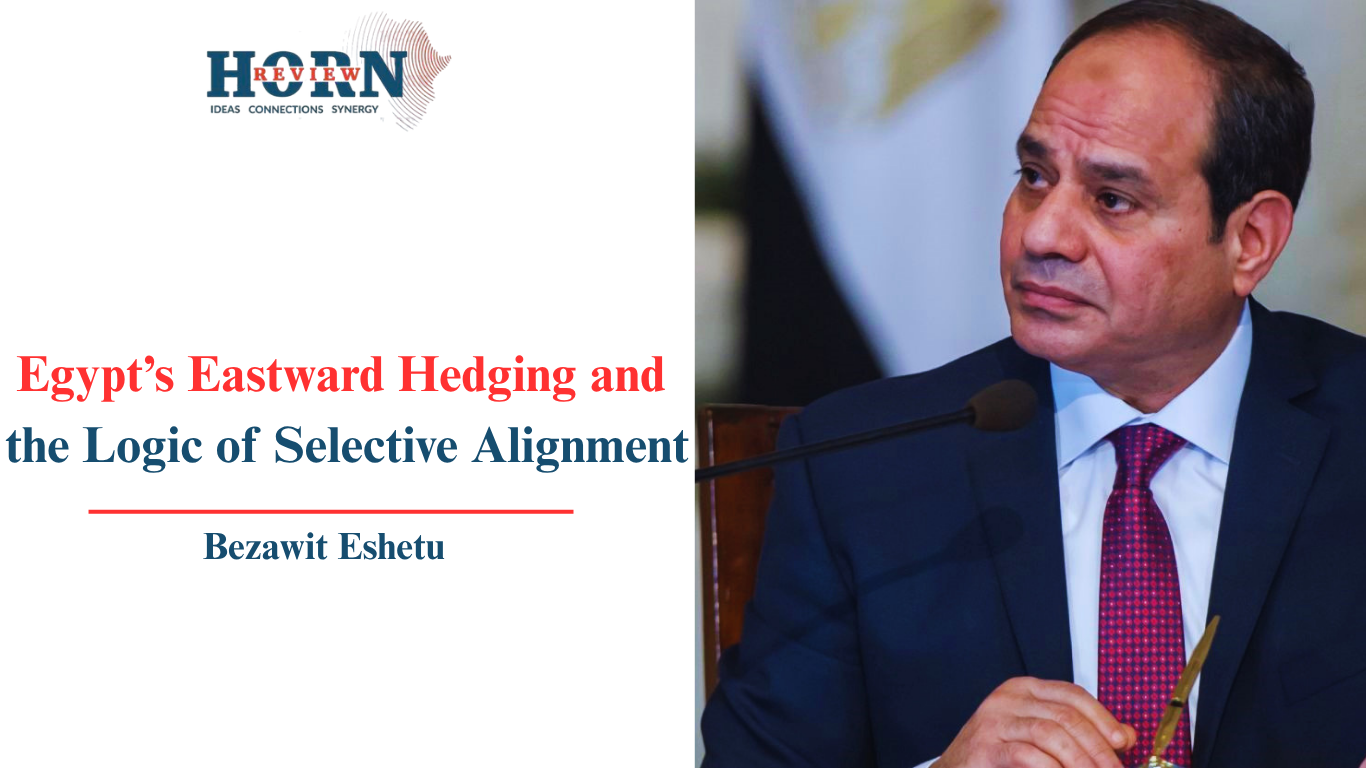
The current path of Egyptian foreign policy often looks like a clear shift toward China and Russia, highlighted by Egypt joining the BRICS+ group and making significant defense purchases from Beijing. To outsiders, this seems like the end of a 50-year alliance with the United States. However, a closer look shows that this is not a simple switch from the West to the East, but rather a strategy of selective alignment. Under the current government, Egypt is trying to achieve more independence by using a multipolar approach to lessen Western influence. Yet, this strategy is tied to a key reality: while the East provides the tools for leverage, the West remains the main authority in terms of legitimacy. This double approach is more about survival than strategy, risking overextension in diplomacy and leaving Egypt isolated.
Egypt’s recent military and economic shift toward China and Russia is a practical response to doubts about American security. The experience of the 2013-2015 aid halt and ongoing U.S. attention to human rights issues have led Egyptian officials to see reliance on Washington as a risk. In light of this, Egypt has aimed to diversify its procurement, almost antagonistically. The joint air exercises, “Eagles of Civilization,” with China in April 2025 and the deployment of the Chinese HQ-9B long-range air defense system in the Sinai Peninsula by early 2026 are not just upgrades but also messages to Washington. These actions indicate that Egypt is ready to seek anti-access/area-denial capabilities to challenge the air dominance of traditional allies. However, these purchases are rarely based on ideology. Beijing’s offer of military cooperation without conditions allows Egypt to avoid the democratic standards often linked to American military aid.
This selective alignment also affects Egypt’s economy, as the country aims to distance itself from Western sanctions. The development of the El Dabaa nuclear power plant by Russia’s Rosatom and the creation of a Russian grain hub in the Suez Canal Economic Zone are initiatives to protect Egypt from the uncertainties of the global financial system. By joining BRICS+, Egypt is exploring alternative payment methods to lessen its ongoing dollar shortage. However, these partnerships with Eastern countries have limits. Neither China nor Russia has shown readiness to provide the kind of broad economic support that the International Monetary Fund or the World Bank can offer. Thus, while the East can supply hardware and goods, it cannot replace the financial structures that bolster the Egyptian economy.
Egypt’s “security belt” strategy reflects defensive risk management more than a straightforward projection of power. By linking Gaza, the Red Sea, and the Horn of Africa into a single strategic environment, Cairo is trying to contain spillovers from surrounding instability and protect its own exposed borders, rather than shape the region in an expansive way. Its willingness to distance itself from U.S.-backed arrangements on Gaza is best understood as a calculated effort to preserve leverage, particularly its role as a mediator and gatekeeper, at a time when it has limited capacity to absorb additional security costs.
The “Badr 2026” drills in Sinai reinforce this posture by signaling deterrence and sovereign control, both outwardly to Israel and inwardly to a domestic audience facing severe economic pressure. Likewise, the claim that “Gulf security is Egyptian security” should be read as a transactional statement of interdependence: Cairo is tying Gulf stability to its own economic survival, especially as Red Sea disruptions affect Suez Canal revenues and foreign-currency inflows. Its reluctance to commit firmly to postwar Gaza arrangements is therefore less a declaration of independence than a recognition that Egypt cannot accept a security burden it may not be able to finance, manage, or politically sustain.
Despite this bold stance, Cairo’s strategy is ultimately limited by its need for legitimacy from the West. When Egypt faces critical situations that require global diplomatic support or high-level mediation, it often turns back to the U.S. A prime example of this limitation is the dispute over the Grand Ethiopian Renaissance Dam (GERD). Although China invests heavily in Ethiopia and Russia has historical ties to Addis Ababa, neither has been able or willing to mediate effectively. Instead, Egypt sought renewed U.S. engagement in early 2026 to push for a legal agreement on water sharing that favors Egypt. In the Horn of Africa, Egypt has also lobbied the U.S. to lift sanctions on Eritrea. By facilitating talks in Cairo between U.S. officials and Eritrean leaders in May 2026, Egypt aimed to use American influence to validate a security arrangement it created to contain Ethiopia. In these scenarios, the U.S. is not a traditional partner but a tool to secure the endorsement of Egyptian goals that the East cannot support.
The historical context for this behavior is extensive, indicating that the current policy is a development of a longstanding pattern rather than a sudden shift. Gamal Abdel Nasser’s 1955 arms deal with Czechoslovakia was an early example of this approach. Nasser’s shift to the Soviet bloc was a practical attempt to break Western arms dominance, yet he spent his later years managing the Non-Aligned Movement to avoid complete Soviet control. Anwar Sadat’s dramatic expulsion of Soviet advisors in 1972v represented a different direction—a turn to the U.S. when Moscow could no longer help recover the Sinai. Hosni Mubarak refined the “cold peace” strategy, maintaining a solid alliance with Washington while keeping enough distance to avoid joining the 2003 Iraq invasion. The current administration has turned this historical pragmatism into a transactional strategy for a divided world, making the balance between relationships clearer and potentially more unstable.
The danger of this “hinge state” strategy is its intrinsic instability. By treating each partner as a tool and each alliance as a transaction, Egypt risks being seen as an unreliable collaborator by everyone. To the West, Egypt’s increasing military ties with China and Russia raise concerns about the sustainability of its Major Non-NATO Ally status. To the East, Egypt’s regular reliance on Washington for mediation reveals that it remains, fundamentally, a Western-dependent nation. Additionally, this policy of “pressuring East, seeking legitimacy from the West” places a heavy burden on the Egyptian state to maintain a fragile balance. If the global order becomes more divided, Egypt’s current flexibility could quickly diminish, forcing it to make choices it has tried to avoid for the past decade.
Thus, Egypt’s foreign policy reflects a state that is attempting to navigate its own economic and security vulnerabilities by diversifying its dependencies. It is not moving from one camp to another; it is attempting to exist in the friction between them. While the East provides the material leverage to resist Western pressure, the West remains the only actor capable of providing the diplomatic and financial legitimacy necessary for the state’s long-term survival. This is the essence of modern Egyptian statecraft: a hard-boiled, clinical calculation that in a world of fragmenting powers, the safest path is to be useful to everyone while belonging to no one. However, as the regional security belt becomes more volatile and great power competition intensifies, the cost of maintaining this delicate balance may eventually exceed the benefits it provides.
By Bezawit Eshetu, Researcher, Horn Review