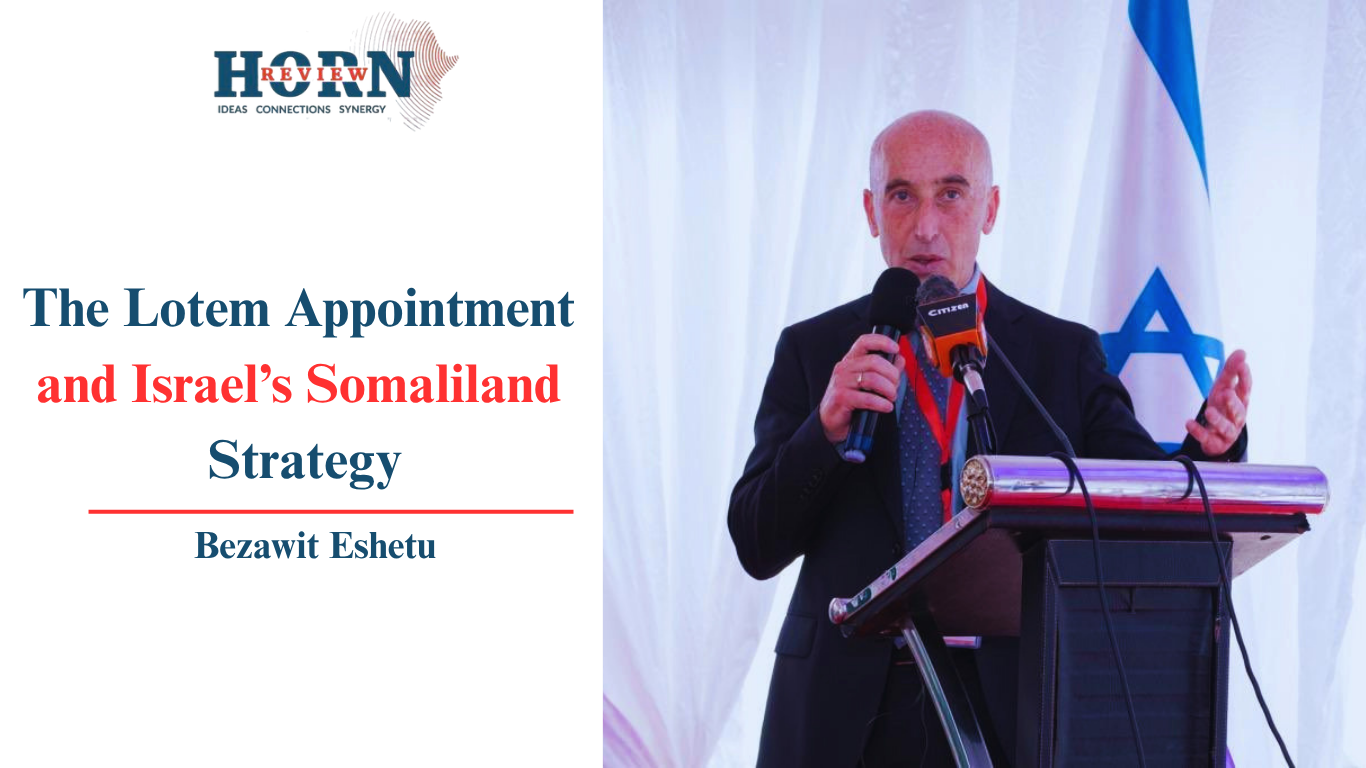
Michael Lotem’s appointment as Israel’s first ambassador to Somaliland, initially in a non-resident capacity, should be read as the institutionalization of a strategic bet rather than a ceremonial gesture. Israel had already taken the politically consequential step of recognizing Somaliland as an independent and sovereign state, becoming the first country to do so. Foreign Minister Gideon Sa’ar subsequently traveled to Somaliland in January 2026 with a promise to open an embassy and appoint an ambassador.
That sequence matters: recognition created the legal and diplomatic opening, but Lotem’s posting converts that opening into an operational framework. In other words, Jerusalem is no longer merely acknowledging Somaliland’s existence; it is treating Somaliland as a node in a wider Red Sea strategy. The logic is rooted in geography. Somaliland sits along the Gulf of Aden opposite Yemen, near one of the world’s most consequential maritime corridors, and Israel’s decision reflects a view that the Horn of Africa is now inseparable from the security of the Red Sea system itself.
That broader system is under sustained pressure from the Houthi campaign. A missile attack on Israel in March 2026 renewed fears of fresh strikes on Red Sea shipping, especially around the Bab el-Mandeb chokepoint through which roughly 12% of world trade typically passes. The commercial consequences have already been visible for Israel: Eilat port saw an 85% drop in activity after Houthi attacks on shipping intensified in the Red Sea.
The strategic point is not simply that Somaliland is close to Yemen, but that it offers Israel a way to extend situational awareness toward the southern gate of the Red Sea at a moment when maritime disruption has become a core feature of regional conflict rather than a side effect. From this angle, the embassy appointment is not about prestige. It is about redundancy, warning time, and the pursuit of a forward diplomatic presence in a corridor where naval exposure, insurance costs, and trade vulnerability now shape state behavior.
This forward diplomatic presence is most clearly embodied in the Port of Berbera and its associated airport, which serve as the operational bridge between abstract geography and real statecraft. Berbera is already a DP World deep-water logistics hub on the Gulf of Aden, facing Yemen, with upgraded berths, Africa’s longest runway, and road.
It provides commercial access, maritime awareness, logistical backup, and a platform for technology exports. It also shortens surveillance routes toward Houthi launch sites, offers alternative supply lines when Eilat’s throughput drops sharply, and provides a stable coastline outside Somali control, allowing Israel to maintain flexibility without establishing a visible base.
Lotem’s Kenya-era MASHAV model of agricultural innovation, water management, arid-zone cooperation, port security, and cyber-logistics fits this setting well. Israeli expertise could strengthen Berbera’s hinterland, attract investment, and turn recognition into tangible governance gains that Somaliland can claim as its own. In this sense, Berbera turns broader Red Sea strategy from concept into operational reality.
Lotem is a strategic choice for that mission because his career has consistently operated in the space where diplomacy becomes practical statecraft. Israeli diplomatic records list him as ambassador to Kazakhstan in 2004 and to Azerbaijan in 2009. Later sources describe him as having served as ambassador to Kenya and as a roving economic ambassador to the African continent.
His posting to Azerbaijan from 2009 to 2012 offers one documented precedent for Israeli diplomacy in a setting shaped by Iranian pressure, geographic exposure, and contested sovereignty linked to the unresolved Nagorno-Karabakh conflict. In that context, the bilateral relationship with Baku developed mainly through operational channels, including energy cooperation, intelligence coordination, and low-profile military-technical arrangements, rather than public declarations. These interactions unfolded against a backdrop of persistent Iranian opposition to Azerbaijan’s ties with Israel.
In 2012, Azerbaijani authorities disrupted an Iranian intelligence plot to assassinate the Israeli diplomat Lotem, yet the partnership continued. During his tenure, Israeli technical inputs were also transferred into sectors such as energy diversification, agricultural modernization, and security cooperation. Lotem later described the period as “without any doubt the most exciting and interesting in my life,” a remark that points to the operational intensity of managing such relations under external constraint.
The parallel to Somaliland rests on structural similarities. Both cases involve exposure to Iran-aligned hybrid pressures and an emphasis on de facto autonomy within a contested sovereignty framework. Whether this exact pattern would apply in Somaliland cannot be taken for granted—it will depend on local political incentives, resource constraints, and regional threat perceptions. Still, the Azerbaijan example illustrates one proven mechanism through which bilateral ties can persist under pressure, even if it does not guarantee the same outcome elsewhere.
That arc is important because it places him repeatedly in environments where Israel’s advantage lies not in ideological alignment but in technical usefulness, resource diplomacy, and trust-building with Muslim-majority or strategically sensitive partners. His assignments were not random postings; they were laboratories for a style of diplomacy that advances Israeli interests by embedding them in local development needs, security anxieties, and economic calculations.
His record in Kenya shows how that method works in practice. Through MASHAV-linked engagement, Lotem emphasized agricultural innovation, financing channels for agriculture, cyber training, water solutions, and county-level cooperation in arid regions. These are not soft extras attached to diplomacy; they are the mechanism through which Israel builds durable influence in places where formal alliances are thin and institutional capacity is uneven.
For Somaliland, that matters more than it might in a conventional embassy posting. A polity seeking recognition needs more than a flag and a protocol officer; it needs demonstrations that sovereignty can produce governance, investment, and practical resilience. Lotem’s background suggests he understands that in contested spaces, legitimacy is earned through function. That is why his experience is relevant not only to bilateral relations, but to the internal state-building logic of Somaliland itself.
This is also where the deeper geopolitical calculation emerges. Israel is not merely looking for another friendly capital in Africa; it is seeking a partner positioned at the edge of a contested maritime theater where Iran-aligned pressure can be felt indirectly and asymmetrically. Somaliland’s value lies in its location, its relative political stability compared with much of the region, and its willingness to engage outside the framework that Somalia and many others insist on preserving.
The January 2026 visit captures the diplomatic fault line clearly: Somaliland welcomed the move as a historic milestone, while Somalia rejected it as an unacceptable interference and the African Union and others opposed the recognition. That backlash is not a side issue. It is the price of any policy that aims to normalize a breakaway authority. Israel appears willing to pay that price because it judges that the strategic return, especially in the Red Sea and Gulf of Aden environment, is greater than the diplomatic cost.
Seen this way, Lotem’s appointment is best understood as the search for a diplomat who can convert recognition into leverage without overdramatizing the relationship. The near-term objective is unlikely to be a conspicuous military arrangement; it is more plausibly a layered partnership built on maritime awareness, technical cooperation, commercial access, and quiet intelligence value. That is where Lotem’s profile fits the task. He has repeatedly worked in places where Israel’s influence is strongest when it is disciplined, developmental, and adaptive rather than declarative.
His earlier postings in Kazakhstan and Azerbaijan trained him to operate amid sovereignty disputes, strategic anxieties, and overlapping external pressures; his time in East Africa taught him that relationship-building in fragile environments depends on producing concrete benefits that local actors can defend as their own. The result is a diplomatic style suited to Somaliland: not a quest for headlines, but the construction of a durable foothold in a region where power is increasingly measured by access, proximity, and resilience.
By Bezawit Eshetu, Researcher, Horn Review