As global attention remains focused on Ukraine, Gaza, and tensions involving Iran, the war in Sudan is receiving far less international attention. But the conflict started in 2023 between the Sudanese Armed Forces and the Rapid Support Forces, continues to fuel one of the world’s worst humanitarian crises as it enters its fourth year.
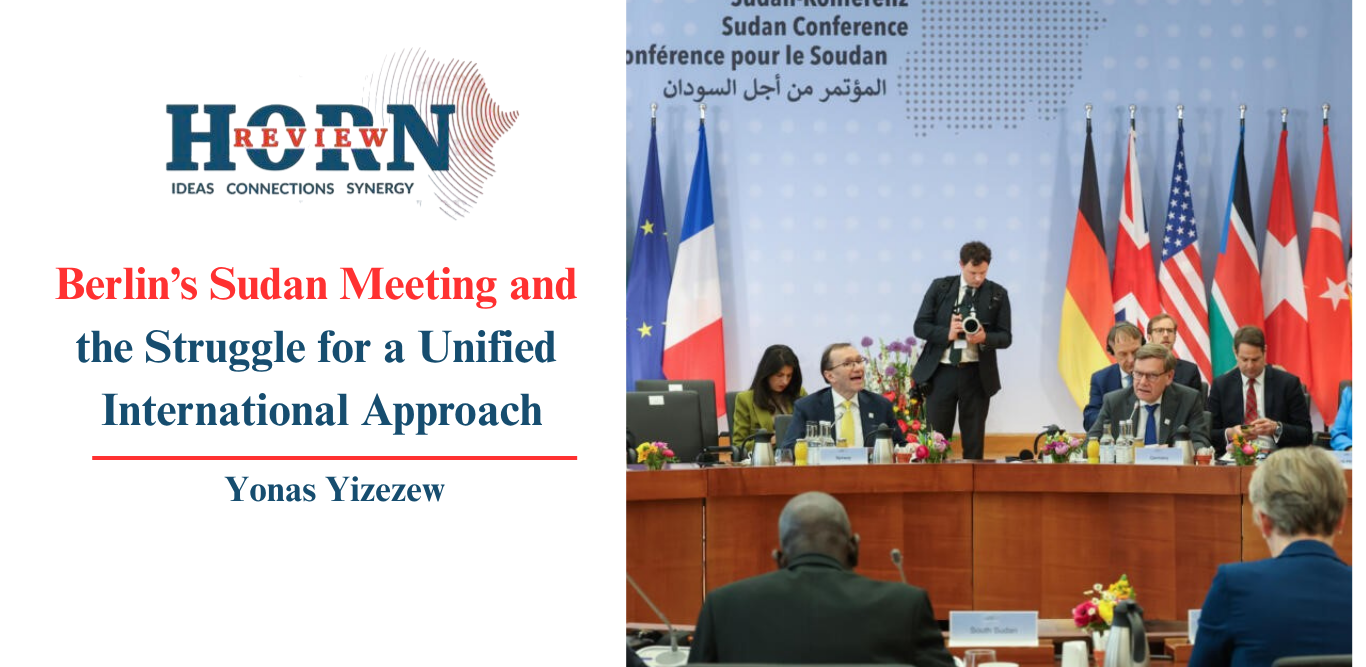
The Berlin conference held on April 15, 2026 was the third major international gathering on Sudan. Prior to that the 2024 Paris conference centered mainly on humanitarian pledges and initial calls for dialogue, while the 2025 London meeting, pushed a Quad-led roadmap for a humanitarian truce but ended without full agreement. Berlin set a broader goal by linking substantial aid mobilization with a dedicated track for civilian participation.
Germany co-hosted the event alongside France, the United Kingdom, the United States, the European Union, and the African Union. More than 55 countries and organizations were present. The conference brought in over €1.5 billion in pledges, with the European Union and its member states contributing a large share. It also produced the Berlin Principles. The statements reaffirmed Sudan’s sovereignty and territorial unity while rejecting a military resolution to the conflict. They called for an immediate humanitarian truce as a pathway toward a durable ceasefire, alongside unrestricted humanitarian access and stronger protection for civilians and remaining state institutions. There was also a clear emphasis on halting external military and logistical support to the warring parties, paired with backing for a civilian-led political process.
A notable outcome was the setting up of a structured space where Sudanese civilian and political groups could meet and produce a joint statement despite their differences. This was facilitated by the African Union-led Quintet made up of the African Union, European Union, IGAD, United Nations, and the League of Arab States. Building on earlier talks in Addis Ababa, it brought together women’s groups, youth networks, professional associations, revolutionary coalitions, and some political actors with different links to the conflict parties. They agreed on a joint declaration with seven main points: an immediate ceasefire, protection of civilians and infrastructure, humanitarian access, civilian-led governance, a Sudanese-owned political process, international support, and justice.
This step carries real weight as Sudanese civilian actors have often stayed fragmented and sidelined by military rivalries and by mediation efforts that focused too heavily on the two generals. The Berlin civilian seminar demonstrated that, despite deep divisions, Sudanese civilian actors could still reach common positions on major national concerns. It created a possible base for a steering committee or wider intra-Sudanese dialogue. The effort added genuine Sudanese agency to a process that had largely remained top-down, while complementing the Quad’s ceasefire work and the Quintet’s political facilitation.
The conference can also be a sign of an effort to bring global focus back to Sudan at a time when the crisis risks being forgotten. By keeping up the series of high-level meetings, it sent a message to the warring parties and their supporters that the international community has not walked away completely, despite clear donor fatigue.
These gains came from Germany’s continued hosting role, coordination within the Quintet, and a clear emphasis on including civilians. These elements built on lessons from the more limited focus in Paris and London.
Despite these achievements, the Berlin conference revealed notable divisions and a degree of diplomatic difficulty. Negotiations aimed at producing a unified communiqué broke down after more than seven hours of discussions. This outcome echoed earlier setbacks and led the co-hosts to issue a separate statement. The main impasse occurred within the Quad grouping, comprising the United States, Egypt, Saudi Arabia, and the United Arab Emirates. This group has the strongest direct leverage over the two Sudanese parties. Differences emerged over wording on the “preservation of state institutions.”. For Egypt and Saudi Arabia, the Sudanese army remains the recognized state authority. The United Arab Emirates, meanwhile, is often accused of backing the RSF, although Emirati officials deny the claim.
Even though divisions within the Quad persist, this group has the capacity to bring together members who have the real capacity to pressure or encourage the warring parties to come to the table. On the other hand, the Quintet has valuable experience and skills in facilitating this kind of broad political dialogue and civilian inclusion. These two tracks should be better integrated so that leverage, security concerns, and inclusive talks reinforce each other from different points of view.
The United States has worked consistently to close these gaps and move unified action forward, with senior-level diplomatic investment. Senior Advisor Massad Boulos played an active part in these efforts, engaging Quad partners directly to seek balanced results and practical de-escalation steps. Still, positions taken by certain Quad members made consensus harder despite American engagement.
Further issues weakened the results. Disagreements among outside actors led to mixed messages that reduced the conference’s overall impact. Some countries placed higher priority on protecting their bilateral ties, such as economic interests in ports, agriculture, and gold trade, than on full coordination. Donor fatigue showed in pledges that lacked clear, fast, and accountable delivery plans, which raised questions about how well support would reach local responders given access problems. Limited enforcement tools made calls to stop external arms flows and financial support largely aspirational. Battlefield developments added to this with SAF advances in central Sudan stood against RSF consolidation in the west after El Fasher, locking in a fragmented stalemate. The absence of direct SAF and RSF representatives also limited immediate progress.
SAF sharply criticized the conference for being organized without enough consultation with Khartoum. It saw the event as outside interference that undermined national sovereignty and risked giving legitimacy to paramilitary groups. This reaction increased mistrust and made follow-up more difficult.
These deadlocks point to deeper regional realities. Strained relations between Saudi Arabia and the UAE, including proxy differences in Sudan and other parts, play a central part. Such competing outlooks have turned Sudan into a field for broader rivalries and reduced unified pressure on the parties. The United States has tried repeatedly to align these interests toward de-escalation, but different national priorities have slowed advancement on difficult endgame questions like force integration, resource sharing, and the future political order.
The conference’s shortcomings also tie directly to the war’s political economy. Gold smuggling continues to finance both sides. RSF-linked networks reportedly move minerals through neighboring countries, while the SAF secures funding and arms from other suppliers, including Iran for drones. This resource predation, along with control over ports and land, makes the conflict self-sustaining. It resembles long-running stalemates in Libya, where external patrons keep divisions alive to protect economic positions, or in Syria and Yemen, where outside splits extended crisis despite many conferences. The civilian track initiated in Berlin could become a meaningful addition if it is effectively utilized.
The Quad has maintained a focus on ceasefire efforts and has issued statements, yet it has achieved limited enforcement due to its internal divisions. The Quintet has demonstrated stronger cohesion in the areas of civilian facilitation and calls for de-escalation. It has carried out extensive consultations that contributed directly to the Berlin outcomes. Nevertheless, neither mechanism has overcome the core challenge of insufficient leverage. This includes the limited capacity to impose costs on external supporters or to alter the military calculations of the parties. United Nations resolutions, African Union roadmaps, and sanctions measures have remained fragmented.
United States involvement stays essential and tries balances humanitarian aims with Red Sea security and counter-extremism goals. European actors stress civilian protection and funding, while African institutions highlight ownership and sovereignty. Despite American attempts to bring approaches together, differing partner priorities have sometimes reduced the total effect. Looking forward, success will depend on turning shared views into monitored de-escalation and on restraining external backers.
In essence, the Berlin conference connected humanitarian pledges, civilian agency, and clear principles partially effective than earlier meetings. It renewed international attention and gave Sudanese voices greater space. At the same time, it showed how unresolved Gulf rivalries, resource incentives, battlefield entrenchment, and differing external priorities still limit bigger steps. Despite steady United States efforts including those led in part by Senior Advisor Massad Boulos to bridge divides, positions taken by various member states have at times weakened unified action. Without narrowing these gaps, improving enforcement on access and restraint, and better linking Quad leverage with Quintet facilitation, the conference could become yet another milestone in a long crisis. Failure could lock in a de facto partition with serious consequences across the Horn of Africa, the Sahel, and global trade routes.
By Yonas Yizezew, Researcher, Horn Review