The Sahel does not usually fall apart in sudden shocks. It tends to happen slowly, almost quietly, through the gradual loss of control over movement and exchange. Roads that once connected towns and carried state authority are increasingly absorbed into informal systems. In some areas, convoys operate with more predictability than official security forces, while gold and other goods move across borders in ways governments struggle to track. For many rural communities, survival is not negotiated primarily with the state but with those who control access to routes and flows. Before capitals visibly weaken, it is circulation that breaks first, and once that happens, sovereignty becomes little more than a formal presence over a shrinking space of real authority.
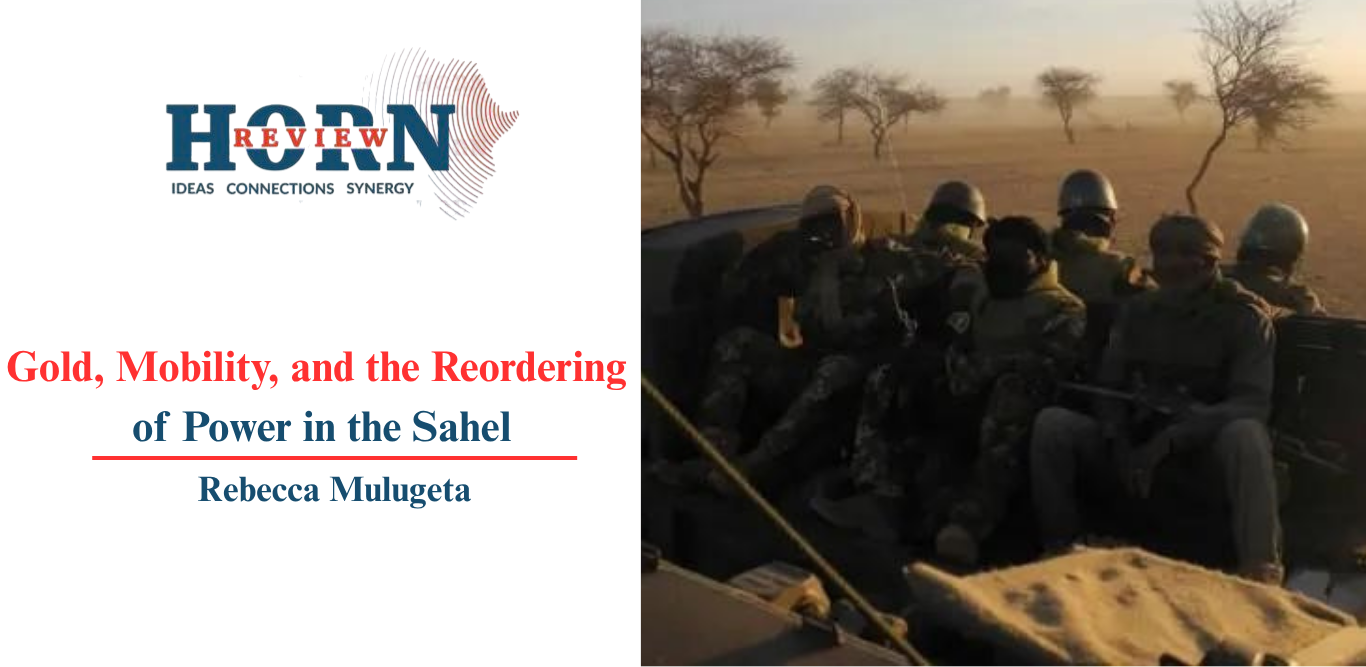
In the desert corridors stretching between northern Mali and southern Libya, this transformation becomes visible at night. Pickup trucks cut across the sand in tightly organized convoys carrying more than weapons. They transport fuel, trafficked migrants, smuggled gold, communication equipment, fighters, couriers, and financial flows that sustain entire networks of power. The armed actors guarding these routes are no longer just militants operating in remote terrain. They function as managers of mobility, deciding who moves, who pays, who is protected, and ultimately who gains access to survival itself.
This is the transformation the world still struggles to fully understand about the Sahel. The region’s crisis is often described through familiar language like terrorism, coups, weak states, extremism, instability. But those labels no longer capture the scale of what is happening across the belt stretching from the Atlantic edge of West Africa to the Red Sea basin. The Sahel is not only experiencing insurgency. It is witnessing the rise of a new political order built around mobility itself.
Across Mali, Burkina Faso, Niger, Chad, Libya, and increasingly Sudan, armed groups have discovered that in fragile states, controlling movement matters more than controlling territory. Borders mean little when governments cannot enforce them. Capitals mean little when roads belong to insurgents. Military victories mean little when fighters, weapons, gold, and money continuously regenerate through transnational corridors the state cannot shut down.
The modern Sahelian insurgent no longer fights like a conventional rebel. They operate like a mobile political actor moving through interconnected systems of trade, conflict, trafficking, ethnicity, and geography. His battlefield is not a frontline. It is a network. And that network is expanding.
For decades, the Sahel existed at the margins of global strategic thinking. It was viewed as an impoverished semi-arid belt beneath the Sahara, politically fragile but geopolitically secondary. That perception has now become dangerously outdated. Today, the Sahel sits at the core of one of the world’s fastest-growing security transformations where insurgency, organized crime, proxy warfare, climate stress, illicit economies, and state fragmentation are merging into one interconnected crisis system.
What makes the region uniquely dangerous is that geography itself has become militarized. Historically, movement always defined the Sahel. Before colonial powers imposed rigid borders across Africa, trade caravans crossed the Sahara linking West African kingdoms with North African markets and the Mediterranean world. Nomadic communities moved seasonally across enormous territories. Livestock routes, Islamic scholarly networks, and informal trading systems connected regions far beyond modern state boundaries.
Mobility was survival. Colonial borders attempted to freeze this fluid geography into territorial states, but the social and economic logic of circulation never disappeared. Modern insurgent groups inherited this reality and transformed it into strategy.
Governments controlled capitals, military headquarters, and international recognition, but vast peripheral regions remained politically abandoned, economically neglected, and militarily thin. The insurgents recognized something fundamental that states could claim territory on paper while losing control of movement on the ground. This distinction changed the nature of conflict across the region.
The tri-border zone linking Mali, Burkina Faso, and Niger demonstrates this transformation clearly. The region has effectively become the operational heart of modern Sahelian insurgency because it allows armed groups to exploit weak state coordination across multiple jurisdictions simultaneously. Fighters attack military positions in Burkina Faso, retreat through Mali, regroup in Nigerien corridors, and maintain logistical links stretching toward Libya and Chad.
The battlefield constantly shifts because insurgencies in the Sahel are no longer territorially fixed. they are circulatory systems. This gives insurgent groups enormous strategic advantages over conventional armies. National militaries remain constrained by bureaucracy, borders, limited intelligence coordination and political fragmentation. Insurgent networks move faster because they are decentralized, adaptive, and deeply embedded within local economies.
Mobility becomes both survival and power. But perhaps the greatest misunderstanding surrounding the Sahel is the tendency to reduce insurgencies purely to ideology. While jihadist narratives remain important, armed groups survive primarily because they have inserted themselves into the region’s circulation economies.
Across the Sahel, legality and illegality overlap within the same logistical systems. Livestock traders, artisanal miners, fuel smugglers, transporters, migrants, traffickers, and armed actors often move through identical corridors. Roads connecting remote communities frequently function beyond meaningful state oversight.
Insurgent groups increasingly regulate these routes rather than hiding inside them. In large parts of northern Mali and Burkina Faso, transporters moving goods across certain roads must negotiate with armed actors. This is where mobility transforms into governance. The significance of this transformation is profound. Armed groups are not always attempting to immediately replace the state through conventional conquest. Instead, they gradually erode the practical relevance of the state itself. If insurgents regulate roads more effectively than governments, mediate disputes faster than local authorities, and guarantee circulation more reliably than national armies, populations slowly begin adapting to insurgent authority as part of daily life.
Gold plays a central role in this evolving insurgent political economy. Across Mali, Burkina Faso, and Niger, artisanal gold mining has expanded dramatically over the last decade, generating enormous wealth within insecure territories largely beyond effective state control. Thousands of miners move through informal sites where regulation is weak and security absent.
Armed groups quickly recognized the strategic opportunity these mining zones presented. In many cases, insurgents do not necessarily directly operate the mines themselves. Instead, they dominate the circulation systems surrounding them. They control access roads, tax transporters, charge protection fees, regulate movement, and profit from insecurity surrounding extraction zones.
Gold therefore becomes more than a resource, It becomes a mobility economy. Whoever controls circulation increasingly controls the gold trade. And whoever controls the gold trade gains financial autonomy capable of sustaining long-term insurgency. This has fundamentally transformed conflict across the Sahel. Earlier militant movements often depended heavily on external sponsors or ideological funding networks. Modern insurgencies increasingly finance themselves internally through territorial economic systems tied to gold, trafficking, fuel smuggling, livestock taxation, and cross-border commerce.
Conflict now reproduces itself economically. Insecurity weakens governance. Weak governance expands informal economies. Informal economies finance insurgencies. Insurgencies deepen insecurity further. The cycle continuously reinforces itself across borders. The Sahara itself became infrastructure. Smuggling routes stretching through Fezzan connected insurgent economies across multiple countries simultaneously. Armed groups operating in Mali and Niger increasingly interacted with wider Saharan circulation systems tied to Libya’s fragmentation.
The Sahel’s crises have fused into a single transnational ecosystem where broken borderlands serve as vital areas for insurgent movement, driven by regional fragility and global proxy rivalries. A central issue sustains this: insurgencies survive not just because states are weak, but because heavy-handed state violence drives local legitimacy straight to groups like JNIM. By exploiting local grievances like ethnic tensions, corruption, and farmer-herder conflicts militants embed themselves as pragmatic power brokers and alternative providers of order.
As communities rely on insurgent-run roads and markets, state authority evaporates, rendering purely military campaigns useless; operations might eliminate commanders, but fighters simply reroute because the underlying network of mobility remains intact. This strategic agility is now driving an expansion toward coastal West Africa and the Horn of Africa, threatening to reshape the continent’s security landscape by locking down lucrative trafficking routes, pressuring major economies, and plugging the Sahelian insurgency directly into global maritime trade networks.
States in the Sahel still maintain formal recognition, capitals, and institutions, but much of the periphery is increasingly shaped by overlapping systems of authority involving insurgents, militias, and informal economic actors. Power on the ground is no longer defined by territorial control but by the ability to manage circulation across vast spaces, including people, goods, and illicit trade routes. While international and regional responses continue to prioritize military and counterterrorism approaches, the real strategic center of gravity has shifted toward mobility and economic networks. This has created hybrid governance landscapes where state authority competes with or adapts to non-state actors beyond capital cities. Long-term stability will depend on whether governance models can evolve to regulate these flows rather than focusing only on territorial security.
By Rebecca Mulugeta, Researcher, Horn Review