Indicators of Sudan–Sahel Convergence
Few states have the contradictions of modern counterterrorism politics as acutely as the of Sudan. Over the past three decades Sudan has oscillated between serving as a global jihadist space and a shattered state whose accelerating segmentation menaces to export instability across Africa’s Sahel belt and beyond. These oscillations are not arbitrary and they are driven by a persistent triad of imperatives with regime survival, ideological affinity and external pressures. Understanding Sudan’s road from its embrace of Al-Qaeda in the 1990s through its tactical cooperation with the United States around the 2005 Comprehensive Peace Agreement to its current state of collapse offers more historical insight. The concern that further disintegration will fuel broader jihadist networks is not speculative and it is grounded in Sudan’s own precedent. As Islamist militias embed within state aligned coalitions and as borders link the Horn to the Sahel Sudan risks becoming not just a victim of extremism but a vector for its transcontinental spread.
The ascent of Omar al-Bashir following the 1989 coup in alliance with Islamist ideologue Hassan al-Turabi fundamentally reoriented Sudanese foreign and security policy. Unlike previous regimes that had toyed with Islamist rhetoric, the Bashir-Turabi axis systematically transformed Sudan into an operational sanctuary for transnational jihadist movements. Between 1991 and 1996 Sudan hosted Osama bin Laden and the core leadership of Al-Qaeda offering them not just refuge but an enabling environment of commercial infrastructure, training camps and diplomatic cover. Bin Laden invested in Sudanese agriculture, construction and import export businesses generating revenue streams that sustained Al-Qaeda’s logistical networks. Training camps near Khartoum and along the border with Eritrea prepared fighters for insurgencies in Afghanistan, Algeria, Bosnia, Chechnya, and Somalia. Sudan’s intelligence apparatus then closely aligned with Turabi’s Popular Arab and Islamic Conference facilitated arms transfers, document forgery and operational coordination among diverse groups including Egyptian Islamic Jihad, Palestinian factions and Algerian armed movements.
This period was not an anomaly but a deliberate regime project. Turabi envisioned Sudan as the vanguard of a global Islamic revival and a staging ground for revolutionary Islamism that transcended national boundaries. For Bashir hosting these networks served immediate regime survival interests and it consolidated the loyalty of hard line Islamist constituencies, deterred domestic opposition and projected regional influence. The logic however proved self defeating. In 1993 the United States designated Sudan a State Sponsor of Terrorism, triggering sanctions, investment flight and diplomatic isolation. Mounting pressure from Egypt, Saudi Arabia, and the United States including a CIA-led campaign to disrupt Sudanese infrastructure and credible threats of military action finally compelled Bashir to expel bin Laden in 1996. Bin Laden relocated to Afghanistan and Sudan briefly recalibrated. But the damage was done. Sudan had demonstrated a durable pattern when ideological affinity and regime insecurity align ungoverned or semi governed spaces within its territory become export platforms for transnational extremism.
The September 11, 2001 attacks fundamentally altered the arithmetic for both. Sudan moved swiftly to offer counterterrorism intelligence cooperation. Sudanese security services shared files on Al-Qaeda operatives, facilitated access to detained jihadists and disrupted suspected transit routes through the Sahel. These actions while motivated primarily by regime survival, produced tangible results for U.S. counterterrorism efforts. By 2005 a more cooperative phase had emerged culminating in a paradoxical partnership. While the genocide in Darfur raged killings that would later lead to Bashir’s indictment by the International Criminal Court , the United States invested heavily in brokering the Comprehensive Peace Agreement between Khartoum and the Sudan People’s Liberation Movement ending Africa’s longest running civil war.
The CPA signed in January 2005 was a masterpiece of diplomacy. Secretary of State Condoleezza Rice’s July 2005 visit to Khartoum ,the first by a U.S. secretary of state in decades symbolized this transactional rapprochement. Sudan gained a credible pathway toward sanctions relief and eventual removal from the State Sponsor list. The United States secured continued counterterrorism cooperation and a peace agreement that stabilized a portion of Sudanese territory if only temporarily.
However this phase revealed deep continuities with the past. Sudan’s regime did not abandon its Islamist networks and it recalibrated them. Intelligence sharing coexisted with continued support for certain militant proxies in Darfur and eastern Sudan. The Darfur conflict itself which intensified after 2003 strained the limits of U.S. tolerance. Washington imposed targeted sanctions on Sudanese officials and maintained arms embargoes even as it defended the CPA process. Full normalization proved elusive. What the 2005 period demonstrated however was Sudan’s recurrent strategic pattern tactical alignment with Western powers when regime survival required it combined with the retention of Islamist and militarized networks as instruments of internal control and regional leverage. Sudan was never a reliable partner in any normative sense and it was a transactional one and the transaction was always precarious. The overthrow of Omar al-Bashir in April 2019 following mass civilian protests inaugurated a tumultuous transition that collapsed entirely into open warfare in April 2023.
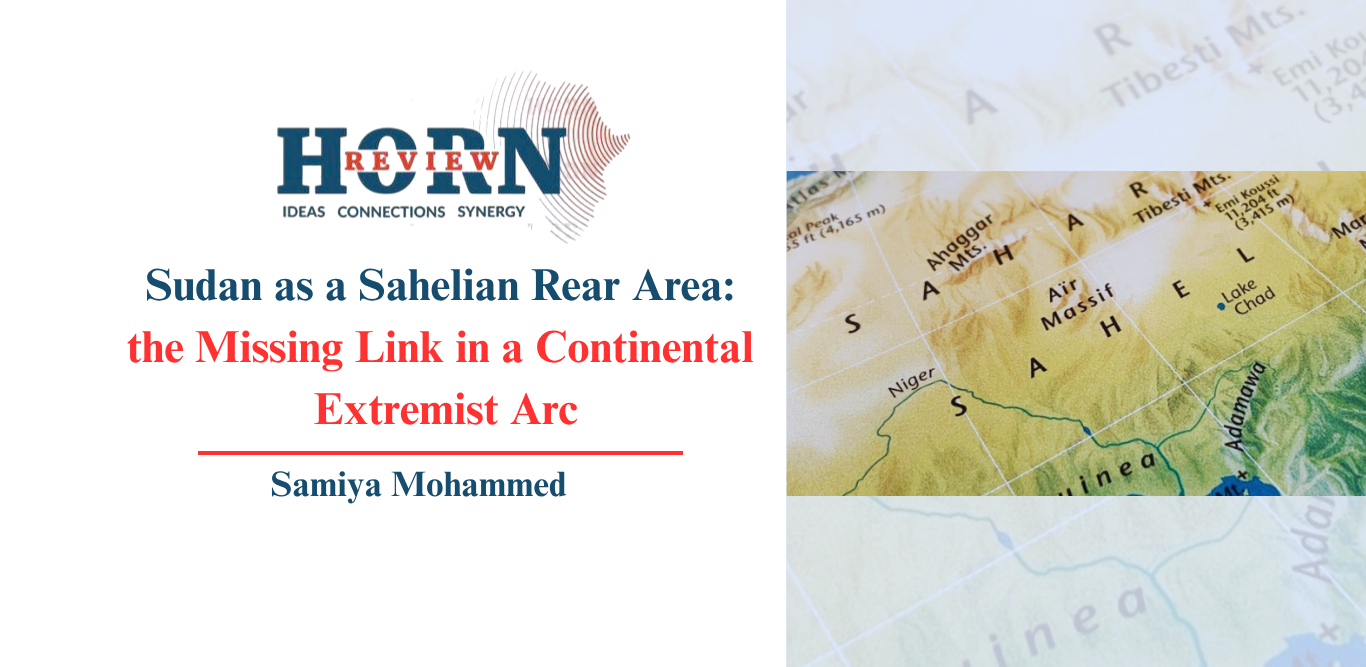
The concern that Sudan’s disintegration will spread extremism westward into the Sahel and beyond is geo strategically grounded making Sudan sit on conflict systems and In the 1990s jihadist logistics moved from Sudan through Chad and Niger to reach Algerian and Malian groups. That infrastructure never entirely disappeared and was just rendered latent by counterterrorism pressure and Sudan’s cooperation.
Today that infrastructure is reactivating and Arms flows from Libya’s uncontrolled arsenals move east into Sudan and Sudanese weapons and fighters move west into Chad and the Central African Republic. More worryingly jihadist groups in the Sahel have demonstrated patience and adaptive capacity. JNIM and Islamic State in the Sahel have expanded their territorial control across Mali, Burkina Faso and Niger. A Sudanese safe haven would provide these groups with depth, alternative logistics and a potential rear area beyond the reach of current counterterrorism operations. Several Experts on Sudan have documented preliminary evidence of communication between Sudanese Islamist militias and Sahelian jihadist commanders though operational coordination remains limited. The risk is not that the Sahel’s insurgencies will relocate to Sudan however it is that Sudan’s collapse will create a contiguous crisis zone allowing fighters, weapons and tactics to circulate freely from the border to the Atlantic coast.
Sudan’s history provides a lesson that an ideological networks operating within state structures produce exportable instability. The 1990s Al-Qaeda was not an aberration and it was the logical outcome of regime decisions to empower Islamist proxies while state capacity eroded in peripheral regions. The 2005 CPA period temporarily suppressed this by imposing a structured mediation framework that however imperfect contained violence and established clear jurisdictional boundaries. Today no such framework exists. The Jeddah negotiations, have produced only brief and repeatedly violated ceasefires. Without a unifying political framework further state breakdown is not just possible but probable. In that scenario the historical precedent suggests a clear road that Extremists do not need to seize the capital but they need only secure a territorial presence in an ungoverned borderland. From there they can offer protection, justice, and resources to local populations in exchange for compliance and silence. Sudan’s borderlands especially the tri-border region with Chad and Libya, the Red Sea hills and the southern marches toward South Sudan are exceptionally suited to this purpose. The result would be a new jihadist sanctuary, smaller than Afghanistan but strategically located between Africa’s most active conflict zones. Such a sanctuary would directly connect the Horn’s extremists with the Sahel’s expanding networks creating a continental jihadist corridor.
The well founded concern over Sudan’s fragmentation fuelling broader jihadist networks demands a policy response that learns from both the 1990s failures and the 2005 partial success. Sanctions alone are insufficient and they neither stabilize territory nor address the governance vacuums that extremists exploit. Military intervention is politically infeasible and strategically risky as external forces would become targets rather than solutions. If Sudan’s disintegration continues unaddressed the country will not just relapse into its 1990s status as a terrorist space but it will become something worse with a porous, decentralized, multi actor battlefield where jihadist groups, ethnic militias, and proxy forces converge. That convergence will extend westward into the Sahel which is already buckling under its own insurgent pressures. Sudan’s history proves that the connection between ungoverned spaces, ideological networks and transnational extremism is not correlative but causal. The current crisis is not a distant civil warand it is the opening phase of a continental security emergency. Containment is still possible but the window is closing, and every month of unchecked disintergartion widens the breach through which extremism will flow.
By Samiya Mohammed, Researcher, Horn Review