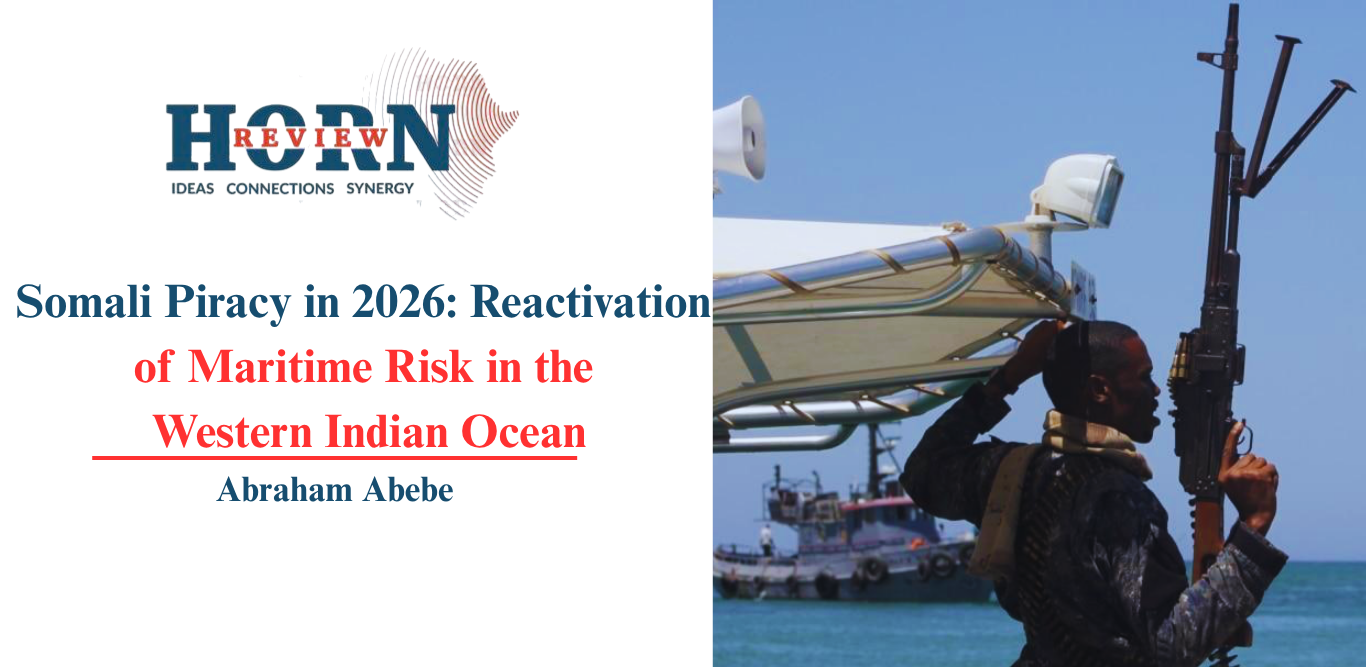
Somali piracy is reemerging in 2026 as a growing maritime security concern, with early indicators of renewed activity visible along key shipping routes in the western Indian Ocean and the approaches to the Gulf of Aden. While initial incidents remain limited in scale, the emerging pattern suggests more than isolated disruption. It points instead to the gradual reactivation of dormant maritime networks, raising renewed concerns over the stability of one of the world’s most critical shipping corridors linking the Indian Ocean to the Red Sea and the Suez Canal.
Between January and the end of March 2026, Somali water coasts showed limited but continued maritime risk consistent with early stage piracy activity. According to the International Maritime Bureau (IMB), two incidents were recorded during this period, including one attempted attack and one successful hijacking of a dhow that could be used as a mother vessel. While overall activity remained low and no large-scale attacks against commercial shipping were confirmed, these incidents indicate that operational capability persists.
Recent maritime security assessments indicate a possible increase in risk indicators consistent with earlier piracy patterns, including reported sightings of unidentified skiffs operating near commercial shipping routes in the western Indian Ocean approaches to the Gulf of Aden. These observations have been assessed within maritime security reporting as potentially consistent with pre-incident activity patterns seen in previous phases of Somali piracy. Taken together, such signals are treated as indicative of a low-level operational environment in which underlying intent may persist, even if sustained operational capability remains limited.
This early warning phase transitioned sharply in April. On 21 April, the tanker M/T HONOUR 25 was hijacked off the Somali coast. On 25 April, a dhow was captured along the central coastline, likely intended for use as a support or staging platform. On 26 April, the cargo vessel M/V SWARD was boarded while transiting a key commercial corridor linking the Suez-bound route with East African waters. Taken together, these incidents appear interconnected, suggesting that pirate groups may be developing a more coordinated and potentially expanded operational capacity.
This pattern reflects not only an increase in incident frequency but a shift in operational behavior. Rather than a temporary spike in maritime crime, it points to a calibrated escalation in operational tempo, consistent with earlier phases of Somali piracy. The sequence indicates a transition from latent capacity to active deployment, although still below the intensity observed during the late-2000s peak.
To contextualize this shift, it is necessary to situate current developments within the broader historical evolution of Somali piracy. Somali piracy did not emerge suddenly but evolved through distinct phases shaped by state collapse and maritime opportunity structures. Its origins lie in the collapse of the government of Siad Barre in 1991, which removed central maritime enforcement and left Somalia’s coastline largely unregulated. By the early 2000s, coastal communities, particularly in Puntland, began intercepting foreign vessels, initially framing these actions as defensive responses to illegal fishing and resource exploitation.
Over time, these activities expanded beyond localised coastal defence. By the mid-2000s, piracy had consolidated into a structured maritime economy with the capacity to operate far beyond territorial waters. Armed groups adopted offshore operational methods, including the use of mother vessels to project activity deep into the Indian Ocean. Between 2008 and 2011, piracy reached its peak, marked by hundreds of attacks annually and ransom payments that generated significant financial flows. During this period, piracy became embedded in the coastal political economy. Networks linking armed groups, financiers, negotiators, and local power brokers formed an increasingly organized system sustained by economic incentives and governance gaps. As a result, piracy was no longer episodic but functioned as a systemic feature within certain coastal zones.
The international response after 2011 was both rapid and sustained. Multinational naval deployments, including EUNAVFOR Operation Atalanta, alongside industry-led security measures such as armed guards, convoy systems, and route adjustments, contributed to a marked reduction in successful attacks from 2012 onwards. From approximately 2013 through the late 2010s, piracy activity declined sharply and entered a prolonged period of low incidence. During this phase, the prevailing assessment was that the threat had been effectively contained.
However, this decline masked enduring continuities. The structural conditions that enabled piracy remained largely unaddressed. Rather than disappearing, piracy networks adapted, reducing visibility while preserving knowledge, logistical familiarity, and social linkages along coastal communities. The events of 2026 reflect the re-emergence of these dormant capabilities. The rapid progression from early warning indicators to coordinated hijackings in April suggests that operational capacity had been rebuilt to a functional threshold. The use of dhows as intermediary platforms, the selection of targets along established commercial corridors, and the temporal clustering of attacks indicate coordination rather than coincidence.
This development should be situated within the broader maritime geography of the Horn of Africa. Somalia’s coastline borders the Gulf of Aden, a critical maritime chokepoint linking the Indian Ocean to the Red Sea and the Suez Canal. This corridor carries a significant share of global maritime trade, meaning that even limited disruptions can have disproportionate effects on international shipping. During the peak piracy period between 2008 and 2012, these dynamics became clearly visible. Shipping routes were diverted to avoid high-risk zones, increasing transit times and operational costs. Insurance premiums rose sharply, while the deployment of private maritime security personnel became standard practice for vessels transiting the region. Together, these adaptations reflected not only the severity of piracy at the time but also its systemic effects on global trade flows.
The current resurgence unfolds within a more fragmented maritime security environment, where patrol coverage is less continuous and response times are longer than during the previous counter-piracy decade. Naval assets previously concentrated on counter piracy operations are now distributed across multiple global theatres. This reflects not a collapse of maritime security architecture, but a reduction in enforcement density along key maritime corridors. Under such conditions, even short-term gaps in surveillance or patrol coverage can create exploitable windows for non-state maritime actors.
The result is a cyclical pattern shaped by both continuity and adaptation. While operational methods and geographic logic remain broadly consistent with earlier phases, the surrounding strategic environment has become more complex and dispersed. Piracy, therefore, does not reappear in identical form but instead adapts to shifting enforcement patterns and geopolitical conditions.
The implications for the Horn of Africa and the wider Red Sea-Indian Ocean system are cumulative. Economically, even limited increases in perceived maritime risk can translate into higher war risk insurance premiums and selective rerouting of commercial traffic, particularly through the Bab el-Mandeb corridor. From a security perspective, renewed piracy activity increases pressure for closer coordination between regional coastal states and international naval deployments operating in overlapping areas of responsibility. Strategically, it underscores the systemic interdependence of the Red Sea and western Indian Ocean, where localized maritime insecurity can quickly propagate into broader disruptions across key global shipping routes.
Somali piracy in 2026 thus represents neither a return to the peak conditions of the early 2010s nor a continuation of the low-activity equilibrium of the past decade. Instead, it reflects an intermediate phase of reactivation within a maritime security environment shaped by persistent coastal vulnerabilities and fluctuating enforcement pressure. Whether this trajectory develops into sustained escalation will depend on the effectiveness of renewed maritime policing and the extent to which structural governance challenges are addressed.
More broadly, piracy in the Horn of Africa is better understood not as a closed historical episode but as a recurrent maritime security phenomenon. Its incidence is shaped by shifting opportunity structures at sea and enduring fragilities on land, allowing it to contract under sustained naval pressure and re-emerge when that pressure weakens. The developments observed in 2026 therefore suggest a renewed entry into this cyclical pattern at a time when the Red Sea-Indian Ocean corridor carries heightened strategic and commercial significance.
By Abraham Abebe, Researcher, Horn Review