
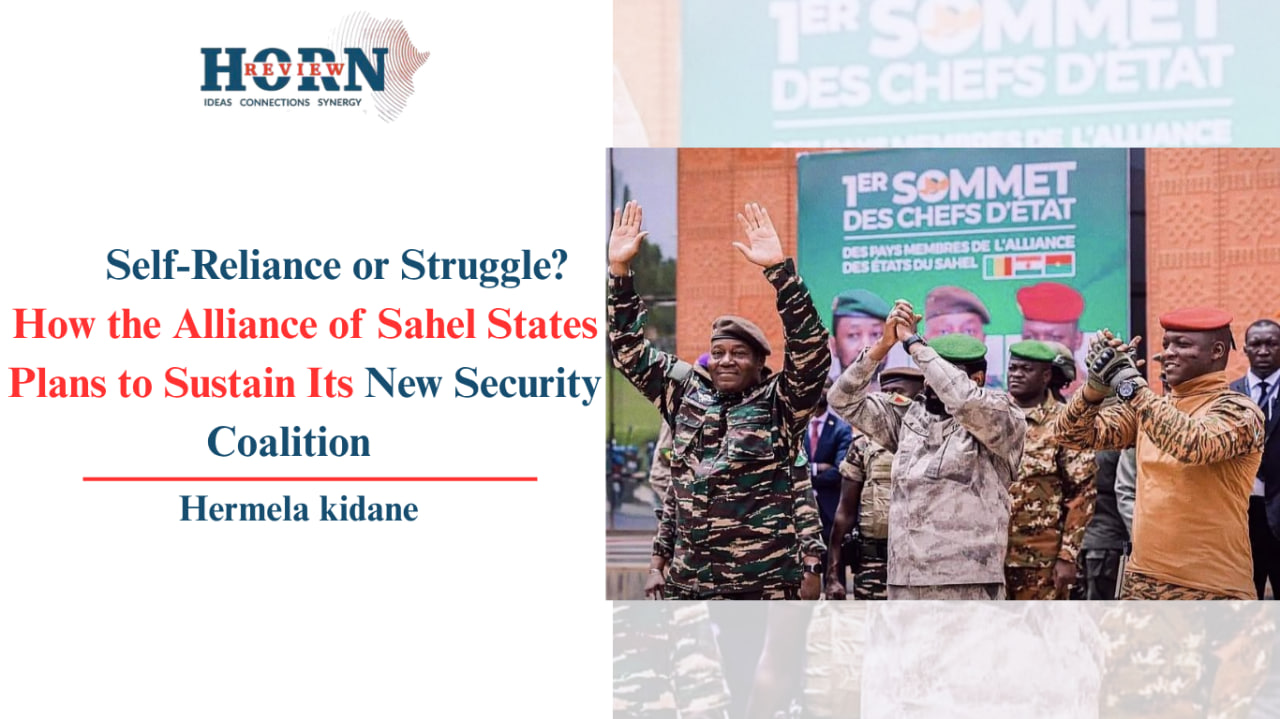
The military leaders of Burkina Faso, Mali, and Niger are testing whether that wisdom holds when the 5,000-strong Unified Force of the Alliance of Sahel States (AES) formally launched in Bamako on 20 December 2025. The ceremony was more than a show of military strength it was a public declaration that these three countries are breaking from the Economic Community of West African States (ECOWAS) and walking away from the generation of externally dependent security frameworks that came before. The AES started as a mutual defense pact in September 2023 and became a confederation by July 2024. Now it faces the question that undid earlier alliances how do you sustain a unified coalition when you have rejected the donor funding and external political structures that once held such efforts together?
This question is not just about logistics it goes to whether the alliance can survive at all. The Sahel has seen many counter-terrorism alliances fail. The G5 Sahel that launched in 2014, was the most recent and ambitious attempt. It brought together Burkina Faso, Chad, Mali, Mauritania, and Niger and its Joint Task Force started in 2017 with strong international backing to coordinate cross-border operations. But the G5 collapsed. It never had reliable funding, donors shifted their priorities over time and Sahelian governments grew to resent what they saw as foreign interference. The AES was built as the institutional expression of that rejection. But to understand whether this alliance can last, we have to look at three things the internal struggles within each member state the lessons from past failed alliances, and the growing debate over whether the AES’s self-reliance model is a genuine breakthrough or a weakness waiting to be exposed.
The most significant threat to the AES’s longevity lies not in its relations with external powers, but within its own borders. The three-member states are currently led by military governments that seized power in a wave of coups between 2020 and 2023. While they share a common ideological opposition to ECOWAS and former colonial power France, they each confront deep internal challenges that could easily fracture their collective front.
Mali is where this crisis began, and the insurgency there has only spread from the arid north down into the center of the country, where the state has struggled to hold ground. Burkina Faso has now become the region’s killing field. Insurgent groups control large stretches of territory and have laid siege to entire towns, cutting off supplies and leaving communities to fend for themselves. Niger was once seen as the West’s reliable partner in the Sahel, but since the July 2023 coup, it too has been dragged into a volatile security spiral it can barely control. These are not three separate crises. They are the same fire burning across porous borders and ungoverned spaces. An insurgent pushed out of Mali slips into Burkina Faso. A weapons cache in Niger supplies fighters in both countries. The violence moves where governments cannot follow.
For the AES to survive, these three states must do what they have never done put collective security ahead of their own survival. But that is a hard sell when your own capital is under threat. A government fighting rebels near its seat of power will think twice before sending its best troops or scarce equipment across the border to help a neighbor. When the state itself is struggling to control its own territory, committing resources to an alliance starts to feel like a luxury it cannot afford. That is the central tension at the heart of the AES and the one that could undo it. The AES leaders came to power in coups and have since restricted political opposition. That creates a paradox the same authoritarian approach that let them break from ECOWAS also makes them unreliable partners. Authoritarian regimes tend to prioritize their own survival over any alliance. Look at Eritrea, which walked away from IGAD .when the bloc no longer served its interests. The AES is not just a counter-terrorism coalition it is a coalition of convenience among regimes whose internal instability could easily pull the alliance apart.
The AES’s leaders have explicitly framed their alliance as a corrective to the failures of the G5 Sahel. That earlier coalition which also included a joint military force was hobbled by a structural flaw its dependency on external financing. With the bulk of its funding coming from the European Union and other Western donors, the G5 Sahel’s operational tempo was dictated by the disbursement schedules and strategic priorities of its international backers. When donor fatigue set in and geopolitical interests shifted, the force’s effectiveness waned. But the G5 Sahel’s collapse was not just about money. It also failed because its members never fully trusted each other. Despite facing the same threats, they pursued their own national strategies, and intelligence sharing was weak. The AES has set up a unified command under Burkinabe General Daouda Traoré to force the coordination the G5 lacked. But the region’s history shows that military cooperation between states rarely lasts. Operating across vast, empty territories is hard. Intelligence services do not like sharing secrets. And political disagreements can stall joint operations. The AES has not yet shown it can overcome any of these problems.
There are two debates on whether the AES will succeed. One side argues that the alliance has built a more resilient structure than its predecessors. They point to its financial model and its diversification of military partnerships. By getting arms, training, and intelligence from Russia’s Africa Corps, Turkey, and China, the AES has avoided the single-point dependency that made the G5 Sahel so vulnerable to France. They also note that the West has not fully cut ties.
Even with strained political relations, the United States still maintains some security cooperation focused on counter-terrorism. This limited Western engagement matters it prevents the AES from being completely isolated and leaves open a path for future normalization that could bring technical expertise and diplomatic support without the old strings attached. Conversely, a more skeptical perspective grounded in the political realities of the region argues that the alliance’s internal contradictions make it fundamentally unstable. Critics point to the absence of formalized border controls and the “lack of state density” in the tri-border region the area where the three nations meet which remains a haven for insurgent groups. They contend that no amount of confederal ambition can substitute for functioning state institutions at the local level. The voluntary patriotic funds, while symbolically powerful rely on contributions in states where tax revenues are already stretched thin by conflict. The new import levy, while a structured revenue mechanism could be difficult to enforce uniformly across three countries with varying administrative capacities.
Skeptics focus on political durability. Yes, the three regimes share an ideology shaped by the coups, but that unity is circumstantial. Authoritarian governments have a history of walking away from coalitions when their own survival is at stake. But the alliance’s success will not be decided by ambition alone. It will come down to whether these governments can turn their plans into reality. Their sovereignty first model is straightforward-fund yourselves, pool resources, diversify partners, and tie security to economic development. It is the most serious attempt yet to break free from the dependency that killed earlier frameworks. And for the first time, they have the tools to try the BCID-AES bank, the import levy and the patriotic funds give them self-financing options the G5 Sahel never had.
However, the internal challenges each member state faces from active insurgencies to political legitimacy threaten to undermine the collective project. The historical record of regional alliances in Africa including the collapse of the G5 Sahel and the unilateral withdrawals from bodies like IGAD serves as a cautionary tale. The AES may prove to be a durable new model for African security regionalism or it may join its predecessors as another short-lived pact undone by insufficient resources, diverging national interests, and the relentless pressure of insurgent violence.
The force that assembled in Bamako makes a bold claim that the Sahel can defend itself without handing over its sovereignty. But that claim will not be proved in summit speeches or official charters. It will be tested in the borderlands where insurgents move freely in the budgets that must stretch further than they ever have and, in the barracks, where soldiers decide which orders to follow. The AES will not be remembered for who founded it or what its leaders promised. It will be remembered if at all for whether it survived the internal struggles that have plagued the very states it now seeks to unite.
By Hermela kidane, Researcher, Horn Review

Could the Riyadh Airport Strike Reshape the Yemen Conflict?
A series of claimed missile and drone strikes on King...
The Makkah Pact and the Limits of Collective Defence
The Makkah Joint Defence Agreement rests on an ambitious...
Saudi-led Multinational Maritime Defence Coalition and the Changing Security of Bab el-Mandeb
On 2 September, the Saudi-led Multinational Maritime Defence Coalition...
The AI Disinformation War in the Horn and the Economics of Digital Conflict
In September, Marc Owen Jones, an Associate Professor of...
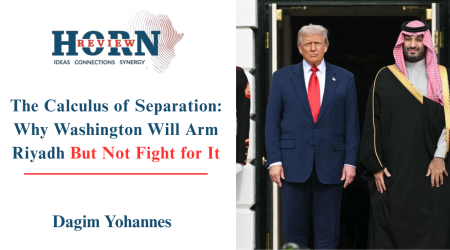
The Calculus of Separation: Why Washington Will Arm Riyadh But Not Fight for It
The episode reveals a distinction in the U.S.-Saudi security relationship...
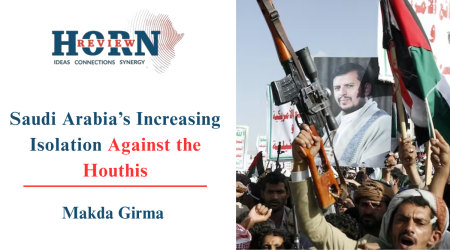
Saudi Arabia’s Increasing Isolation Against the Houthis
Saudi Arabia’s renewed confrontation with Yemen’s Houthis has exposed how...
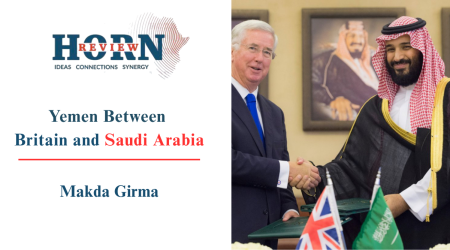
Yemen Between Britain and Saudi Arabia
The Houthi advance along Yemen’s Red Sea coast has exposed...
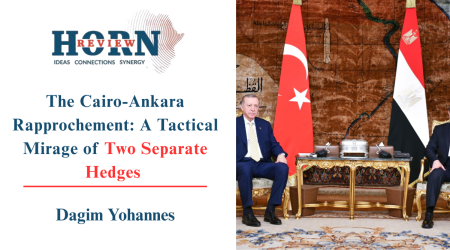
The Cairo-Ankara Rapprochement: A Tactical Mirage of Two Separate Hedges
The recent run of headlines out of Cairo and Ankara,...
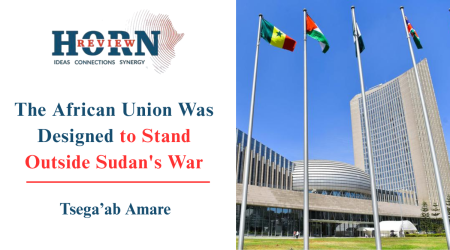
The African Union Was Designed to Stand Outside Sudan's War
Every time Sudan's war comes up in public discussion, mentioning...
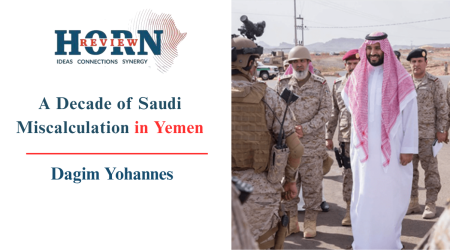
A Decade of Saudi Miscalculation in Yemen
On March 26, 2015, Mohammed bin Salman, then a thirty-year-old...