The Red Sea is no longer governed by informal understandings or tacit security assumptions. In recent years it has become an arena of open competition, where regional and extra-regional actors pursue economic, security and political objectives that often collide. The Horn of Africa sits at the center of that contest because of its proximity to key maritime chokepoints, the fragility of some states, and the strategic ambitions of multiple outside powers. The result is not a tidy bipolar division. Instead, alliances form and dissolve across theatres, producing overlapping and shifting alignments that force constant adjustment.
One clear alignment has formed around Israel and the United Arab Emirates. Since the Abraham Accords this partnership has moved beyond diplomacy into security coordination, port projects and intelligence cooperation. Israel’s recent formal recognition of Somaliland was a decisive escalation of that trajectory. By recognizing Somaliland, Israel secured political and strategic access close to the Bab el-Mandeb, a sea lane critical to its trade and vulnerable to Houthi missile and drone attacks originating in Yemen. The move also reflects the revival of an old Israeli approach of building ties with peripheral actors to offset hostile environments at the core.
The UAE has been the practical enabler of this shift. Abu Dhabi, through major logistics firms and direct investment, established a foothold in Berbera and helped create a logistics and security node on the southern flank of the Red Sea. DP World’s port developments and related economic zones at Berbera have created both commercial depth and a platform for influence. Planned corridors linking Berbera to Ethiopia further bind these projects into the Horn’s economic geography and offer Addis Ababa an alternative maritime outlet. These investments challenge the assumption that Red Sea governance remains the preserve of a consensus among Arab littoral states.
Those developments clash directly with Egyptian and Turkish outlooks, though for different reasons. Cairo sees the expanding Israel–UAE footprint as a strategic risk to two core Egyptian interests: freedom and security of the Suez Canal, and leverage over Nile Basin politics. Ethiopian access to ports outside Djibouti, especially if reinforced by Israeli and Emirati ties, reduces Cairo’s geographic leverage over Addis Ababa at a moment when the GERD dispute remains unresolved. That loss of indirect pressure complicates Egypt’s bargaining position on water and security issues.
Turkey’s concern is anchored in its operational presence and posture in Somalia. Ankara opened its largest overseas military facility in Mogadishu in 2017 and has since pursued training, naval cooperation and broader defense ties with the Somali federal state. Turkey frames itself as a guarantor of Somali territorial integrity and a security partner for Mogadishu. Any international move that legitimizes Somaliland as a separate polity contradicts that policy and risks eroding the legal and diplomatic norms Ankara defends in the Horn. Those tensions rise further when the recognizer is Israel, a state Turkey treats as a strategic rival in parts of the region. In addition, the UAE’s growing presence in Somalia’s regional states makes it difficult for other states to counter its influence, which might further fragment Somalia.
Those pressures produced unexpected tactical alignments. Turkey opposed the Israel–UAE–Somaliland trajectory and, for the moment, found common cause with Egypt on the question of Somali unity. That alignment does not erase deeper Turkish-Egyptian competition across the Middle East and North Africa, but it does show how single issues can produce temporary overlaps. At the same time, Turkey must weigh its options carefully because the UAE is deeply entangled in Turkey’s economy. Abu Dhabi’s investments, trade links and financial ties constrain Ankara’s ability to move decisively against Emirati interests, which complicates the formation of a coherent anti-UAE front.
Overlaying these dynamics is a widening rift between Riyadh and Abu Dhabi. What began as policy divergence in Yemen has expanded into a broader strategic split. Saudi officials have openly accused the UAE of backing separatist actors and of interventions that undermine central authorities in Yemen and beyond. That rupture has rippled into Libya, the Red Sea and Somalia, and it has reshaped how Gulf States cultivate partnerships in the Horn. The Saudi–UAE split makes the regional landscape more volatile and multiplies the number of competing vectors states must navigate.
Egypt finds itself squeezed between security alignment and economic dependence. On security grounds Cairo has gravitated closer to Riyadh on issues in Yemen, Sudan and the Red Sea. At the same time, Egypt’s economy depends heavily on Emirati investment and periodic financial support. President Abdel Fattah el-Sisi has publicly criticized interventions that promote fragmentation, while intelligence coordination with Riyadh against the UAE has increased on matters such as Yemen and Sudan. The net effect is an uncomfortable balancing act: preserve Emirati economic ties while aligning more closely with Saudi security priorities.
Saudi policy choices have also widened the diplomatic space for other actors. Turkey aligns with Saudi Arabia in the Somalia case because both oppose an expanded Israeli footprint in Somaliland, even though Ankara and Riyadh have long disagreed on other regional questions. Qatar has re-entered this landscape too. Doha recently signed a defense cooperation agreement with Somalia, adding another channel of security engagement that offsets the UAE’s earlier ties to Mogadishu and Somaliland.
The Saudi–Pakistan defense pact and related efforts to assemble wider security frameworks complicate matters further. Riyadh’s outreach to Islamabad and attempts to create broad defense linkages show a preference for formalized collective security that some regional powers view with suspicion. Turkey’s refusal to join certain multilateral frameworks signals that the emerging patchwork of alliances will include states with divergent long-term goals. On the other hand, The UAE is also engaged with Pakistan across various sectors, making complete dis-alignment difficult, and Pakistan is similarly unlikely to pursue it, because the UAE is the third largest trading partner of Pakistan next to China and the U.S. Actors therefore converge tactically in particular areas while retaining separate strategic agendas.
Somalia has become the principal battleground for influence in this configuration. Mogadishu faces deep disagreements with neighboring capitals. Somaliland’s growing international profile is attracting attention and investment that complicate Somali federal politics. At the same time, the federal government in Mogadishu struggles to sustain authority and cohesion under external and internal pressure. Control of ports, maritime routes and local proxies now matters as much as formal diplomacy.
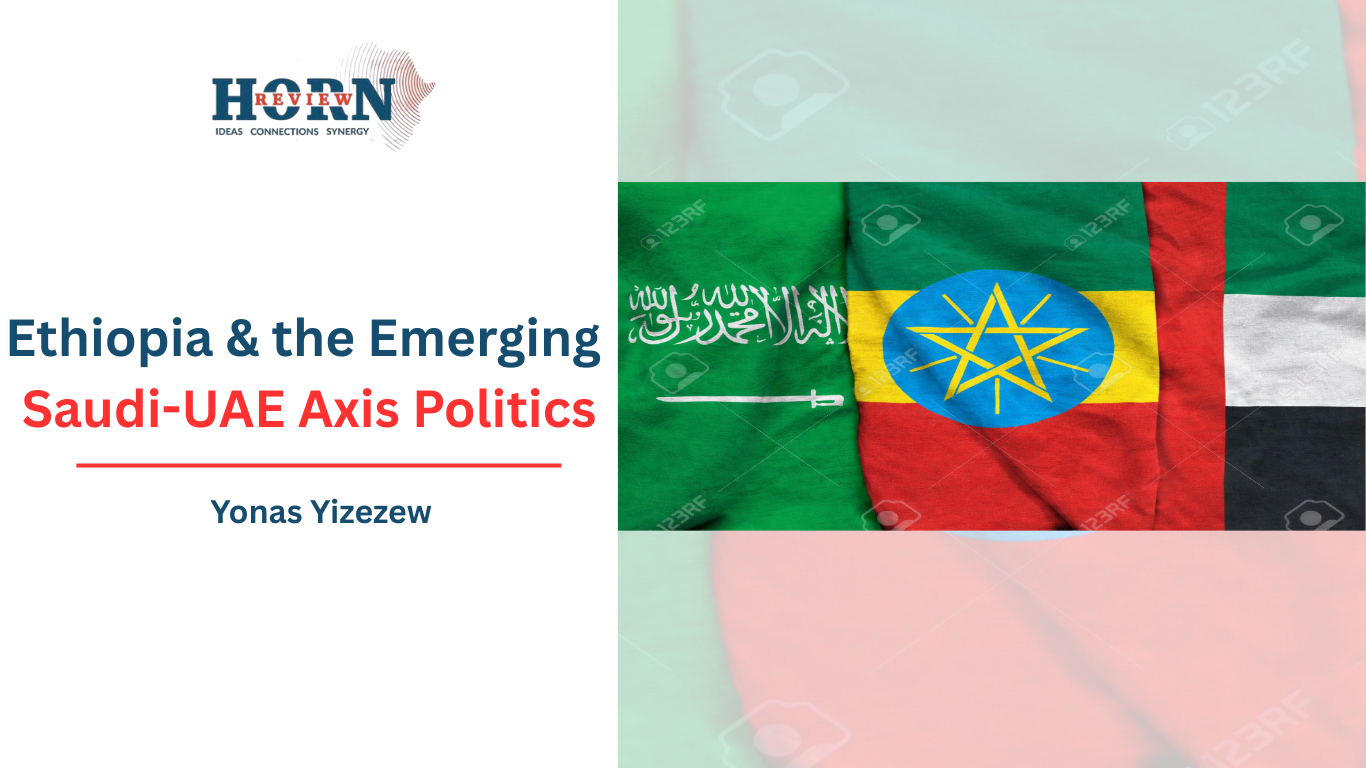
Ethiopia sits at the intersection of these dynamics and is often described as embedded in a UAE–Israel axis. That view has empirical grounding. Addis Ababa signed a port access arrangement with Somaliland in early 2024 that gives Ethiopia a stake in Berbera and a long-term maritime outlet. The UAE has supplied finance, infrastructure investment and political backing that have helped stabilize Ethiopia during periods of internal strain. Israel has deepened cooperation on technology, water management, cyber security and intelligence in ways that strengthen state resilience. These ties offer Ethiopia tangible benefits: capital, know-how and alternative access to the sea, all of which reduce some vulnerabilities of a landlocked state and provide leverage in diplomatic contests over the GERD.
It might be difficult to categorize Ethiopia as belonging to a single bloc, given its multiple overlapping interests with different regional and global actors. Addis Ababa has pursued a deliberate policy of diversification. Relations with Turkey remain operational across defense and investment channels. Ankara supplied drones and military technologies at critical moments and played a decisive diplomatic role in easing Ethiopia–Somalia tensions through the Ankara process and the subsequent declaration in December 2024. That mediation helped avert a full rupture after the Somaliland port deal and restored channels for dialogue. For Ethiopia, maintaining ties with Turkey mattered because instability in Somalia directly affects its eastern border, and because Turkey’s military presence in Mogadishu has direct security implications for Ethiopian calculations.
At the same time, Ethiopia keeps working links with Saudi Arabia and Qatar. Riyadh has opened investment channels in agriculture, renewable energy and manufacturing that contribute to economic diversification. Doha’s engagement in aviation, humanitarian assistance and mediation offers diplomatic flexibility. The Ethiopian foreign minister’s recent visit to Saudi Arabia demonstrated Addis Ababa’s intent to remain an anchoring partner for Gulf actors invested in the Horn and the Red Sea. By keeping Saudi Arabia and Qatar engaged, it balances Gulf rivalries and avoids being drawn too deeply into one side’s agenda.
Ethiopia’s strategy is therefore should be hedging in practical terms. The state extracts different benefits from different partners while limiting exposure to any single conflict. That approach reduces vulnerability to diplomatic pressure, secures development projects and preserves access to multiple maritime options. It also carries risks. Hedging invites accusations of inconsistency and exposes Ethiopia to pressure from rival blocs to take clearer sides. Even so, in a Red Sea environment defined by fragmentation rather than consensus, hedging is a rational and perhaps necessary response.
The Red Sea today is shaped less by shared rules than by transactional alignments. Israel and the UAE project influence through recognition and port investments. Turkey anchors itself through sustained military presence and active mediation. Saudi Arabia emphasizes sovereignty and state stability. Egypt must reconcile security needs with economic dependencies. Ethiopia’s foreign policy should therefore be read as adaptation rather than unambiguous allegiance. That adaptation will continue as rivalries deepen and alliances remain fluid, and policymakers in the Horn should plan accordingly.
By Yonas Yizezew, Researcher, Horn Review