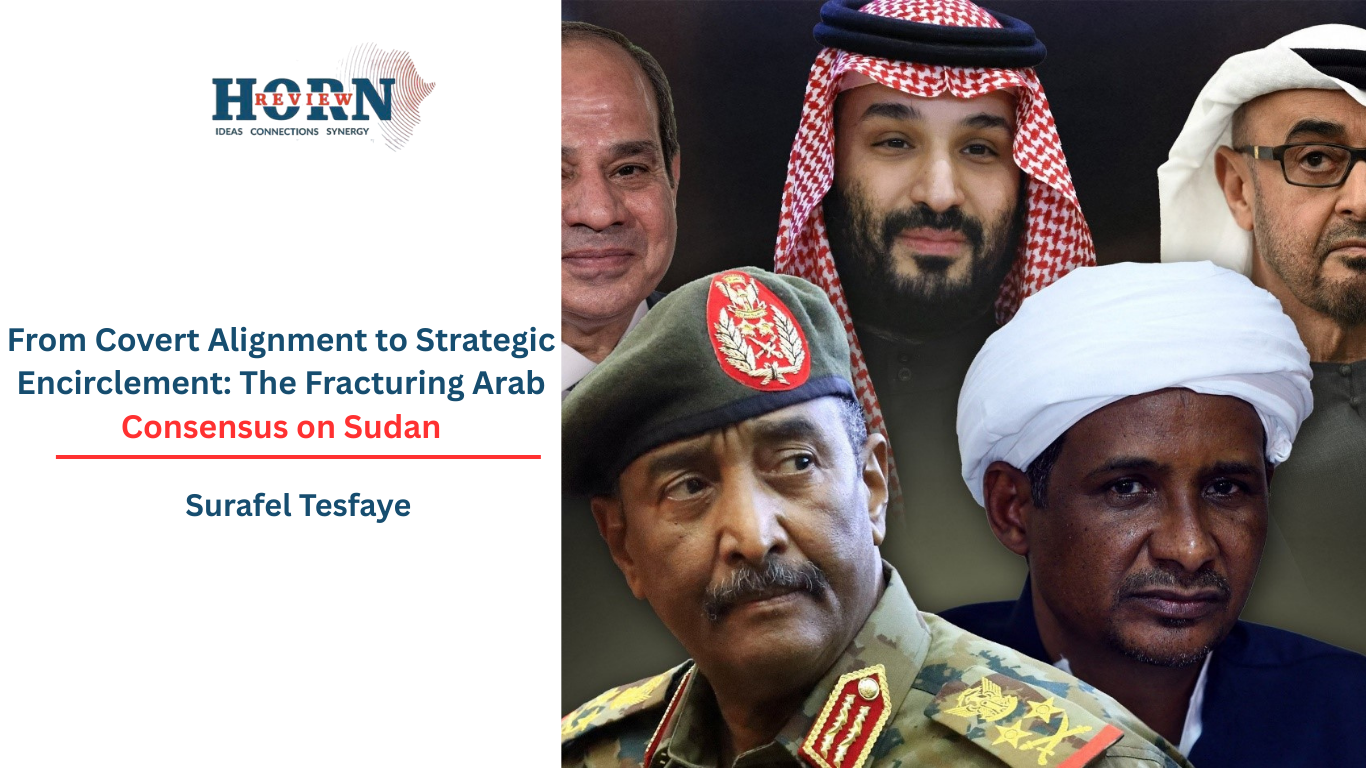
For much of the Sudan war, Egypt sought to remain a power behind the curtain shaping outcomes without appearing on the battlefield. That posture is now changing. Since mid-2025, Cairo has reportedly conducted a series of discreet but deliberate air operations targeting weapon convoys linked to the Rapid Support Forces (RSF), particularly along the southeastern Libyan corridor connecting Kufrah airbase to RSF-controlled Darfur. These strikes, reported in June, October, and November 2025 and again on January 9, 2026, mark Egypt’s transition from indirect institutional backing of the Sudanese Armed Forces (SAF) to active enforcement of what it defines as non-negotiable national security red lines.
The geography is not incidental. The tri-border zone linking Egypt, Libya, and Sudan has become the RSF’s most critical external artery a permissive space where Emirati-supplied weapons, ammunition, and mercenaries reportedly flow through Haftar-controlled territory into western Sudan. Earlier Egyptian strikes were framed as responses to convoys that strayed into Egyptian territory. The more recent operations, however, reflect a broader strategic intent: to deny southeastern Libya as a logistics rear base for the RSF and to deter both the Libyan National Army (LNA) and its Emirati patron from facilitating Sudan’s militarization through this corridor.
Officially, Cairo continues to deny direct involvement. The Egyptian Foreign Ministry has dismissed RSF accusations, reiterating its call for international verification while referring to the RSF as a militia rather than a legitimate military actor. Yet the pattern of allegations is too consistent to ignore. On January 9, 2026, Egyptian aircraft reportedly struck an RSF-bound convoy near the border triangle, allegedly destroying armored vehicles. In November 2025, the RSF accused Egypt of airstrikes near Jebel Moya in Sennar State, while RSF leader Mohamed Hamdan Dagalo previously claimed Egyptian strikes using U.S.-made munitions pushed his forces out of key positions in late 2024. Whether acknowledged or not, these reports collectively indicate a shift from plausible distance to controlled escalation.
This shift rests on a deeper institutional alignment. In December 2025, Egypt publicly signaled the activation of a joint defense agreement with the SAF, explicitly tying Sudan’s stability to Egyptian national security. This formalization followed months of practical cooperation: drone training for SAF personnel in Egypt, reported transfers of Bayraktar TB2 drones and K-8 aircraft, and the establishment of joint intelligence and operations rooms focused on border security and RSF movements. What changed in early 2026 was not Egypt’s position but its willingness to operationalize it kinetically.
The historical context is critical. When the war erupted in April 2023, RSF forces detained Egyptian troops stationed at Merowe Airportfor joint exercises. Although the soldiers were later evacuated, the incident crystallized Cairo’s perception of the RSF as an unpredictable, non-state force capable of humiliating state militaries and destabilizing borders. Since then, Egypt has steadily abandoned the role of neutral broker and repositioned itself as the SAF’s strategic guarantor.
The January 9, 2026 strike carried an additional layer of signaling. It occurred just two days before Saddam Haftar, deputy commander of the LNA, arrived in Cairo for meetings with Egypt’s defense leadership. The timing strongly suggests intent. While Egypt and Haftar remain traditional allies, their interests have diverged sharply over Sudan, particularly amid allegations that Haftar’s sons have facilitated RSF logistics through eastern Libya. The strike functioned as a message: Egyptian tolerance for ambiguity in southeastern Libya has expired. The subsequent meetings were less about reaffirming alliance than about recalibrating boundaries and forcing alignment.
At the regional level, Egypt’s actions intersect with a broader realignment. On January 5, 2026, Egypt and Saudi Arabia publicly emphasized that their positions on Sudan were “identical.” This was not diplomatic flourish. It reflected an emerging Saudi-Egyptian axis designed to counterbalance Emirati influence over the Sudan file. Saudi Arabia has reportedly begun closing its airspace to Emirati aircraft suspected of supplying RSF logistical hubs in Libya a move Egypt quietly supports and mirrors. Cairo’s airstrikes on convoys achieve on the ground what Riyadh enforces in the air: the gradual encirclement of RSF supply chains.
By January 2026, multiple reports indicated that Egypt had effectively blocked its airspace to UAE military and cargo flights linked to RSF operations in Sudan and Libya. This step goes beyond symbolic displeasure. Airspace denial is a coercive tool, signaling that Egypt is now willing to impose costs on Emirati operational freedom. This action reportedly forms part of a coordinated effort with Saudi Arabia and Somalia to disrupt UAE logistical networks across the Red Sea and Horn of Africa.
These developments expose the growing strain in Egypt–UAE relations. For years, Cairo avoided overt confrontation largely due to economic interdependence the UAE remains Egypt’s most significant financial backer. This explains why Egypt initially confined its support for the SAF to covert channels while maintaining a veneer of mediation. That restraint is now eroding. Intelligence sharing with Saudi Arabia on UAE activities in Yemen and the Red Sea, combined with airspace restrictions and kinetic interdiction, suggests that Egypt now views Emirati backing of the RSF as a direct strategic liability.
The underlying disagreement is structural. Egypt has declared the fragmentation of Sudan a red line, fearing that RSF territorial gains especially after the fall of El Fasher in late 2025 have produced an armed actor controlling Darfur, smuggling routes, and access points toward Libya and Chad. From Cairo’s perspective, this creates an uncontrollable force on its doorstep, amplifying risks of arms trafficking, irregular migration, and infiltration by Sahel-based extremist networks into Egypt’s Western Desert.
Beyond border security, Sudan’s fate intersects with Egypt’s existential concerns. A unified Sudan remains indispensable to Cairo’s position on Nile water negotiations and the GERD. The RSF’s reported links with Ethiopia intensify Egyptian fears that Sudan could drift out of its strategic orbit, undermining Egypt’s leverage on water security. Supporting the SAF, therefore, is not simply about Sudan it is about preserving a regional balance critical to Egypt’s survival calculus.
Despite this escalation, Egypt continues to practice strategic denial. Publicly, it frames itself as a mediator and denies direct combat involvement, preserving diplomatic maneuverability and avoiding an immediate rupture with the UAE. Privately, however, it is enforcing red lines through airstrikes, airspace control, and regional coordination. This duality allows Cairo to disrupt RSF logistics while postponing a full-scale diplomatic confrontation.
The relationship with the UAE now sits in a precarious equilibrium. Economic ties and broader political interests still restrain a complete break, but January 2026 marks a decisive inflection point. Direct military actions, synchronized Saudi-Egyptian pressure, and intelligence cooperation against Emirati operations indicate that the Sudan war is no longer a manageable disagreement it is a fault line.
Egypt’s silent war against the RSF is thus not an isolated campaign but part of a wider contest over statehood, influence, and regional order. As Cairo moves from restraint to enforcement, the risk is no longer escalation in Sudan alone, but the unraveling of an Arab alignment once assumed to be durable. Whether Egypt can maintain strategic ambiguity while tightening the noose around the RSF remains the central question shaping the next phase of the conflict.
By Surafel Tesfaye, Researcher, Horn Review