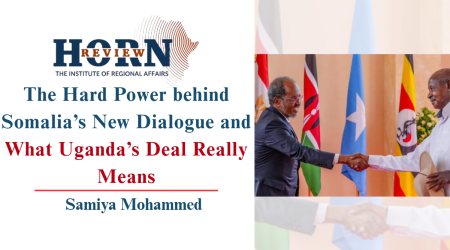
On 23 November while President Hassan Sheikh Mohamud was in Uganda engaged in talks with President Yoweri Museveni concerning the intensification of offensives against Al Shabaab, the sustainable funding of the African Union Support and Stabilisation Mission in Somalia and the phased withdrawal of Ugandan troops a decree issued from the Prime Minister’s Office in Mogadishu fundamentally altered the leadership of the country’s defence apparatus. Prime Minister Hamza Abdi Barre citing constitutional authority and purportedly acting after consultations with the president removed Defence Minister Ahmed Moallim Fiqi and installed Saadaq Omar Mohamed Hassan widely known as Saadaq Joon as his replacement alongside a minor reshuffling of two deputy ministerial posts. No official justification was proffered for Fiqi’s departure beyond the sterile bureaucratic formulation that he was vacating the office. This absence of a stated rationale is itself the most telling datum as it confirms that the reasoning behind the change was not one of performance, operational failure or a coherent recalibration of security strategy but rather the immutable logic of Somali federal politics and positions are currency and that currency is spent to keep clans quiet, placate restive allies and manage the perpetual arithmetic of the 4.5 power sharing formula.
The evidentiary trail leading to this is documented in the sequential political developments in the central state of Galmudug. The removal of Fiqi which is a Sacad sub clan member of the Habar Gidir followed the election of Liban Ahmed Hassan to the Galmudug presidency where a leader hailing from the very same Sacad sub clan . In the zero sum of clan representation, the elevation of a Sacad president in Dhusamareb rendered the continuation of a Sacad defence minister in Mogadishu politically redundant or at least inefficient as a mechanism of patronage distribution. The federal government’s allocation of key portfolios is not a technocratic exercise however it is a delicate balancing act designed to ensure that the major clan families and their sub clan cliente list networks feel adequately represented in the central government’s structure. When one node of that network which is Galmudug, it shifted its leadership to a specific sub clan, the federal then required a corresponding adjustment to maintain the equilibrium of the broader power sharing compact. Fiqi despite his pedigree as one of Hassan Sheikh’s loyalists and a reliable person against the political opposition became expendable the moment his sub clan’s representation was secured elsewhere. Loyalty in Somalia is rewarded with portfolios but it is never permitted to override the structural imperatives of clan balance.
The mechanics of the transaction point to a premeditated arrangement rather than a reactive reshuffle. Reporting indicates that the groundwork for Saadaq Joon’s appointment had been laid months earlier when former Galmudug President Ahmed Abdi Kariye which is a figure from the Saleebaan branch of the Habar Gidir withdrew from his re election bid in June 2026. That withdrawal was secured through an arrangement involving financial compensation, land allocations and assurances that his loyalists would be appointed to strategic federal positions. The Defence Ministry in this reading was the ultimate prize dangled before the Saleebaan faction in order to induce Qoor Qoor’s acquiescence to the electoral ascendancy of Liban Ahmed Hassan. Saadaq Joon as a fellow Saleebaan and a Qoor Qoor ally was the designated beneficiary of this bargain in which a fact that transforms the 23 November decree from a routine cabinet adjustment into the final execution of a clan power sharing contract. Hassan Sheikh present in Uganda but omnipresent in Mogadishu’s politicals signed off on the trade. The Prime Minister’s decree was the formal, constitutionally required instrument yet the political reporting treats the Prime Minister as little more than a functionary executing a decision that originated in Villa Somalia in order to manage the Galmudug fallout and keep the Saleebaan side content.
The timing of the announcement is an exercise in deliberate optics designed to bury inconvenient political news beneath the gravity of a foreign policy engagement. By issuing the decree on the exact day the President was in Uganda discussing the drawdown of Ugandan forces and the imminent expiration of AUSSOM’s mandate at the end of 2026, the government ensured that the narrative of clan horse trading was subordinated to the high level diplomacy of security transition. This is a familiar tactic in Somalia in which domestic political vulnerabilities are shielded by the projection of international statesmanship. Yet at the very moment the Somali National Army is expected to assume a greater operational burden from departing African Union troops in which a transition that demands stability, continuity and competence at the helm of the Defence Ministry, the President and his Prime Minister chose to treat the portfolio as a bargaining in a sub clan dispute. The signal emitted to international partners particularly those funding AUSSOM and training the SNA is that the federal government’s commitment to security sector reform remains subordinate to the imperatives of political survival and clan appeasement.
It is essential to note that this was demonstrably not a competence firing. On the very day of his removal Fiqi held a press conference in which he claimed successful operations against Al Shabaab and accused political opponents of attempting to induce desertions within the army in which a performance that showed his continued engagement with the security brief . He subsequently and gracefully welcomed his successor a gesture that reinforced the impression that the dismissal was an act of political arithmetic rather than a disciplinary measure. The incoming minister Saadaq Joon is not without relevant credentials, he is an MP and a former commander of the Banadir Regional Police Force and his appointment carries an additional, intriguing regional dimension given his marital connection to the family of Djibouti’s president. Yet these qualifications however are incidental to the selection. The primary qualification for the Defence Ministry in this instance was not a command of military logistics or counterinsurgency doctrine but the accident of sub clan affiliation and the political debts owed to a former regional president.
The implications of this episode extend the personal fortunes of Fiqi and Joon. They illuminate a structural pathology that has persistently undermined Somalia’s security transition which is the treatment of the Defence Ministry as a patronage instrument rather than an institution of national security. In a functioning civil military system, the minister of defence is a linchpin of stability providing continuous civilian oversight and strategic direction during periods of operational flux. In the Somali system the minister is a placeholder for a clan constituency, rotated according to the rhythms of federal member state elections and the perpetual renegotiation of the 4.5 formula. The consequence is a defence leadership that lacks the institutional memory, the sustained focus and the political autonomy necessary to build a professional army capable of holding territory against Al Shabaab. Every reshuffle resets the relationships between the minister and the Chief of Defence Forces between the ministry and international partners and between the political leadership and the officer corps. These resets are costly in a conventional security environment and in an environment characterized by an active insurgency, the impending departure of Ugandan forces and the uncertain future of AUSSOM funding they are potentially catastrophic.
The 4.5 formula for all its utility as a mechanism for elite accommodation is fundamentally incompatible with the demands of modern state building in the security sector. It incentivizes the fragmentation of ministerial authority along clan lines ensuring that no single actor can accumulate the institutional power necessary to challenge the center but in doing so it guarantees that the security forces remain a confederation of clan militias in uniform rather than a unified national army. The Fiqi to Joon transition is an illustration of this. The ministry was transferred to a representative of a different sub clan as part of a political settlement in Galmudug. The Somali National Army, the institution that is supposed to be the ultimate guarantor of the state’s monopoly on violence is thus placed in the hands of an official whose primary mandate is not the defeat of Al Shabaab but the maintenance of Saleebaan satisfaction within the federal coalition. This is a foundation upon which to build a national defence.
As the political crisis over electoral arrangements continues to fester and as the security transition accelerates toward the end of AUSSOM’s mandate, the precedent set by the decree is ominous. The Defence Ministry will remain a currency to be spent and a signal to be sent to restive sub clans whose loyalty is perpetually contingent. Until the incentive structure of Somali federalism is the cycle of reshuffles, accommodations and quiet payoffs will continue and the Somali National Army will remain an aspiration rather than an institution. Fiqi’s departure is the system working exactly as designed and that is precisely the problem.
By Samiya Mohammed, Researcher, Horn Review