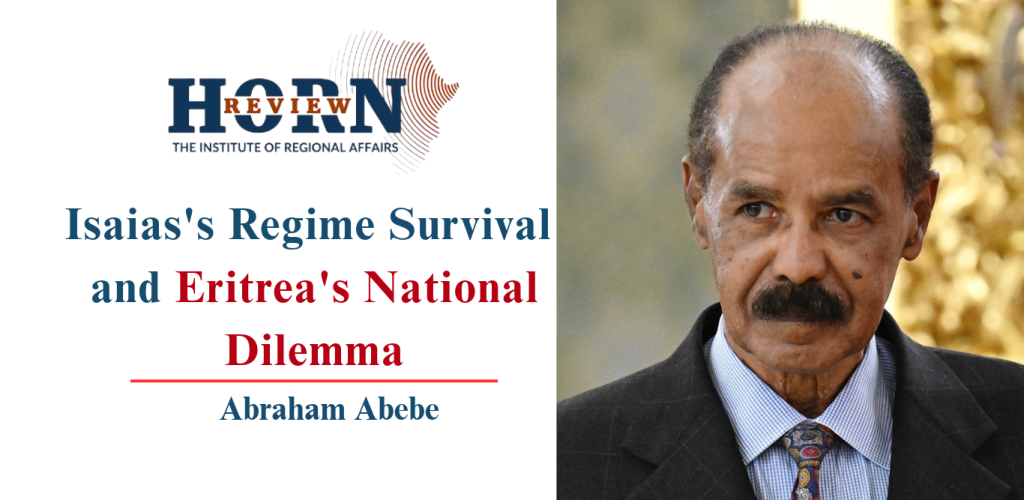
There is a fundamental contradiction at the centre of Eritrea’s current political and strategic predicament: a president who claims to defend national sovereignty is pursuing a foreign policy that threatens the country’s security and long-term interests. Isaias Afwerki’s growing hostility towards Ethiopia, his cooperation with anti-Ethiopian armed groups and his participation in an emerging anti-Ethiopian alliance with Egypt and Sudan raise serious questions about whose interests his government is serving. Isaias’s foreign policy increasingly suggests that preserving his political authority takes precedence over Eritrea’s broader national interests. Eritreans must therefore confront an essential question: how long should their country’s future remain tied to the political survival of one individual?
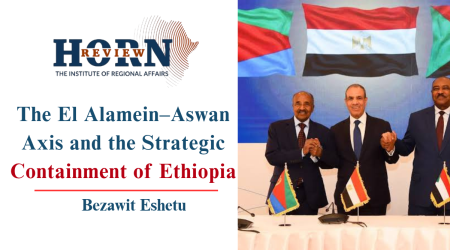
This contradiction is particularly evident in Isaias’s relationship with Egypt. Cairo’s longstanding dispute with Ethiopia over the Grand Ethiopian Renaissance Dam (GERD) has increasingly shaped its regional calculations and relations with Addis Ababa. Eritrea, however, has different national priorities. Its economic recovery, regional connectivity and security depend on constructive relations with neighbouring states, particularly Ethiopia. Nevertheless, Asmara’s growing engagement with Cairo and Khartoum, reflected in the October 2026 quadrilateral summit involving Egypt, Eritrea, Sudan and Somalia, has reinforced concerns about an emerging regional alignment whose positions increasingly conflict with Ethiopia’s strategic interests. Isaias risks making Eritrea an instrument of Egypt’s regional calculations while exposing his country to the consequences of confrontation with Ethiopia. Egypt’s disagreement with Addis Ababa over the Nile does not automatically make hostility towards Ethiopia beneficial to Eritrea.
Beyond this diplomatic alignment, reports point to Eritrea’s deeper involvement in activities directed against Ethiopia. Eritrea has provided military bases and logistical facilities for TPLF-led Tsimdo formations, alongside direct operational cooperation between Eritrean forces and these armed groups in attacks against Ethiopia. Financial resources originating from Egypt and Sudan are also reportedly being channelled through networks associated with the Eritrean government to support Tsimdo’s activities. If substantiated, these activities would represent a significant escalation in Isaias’s approach towards Ethiopia.
The regional implications of these relationships extend beyond the activities of individual armed formations. An ACLED assessment and a November 2026 British government country bulletin reported cooperation involving Eritrean-linked actors and Ethiopian opposition groups, including TPLF-associated figures. The May 2026 meeting in Port Sudan further illustrates the regional dimension of these relationships, bringing together figures linked to Eritrea, Sudanese actors and Ethiopian armed opposition groups. By allowing Eritrean territory to become a platform for activities directed against Ethiopia, Isaias is exposing his country to potential retaliation and making regional instability more difficult to contain.
The history of Eritrea’s relations with Ethiopia makes Isaias’s current approach particularly damaging to the prospects for regional peace. The 2018 rapprochement created an opportunity to replace decades of hostility with diplomatic engagement, trade and regional connectivity. The reopening of diplomatic relations and border crossings demonstrated the practical benefits of cooperation, but the initial political progress was never consolidated through durable economic and institutional ties. Relations subsequently deteriorated, particularly during and after the Tigray war, when Eritrea’s military involvement in Ethiopia’s internal conflict and disagreements over regional security further undermined mutual trust. By October 2026, the breakdown of diplomatic relations had become explicit. Reports of military deployments along the common border in November further heightened fears of direct confrontation.
The consequences of another war would be particularly severe for Eritrea given the substantial differences between the two countries in population and economic capacity. Ethiopia has a considerably larger population and a broader economic base, giving it greater capacity to absorb the pressures of a prolonged confrontation. Eritrea, by comparison, has limited economic resources, a less diversified economy and an already constrained development environment. Another military confrontation could damage critical infrastructure, disrupt economic activity, accelerate population displacement and further weaken the country’s institutional capacity. A prolonged confrontation could severely undermine Eritrea’s already fragile state institutions, territorial security and capacity to maintain political stability. Although the precise outcome of another war cannot be predicted, the possibility of state fragmentation or collapse should be taken seriously. No responsible Eritrean should treat such a risk as an acceptable price for preserving one man’s political authority. Extended economic disruption, further international isolation and the diversion of scarce resources towards military mobilisation could undermine Eritrea’s development prospects for years.
The prospect of another war should prompt Eritreans to reconsider the difference between patriotism and political loyalty. Isaias has governed through a political system in which opposition to his government can be portrayed as hostility towards Eritrea itself. This equation must be rejected. Eritrea belongs to its people, not to its president, and defending national sovereignty does not require supporting every decision made by the government in Asmara. Eritrean intellectuals, academics, former officials, opposition organisations, diaspora communities and younger generations have a responsibility to challenge policies that threaten their country’s future. Genuine patriotism means protecting the lives and development prospects of the Eritrean population. Political accountability is therefore essential to ensuring that national policy serves the country rather than the interests of its incumbent leadership.
Ethiopia’s pursuit of maritime access is another issue that Eritrean political and intellectual communities should examine through the lens of long-term regional interests. With a population exceeding 130 million and over 95 per cent of its international trade dependent on Djibouti’s ports, Ethiopia has compelling economic and strategic reasons to diversify its maritime access. The political circumstances surrounding Ethiopia’s loss of direct maritime access following Eritrea’s independence remain sensitive in Addis Ababa, particularly because no specific decision by an elected Ethiopian government or national referendum approved the country’s permanent landlocked status. Assab is particularly relevant because of its geographical proximity to Ethiopia and its historical role in serving Ethiopian trade. Long-term port-access, commercial arrangements, infrastructure investment and transport connectivity could benefit both populations. Eritrea could expand trade and access to Ethiopia’s substantial market, while Ethiopia could diversify its maritime routes.
Isaias must therefore end the activities that increase the risk of confrontation between the two countries. Eritrean forces operating inside Ethiopian territory should be withdrawn, support for armed operations against Ethiopia should cease, and Eritrean territory should no longer be used as a base for armed groups pursuing military objectives against Ethiopia. Ethiopia, for its part, should continue prioritising peaceful negotiations over maritime access and other bilateral disagreements. However, lasting reconciliation requires more than a temporary adjustment in Isaias’s policies. It requires a political transformation in Eritrea that places national interests, economic development and peaceful relations with neighbouring countries above the continued rule of one individual. Only a political direction committed to accountability and cooperation can provide a durable foundation for rebuilding relations between the two countries.
Eritrea’s future will ultimately be shaped by whether its leadership recognises that the survival of a state cannot be built on permanent hostility towards its neighbours. Isaias Afwerki’s political legacy should not be measured by how long he retains power or how firmly he confronts Ethiopia, but by the consequences his decisions leave for the country and its people. Another war would deepen Eritrea’s vulnerabilities without resolving the political and strategic problems that have brought the two countries to the brink of confrontation. The responsibility now rests with Eritrean intellectuals, opposition figures and diaspora communities to reject the use of national interests as an instrument of regime survival and demand a foreign policy grounded in peaceful relations, economic development and regional cooperation.
By Abraham Abebe, Researcher, Horn Review