In various times, states seeking to limit the power, options or rise of a neighbor or rival have repeatedly used a various set of tools. Their employed mechanisms include constraining the target’s strategic space, preserve its dependencies, deny it independent capacity in key domains and shape the regional environment so that its growth and influence remains manageable. In order to do that, that state or coalition establishes an approach centered on a particular domain—such as a sea, a river basin, or a security architecture—asserting that these spaces belong exclusively to a defined category of states (littoral states, downstream states, or historical custodians). This approach is then used to render that country’s initiatives unlawful, strip them of legitimacy, and portray them as violations of the regional order.
Egypt’s engagement with the Horn of Africa increasingly reflects this pattern, as it seeks to shape the political and security conditions surrounding the region. Particularly following the deterioration of relations between Ethiopia and Eritrea and Ethiopia’s renewed pursuit of maritime access, Egypt began to more actively advance the notion of littoral exclusivity, which gradually evolved and intersected with other regional domains. Classic containment aimed to restrict the expansion of a rival power. Littoral exclusivity does something similar by using control of the coastal interface and chokepoints to hem in a neighboring continental or landlocked power’s reach, trade options, and naval aspirations.
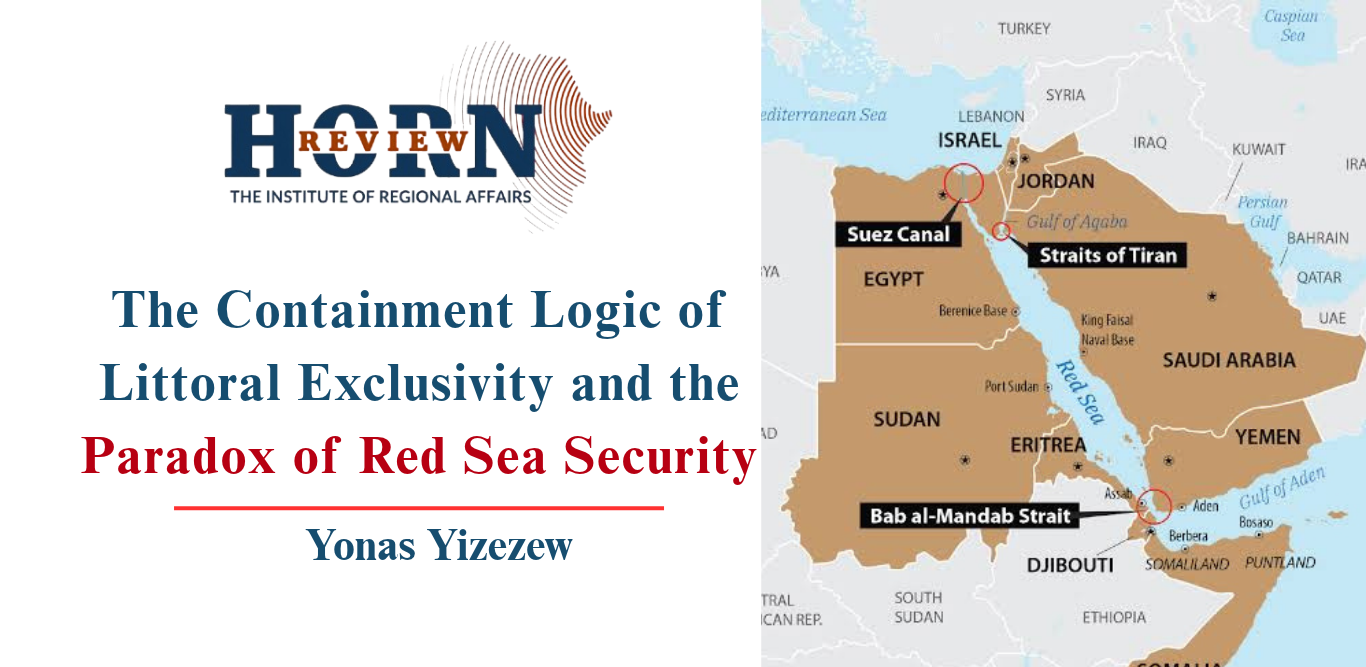
In this sense, littoral exclusivity means asserting that only states with a coastline on a Red Sea may have a say in its security, access arrangements and political frameworks. When applied selectively against a proximate, dependent, non-littoral power and when merged with other mechanisms of influence building surrounding the country, it becomes containment. The objective of this move is to restrict Ethiopia’s strategic options, economic security, alliance choices and ability to project influence, while aiming to preserve the dominant littoral state’s regional primacy.
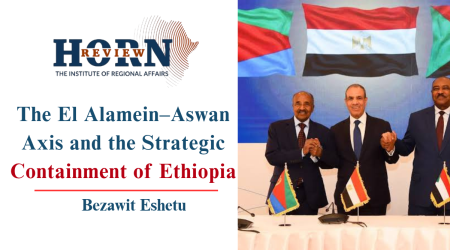
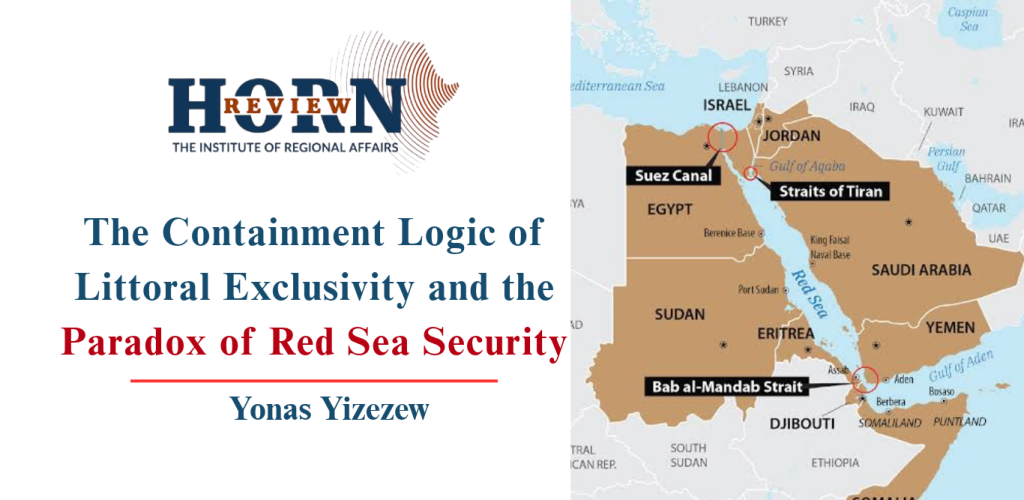
Instead of confronting Ethiopia only bilaterally, Egypt has worked to rally support and expand its orbit of influence by doubling down on military, diplomatic, and economic ties with the states that surround it. Defense protocols, troop deployments, port access arrangements, and political alignment create an arc of influence. Egypt’s forward positioning in Somalia and Sudan illustrates its efforts to limit Ethiopia’s freedom of action on multiple flanks. Any efforts by Ethiopia to secure port access—including the 2024 memorandum of understanding with Somaliland that envisioned port facilities and possible naval presence—and a greater voice in Red Sea affairs are met with joint statements rejecting non-littoral involvement. At summits such as the New Alamein meeting of Egypt, Eritrea, Sudan and Somalia, and in bilateral statements with Eritrea, Egyptian officials have insisted that Red Sea security belongs solely to coastal states. Within this picture, Somalia tends to occupy a distinct position, as it is the only member who still maintain a functional (if strained) diplomatic relation with Ethiopia. On various occasions, its president has expressed its support for Ethiopia’s sea access and in fact, indicated that it is open to facilitating it. Yet its actions suggest otherwise, given its political and strategic alignment with Egypt’s regional strategy.
Another tool Egypt employs is issue linkage, whereby pressure in one domain is deliberately connected to another, making concessions or restraint in one area conditional on relief in the other. For instance, linking the Grand Ethiopian Renaissance Dam (GERD) dispute with Ethiopia’s pursuit of maritime access, while bringing additional factors into the equation, aims to multiply the points of leverage against Ethiopia. The exclusivity doctrine sits alongside Egypt’s long-standing opposition to the GERD.
Earlier this year, Egypt was reportedly prepared to support Ethiopia’s commercial access to the Red Sea if Addis Ababa showed flexibility on the Nile dispute. Although Cairo later denied the report, the report may suggest an attempt to test the waters by assessing Ethiopia’s willingness to link its maritime ambitions with concessions over the GERD. It also points to Egypt’s interest in exploring additional bargaining leverage by bringing the two issues into the same diplomatic equation.
Egypt has also doubled down on establishing ties with Ethiopia’s immediate neighbors as another mechanism to keep Ethiopia off guard. Egypt initially pursued this approach with Nile riparian states to secure their support for its position on the Nile dispute. However, its efforts appear not to have been productive, given its failure to stop the GERD, the ratification of the CFA, and the apparent alignment of most riparian states with Ethiopia’s position. Afterwards, as the two issues became increasingly interconnected, Egypt began to strengthen its relations with Ethiopia’s immediate neighbors and capitalize on any friction between Ethiopia and its neighbors. Besides, this would collectively help reduce Ethiopia’s strategic depth and options. Various factors have contributed to the sharpening of Egypt’s regional activities, including the Sudanese civil war and Ethiopia’s MoU with Somaliland. Such an encirclement strategy could help Egypt constrain Ethiopia’s regional influence, monitor its affairs and relations with neighboring countries closely, and its strategic options along a vital shared waterway.
This exclusivity appears to be weaponized in the service of regional rivalries, in contrast to the practical realities of the Red Sea. Various extra-regional powers maintain naval task forces, military bases, or regular patrols in the region to protect the security of the Red Sea and Bab el-Mandeb. Meanwhile, on the other side of the waterway, the military confrontation involving the Houthis and Saudi Arabia has contributed to the region’s insecurity.
This insecurity itself undercuts rigid exclusivity, particularly in light of Saudi Arabia’s recent pragmatic initiatives. Recognizing the need for more inclusive arrangements, Riyadh invited a diverse coalition of Arab, African, and Asian states, including non-littoral countries, to discuss maritime security. A strict “only littorals decide” principle overlooks the reality that the Red Sea functions as a lifeline extending well beyond the coastal states and that rigid exclusivity is incompatible with the region’s actual interdependence.
Absolute claims that only coastal states decide have frequently been limited or overridden when the vital interests of non-littoral or highly dependent states, freedom of navigation, or regional interdependence are at stake. The international response to piracy off the Somali coast is particularly relevant to the Red Sea and Gulf of Aden. Following the escalation of piracy in 2008, the United Nations Security Council adopted Resolution 1816. The resolution authorized states cooperating with Somalia’s Transitional Federal Government to enter Somali territorial waters and use necessary means to repress piracy, subject to the resolution’s conditions. The decision reflected the recognition that piracy off Somalia was not simply a coastal security problem. It threatened international shipping, humanitarian deliveries, and commercial maritime routes. The international response subsequently involved naval deployments by the European Union, NATO, China, India, and other states. The recent resurgence of piracy in the region reinforces the point that maritime security in the Red Sea and Gulf of Aden cannot be treated as the exclusive concern of littoral states, given its direct implications for international shipping and the security interests of states dependent on these waterways. All these indicate that when the interests of regional countries are deeply implicated—especially as the security of the region continues to deteriorate—their participation in addressing these challenges becomes essential.
Ethiopia has contributed to counterterrorism efforts in Somalia for decades. Its role in peace support operations and the fight against al-Shabaab has made it an important actor in regional security. Ethiopia’s security environment is closely intertwined with developments in the Red Sea, particularly given the threats posed by al-Shabaab, domestic insurgent groups, and maritime insecurity. Meanwhile, the reported links between the Houthis and al-Shabaab across the Gulf of Aden add another layer of concern, potentially creating new security risks for Ethiopia and the wider Horn of Africa.
Absolute claims of littoral exclusivity have historically proven difficult to sustain when the vital interests of non-littoral states, freedom of navigation, or regional interdependence are at stake, as the international response to piracy and the sustained presence of extra-regional naval forces have already shown. In the current Red Sea setting, the rigid application of this doctrine risks deepening regional polarization, narrowing diplomatic space, and raising the costs of any future arrangement. Moreover, Egypt’s reported willingness to consider supporting Ethiopia’s commercial sea access in exchange for flexibility on the GERD reveals the instrumental nature of the exclusivity rhetoric and risks leaving the neighbors who echoed Cairo’s position looking as if they were used to advance a bargaining strategy that was never absolute.
By Yonas Yizezew, Researcher, Horn Review