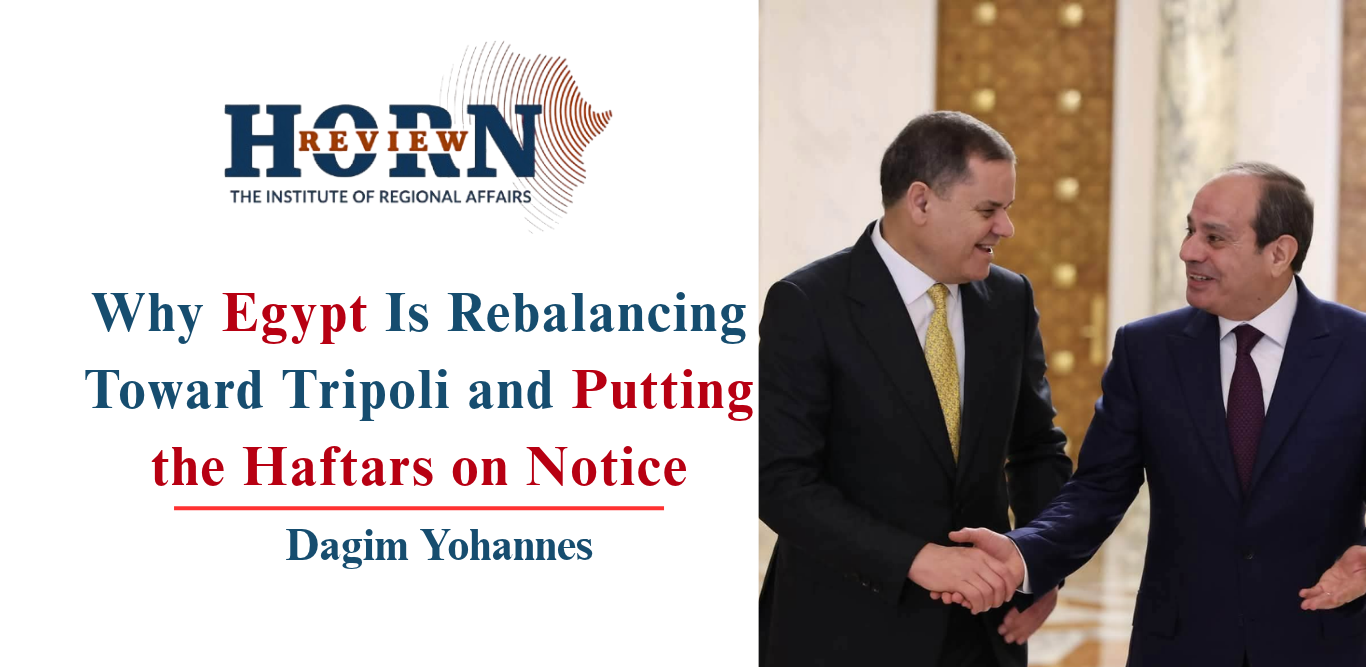
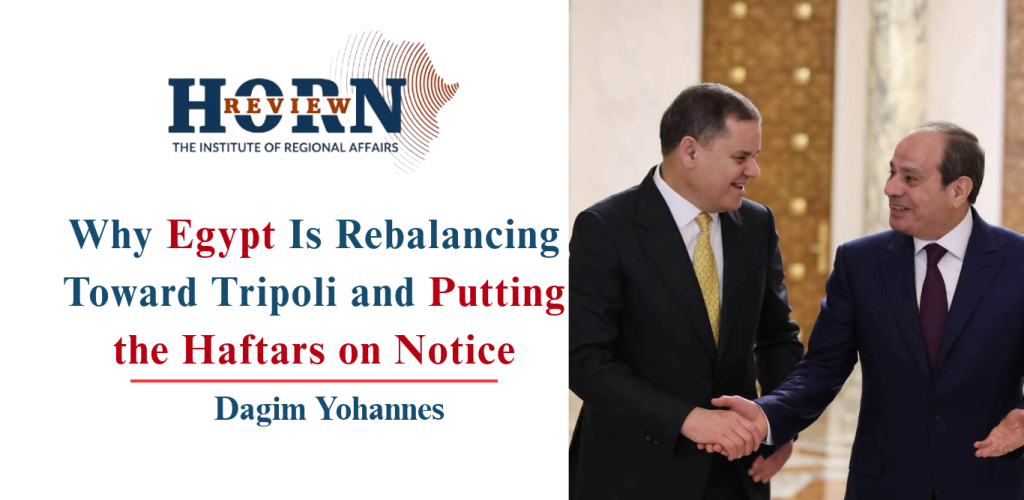
On November 18, Egyptian Prime Minister Mostafa Madbouly formally welcomed Libyan Government of National Unity (GNU) Prime Minister Abdulhamid Dbeibah to Cairo, a visit that culminated the following day in talks with President Abdel Fattah el-Sisi and the signing of nine bilateral agreements. Less than twenty-four hours before Dbeibah’s arrival, however, a note verbale from Egypt’s Permanent Mission was circulated at the United Nations repudiating the 2019 Turkey–Libya maritime delimitation agreement and Libya’s claimed outer continental shelf limits as legally “null and void”.
That simultaneous display of legal hardball at the UN and high-level diplomatic hospitality in Cairo captures the decisive evolution of Egyptian statecraft in recent times. For over a decade, Cairo approached Libya through a rigid, binary framework: unconditional backing for Field Marshal Khalifa Haftar’s eastern-based Libyan National Army (LNA) and institutional distance from western Libya. Today, Egypt is moving away from that all-in bet, not out of sudden political affinity for Tripoli, but because a purely eastern strategy left Cairo geopolitically outflanked, legally exposed in the Eastern Mediterranean, and locked out of the internationally recognized institutions that underwrite sovereign contracts..
The Benghazi Shock and the Collapse of Asymmetric Proxy Politics
The immediate catalyst for Cairo’s recalibration was an October vote in Benghazi that shattered a core assumption of Egyptian national security planning. Libya’s eastern House of Representatives (HoR), long aligned with Haftar, voted to ratify the controversial 2019 Turkey–Libya maritime memorandum, formally repealing its own 2020 resolutions that had condemned the pact and called for severing ties with Ankara.
For years, Egypt’s Eastern Mediterranean energy and legal architecture, built alongside Greece and Cyprus under the 1982 UN Convention on the Law of the Sea (UNCLOS), rested on the premise that eastern Libya would act as a reliable bulwark against Turkish maritime expansion. Watching the eastern legislature endorse Ankara’s maritime map just as Haftar’s sons, Saddam and Khaled, deepened military and political outreach to Turkey exposed a stark asymmetry: Turkey was successfully playing both sides of the Libyan divide, while Egypt had confined itself to one. Indeed, Turkish Foreign Minister Hakan Fidan, speaking on Sunday after talks with Dbeibah in Istanbul alongside intelligence chief Ibrahim Kalin highlighted Ankara’s role in backing the GNU, pointed to President Recep Tayyip Erdoğan’s expected visit to Libya for the December 8–9 Turkey–Africa Summit, and stated that Turkey has elevated relations with eastern Libya to a level nearly on par with the west.
Cairo’s response has been a strategic decoupling. Even as Egyptian diplomats reiterated at the UN that Cairo would never recognize the Turkish–Libyan memorandum, Foreign Minister Badr Abdelatty used his November 7 meeting with Dbeibah in Tripoli to address Egypt’s objections directly and establish that Egyptian concerns must be factored into any future maritime delimitation. That meeting also marked the formal reopening of Egypt’s historic embassy headquarters in Tripoli after twelve years, an upgrade that built upon the mission’s initial resumption of diplomatic operations in May 2021 and followed intensive shuttling by General Intelligence chief Hassan Rashad. Rather than relying on eastern proxies who had begun cutting independent deals with Turkey, Cairo elevated its direct institutional channel to the internationally recognized authority in western Libya.
Following the Institutional Balance Sheet
Beyond the Mediterranean chessboard lies a pressing economic imperative. Navigating tight domestic fiscal constraints, Cairo can no longer afford to treat western Libya, home to the majority of the country’s population, the Central Bank of Libya’s formal headquarters, and the National Oil Corporation, as off-limits territory.
Building on Abdelatty’s November 7 talks in Tripoli, Thursday’s summit in Cairo attended by Prime Minister Madbouly and General Intelligence chief Hassan Rashad yielded nine agreements and memoranda of understanding centered on concrete commercial integration: refining Libyan crude in Egyptian facilities, linking cross-border natural gas pipelines, and expanding cooperation across fisheries, labor, small enterprises, and institutional training. Sisi also ordered direct coordination between the two countries’ interior ministries to ease entry and residency procedures for Libyans, extending Cairo’s engagement into formal administrative and border-security channels. Yet notably, neither side disclosed financial values or implementation timelines for the deals, an implicit acknowledgment that even amid fierce east–west contests over Libyan oil revenues and central bank governance, scaling major infrastructure requires formal institutional sign-off from Tripoli and broader political stability.
Recalibrating, Not Severing, the Haftar Relationship
In Benghazi, Cairo’s red-carpet reception for Dbeibah has been read as a warning shot, further underscored by regional media reports that Egypt quietly withdrew military advisers attached to Saddam Haftar in eastern Libya amid mounting strategic friction. On Sunday, however, Egyptian Minister of State for Information Diaa Rashwan officially denied those reports as baseless, insisting there are no disagreements with the LNA General Command and that military communication and coordination continue normally. Yet even taking Cairo’s public denial at face value, characterizing the broader shift as a wholesale Egyptian abandonment of the LNA misreads Cairo’s risk calculus. General Intelligence chief Hassan Rashad still hosted Saddam Haftar in Cairo on November 13, just days before Dbeibah’s arrival, and Egypt continues to rely on the LNA to police its porous 1,100-kilometer western desert border and manage spillovers from the war in Sudan.
What has changed is the structure of leverage. As Khalifa Haftar ages, decision-making in eastern Libya has increasingly consolidated around a younger generation of commanders pursuing a distinctly transactional foreign policy, simultaneously courting Ankara, Moscow, and Western capitals. By maintaining intelligence-level engagement with eastern commanders while extending high-level governmental engagement to Dbeibah’s administration, Egypt is signaling to Benghazi that its strategic partnerships are no longer exclusive and that Cairo possesses viable institutional alternatives if eastern actors drift too far into Ankara’s orbit.
From Proxy Warfare to Managed Equilibrium
For Libya’s political trajectory, Egypt’s pivot is a double-edged sword. Lower friction between Cairo and Ankara, paired with Abdelatty’s coordinated engagement with UN Special Representative Hanna Tetteh, substantially reduces the danger of a return to full-scale proxy conflict. At the same time, Cairo’s dual-track architecture is less a blueprint for rapid national unification than a sophisticated mechanism for containment.
Egypt has effectively made peace with Libya’s partitioned reality. Rather than expending capital to install a single victor from the east, Cairo is institutionalizing relationships with both power centers to secure three non-negotiable outcomes: a sealed western border, a share of Libya’s energy and reconstruction capital, and the ability to challenge any maritime arrangement that compromises Egypt’s maritime interests in the Eastern Mediterranean. Yet this balancing strategy carries a fundamental structural limitation: eastern and western authorities are not necessarily pursuing compatible interests. This contradiction was laid bare by the eastern parliament’s approval of the Turkish maritime pact, demonstrating that Cairo cannot guarantee either partner will consistently respect its strategic priorities. If Egypt leans too heavily on Tripoli to discipline Benghazi, it risks pushing Saddam Haftar toward deeper alignment with Ankara or encouraging eastern commanders to revive and expand their logistical backing for Sudan’s Rapid Support Forces directly undermining Egypt’s support for the Sudanese Armed Forces along its volatile southern flank. In the unsentimental calculus of regional realpolitik, Cairo has stopped fighting the last war in Libya, betting it can manage a two-front balancing act without losing its footing on either side.
By Dagim Yohannes, Researcher, Horn Review