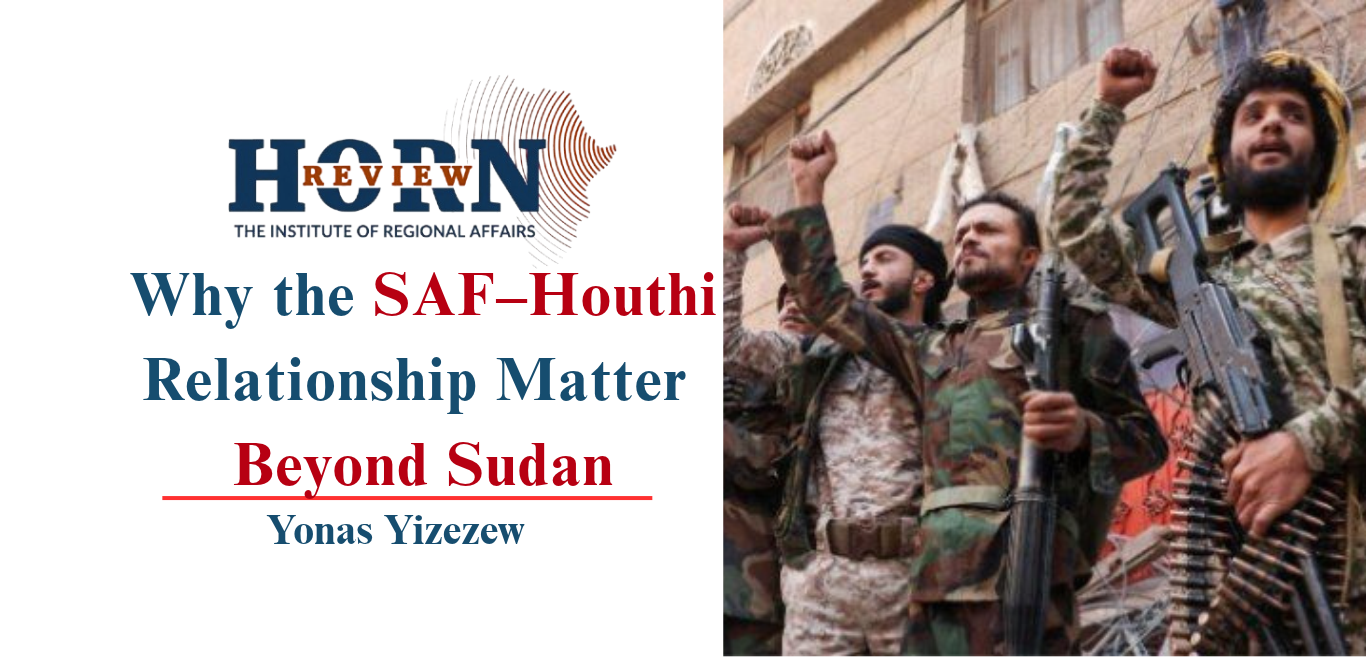
The Century Foundation has published a detailed report examining the Houthis’ expanding presence and influence across the Horn of Africa and the wider African continent. The report traces the group’s growing regional reach, examining its links with al-Shabaab in Somalia, its connections to Eritrea, and its expanding networks across the Red Sea and parts of the Sahel. It also explores the group’s relationship with Iran and the emerging security implications of these connections for the Horn of Africa and the wider region. Of particular concern is the group’s relationship with the Sudanese Armed Forces (SAF). In the context of Sudan’s ongoing civil war, this connection could provide a channel through which networks operating across the Sahel, the Horn of Africa and the Red Sea become increasingly interconnected.
In that sense in the Horn of Africa, the distinction between a spoke and a hub is particularly visible. The Houthis have evolved beyond their role as a conduit for Iranian influence in the Red Sea. They now serve as regional intermediaries, facilitating weapons transfers, technical cooperation, and logistical links across the maritime corridor. Their engagement with the SAF provides one of the most consequential entry points into this emerging network. This relationship connects the movement to a battling military actor, a strategically located coastline, and an established military-industrial infrastructure.
Sudan became attractive to Iran and the Houthis largely because of the war that erupted between the SAF and the Rapid Support Forces (RSF) in April 2023. The conflict exposed the SAF’s weaknesses in aerial warfare, surveillance and weapons procurement. For Tehran, the war offered an opportunity to restore influence in a country with which it had maintained close military relations before Sudan severed diplomatic ties in 2016. Renewed Iranian engagement included the supply of Mohajer-6 drones, ammunition and radar systems, alongside reported technical assistance. These capabilities helped strengthen the SAF’s battlefield position during its campaigns to recover territory in 2024 and early 2025. For the Houthis, Sudan offers a different opportunity. Its Red Sea coastline provided geographical access to the African side of the maritime corridor, while its wartime procurement requirements created opportunities to establish relationships with military and political intermediaries.
The SAF-Houthi relationship can be a transactional partnership operating within a broader Iranian framework. Tehran remains the senior partner, supplying the principal military resources and technological expertise. The Houthis function as regional intermediaries, potentially facilitating weapons transfers and logistical arrangements through networks that connect Yemen with Sudan. The Century Foundation reports that the Houthis transferred at least three shipments of small arms and light weapons to the SAF on Iran’s behalf from mid-2024.
The coastal region of Port Sudan is central to this relationship. For a considerable time during the war, the city has served as the SAF’s administrative and political seat, and its location opposite Yemen makes it especially valuable for transporting equipment and personnel across the Red Sea. Reports indicate that the existence of possible Houthi-linked logistical activity at the port. The Houthis’ recent advance to the Bab el-Mandeb Strait could further strengthen this relationship, given the proximity of the Sudanese and Yemeni coastlines.
What gives this development particular weight is the Sudanese military’s Islamist composition. The army encompasses former regime networks, Islamist constituencies, intelligence figures, and military commanders whose interests extend beyond the immediate conduct of the war. Since the fall of al-Bashir, the Sudanese Islamic Movement has retained influence within sections of the military and security establishment. The movement’s historical relationship with Tehran offers a political foundation for renewed cooperation with Iran.
The report further identifies figures associated with the military-industrial establishment, including Defense Industries System chief Mirghani Idris Suleiman. He holds important positions in procurement and defense production, and he is also on under the EU and U.S. sanction list. Islamist volunteer formations such as the al-Baraa ibn Malik Brigade have also reinforced the influence of networks sympathetic to closer relations with Iran.
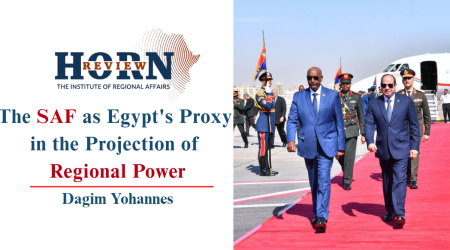
Houthi and Iranian support for the SAF’s Islamist faction is increasingly generating friction both within the military leadership and between the SAF and its international backers. The military leadership must also maintain relations with Egypt, Saudi Arabia, and other governments wary of Iran’s regional ambitions. Yet the growing influence of pro-Iranian constituencies creates a contradiction between the SAF’s external diplomatic posture and the networks operating within its own political and military environment. General Abdel Fattah al-Burhan may seek international recognition as Sudan’s legitimate national authority, but that claim is increasingly difficult to separate from the political and military interests of the factions on which his wartime coalition depends.
Basically, Saudi Arabia is another significant supporter for the SAF. Despite being engaged in a prolonged confrontation with the Houthis across the Red Sea, it continued its support to the SAF. This creates a strategic dilemma and division for the Sudanese military, which maintains connections with the Houthis while depending on Saudi support. A recent report indicates that, amid its confrontation with the Houthis, Riyadh sought Sudanese troops from Burhan for deployment. The request reportedly generated considerable internal resistance within the SAF, with some accounts suggesting that Burhan declined to commit troops. If confirmed, this episode would expose the depth of the contradictions in the SAF’s external relationships, caught between its connections with Iran-aligned networks and its reliance on Saudi support.
These concerns are also reflected in Washington’s assessment of the SAF. Washington has identified the Sudanese Muslim Brotherhood’s role in recruiting more than 20,000 fighters for the SAF. Many of these fighters reportedly received training from Iran’s Islamic Revolutionary Guard Corps (IRGC). The United States subsequently designated the group a Foreign Terrorist Organization in March 2026. These Islamist networks have also complicated the SAF’s position on the Houthis. Some army-aligned militias reportedly sympathize with the movement and maintain smuggling links with Houthi-controlled Yemen. This has the potential to make participation in a Saudi-led confrontation with the Houthis particularly contentious, as witnessed recently. However, Washington’s concerns extend beyond these militia networks. Massad Boulos, President Trump’s senior adviser for Arab and African affairs, has specifically identified the SAF’s connections with radical Islamists and its importation of Iranian weapons as major sources of concern for the administration.
Regarding SAF’s broader wartime strategy also, it appears to be increasingly self-defeating. In its immediate neighborhood, it is pursuing an increasingly confrontational posture towards Ethiopia while following symmetry with Egypt’s own regional calculations. This approach risks further complicating Sudan’s relations with its neighbors, deepening its external dependencies and drawing the country into regional rivalries that could undermine its own strategic interests.
The SAF’s relationship with the Houthis also needs to be considered alongside the latter’s reported engagement with al-Shabaab in Somalia. Despite their ideological differences, the two movements have found practical incentives to cooperate. Al-Shabaab faces increasing pressure from aerial surveillance and drone operations, while the Houthis possess experience in drone warfare, weapons modification and asymmetric military operations. With that, it is necessary to bear in mind the connection al-Shabab has created with terrorist groups operating in the Sahel. The terrorism arc, stretching from the Sahel to the Horn of Africa, would find a capable actor with technologies that can challenge even heavily funded and technologically advanced defense systems, such as Saudi Arabia’s.
What would complete this emerging Red Sea corridor is Eritrea. Even as it has grown closer to Saudi Arabia in recent years, Asmara has publicly declared its opposition to military action against the Houthis. More importantly, there is a strategically significant renewal of Houthi and Iranian logistical activity along the Eritrean coast. The ties dated to the late 2000s when the IRGC used Eritrean facilities for Houthi training. Afterwards, they were suspended after Eritrea aligned with the Saudi-led coalition. Those channels appear to be reopening as a result of changing regional alignment. These include Eritrea’s improving relations with Iran, its support for the SAF in Sudan’s civil war, and rising tensions with Ethiopia. This would create an intermittent but resilient logistics and transit network running from northeastern Somalia through Djibouti and Eritrea to Port Sudan. This would effectively give the Houthis and their Iranian backers a continuous presence along the African shore of the Red Sea and Gulf of Aden.
Eritrea’s role therefore extends beyond diplomatic positioning. It potentially supplies the missing northern link that hardens the Houthis’ transformation from a Yemen-centric spoke into a regional hub capable of facilitating weapons transfers, personnel movement, and technical cooperation across multiple conflict theaters. In an already disordered neighborhood, this coastal continuum risks knitting Sudan’s civil war, Somalia’s insurgency, and Red Sea shipping insecurity into a more coherent and harder-to-disrupt ecosystem.
By Yonas Yizezew, Researcher, Horn Review