The current Ethiopian state establishment is engaged in a comprehensive reassessment of the historical and political questions foundational to the pivotal transitional era of 1991-1995. Central to this broader inquiry, and lying at the heart of the national dialogue process and the mandate of the National Dialogue Commission, is a fundamental question of statecraft: Why did Ethiopia’s ruling elites at the time fail to insist on a negotiated settlement that would guarantee the country secure, enduring access to the sea while providing Eritrea with corresponding economic, political, and security benefits?
Understanding how a state with centuries of Red Sea projection yielded its maritime access transforming overnight into the world’s most populous landlocked nation requires confronting the decisions, arrangements, and political settlements of 1991–1995. Crucially, a mature recognition of Eritrean self-determination and independence does not require the uncritical acceptance of every political decision made during that process. Any rigorous political analysis must dissect why an unelected transitional leadership accepted an inherently fragile settlement: one that decoupled national self-determination from permanent maritime rights, transferring complete geopolitical leverage to a newly emerging neighbor and trading long-term strategic security for short-term political consolidation.
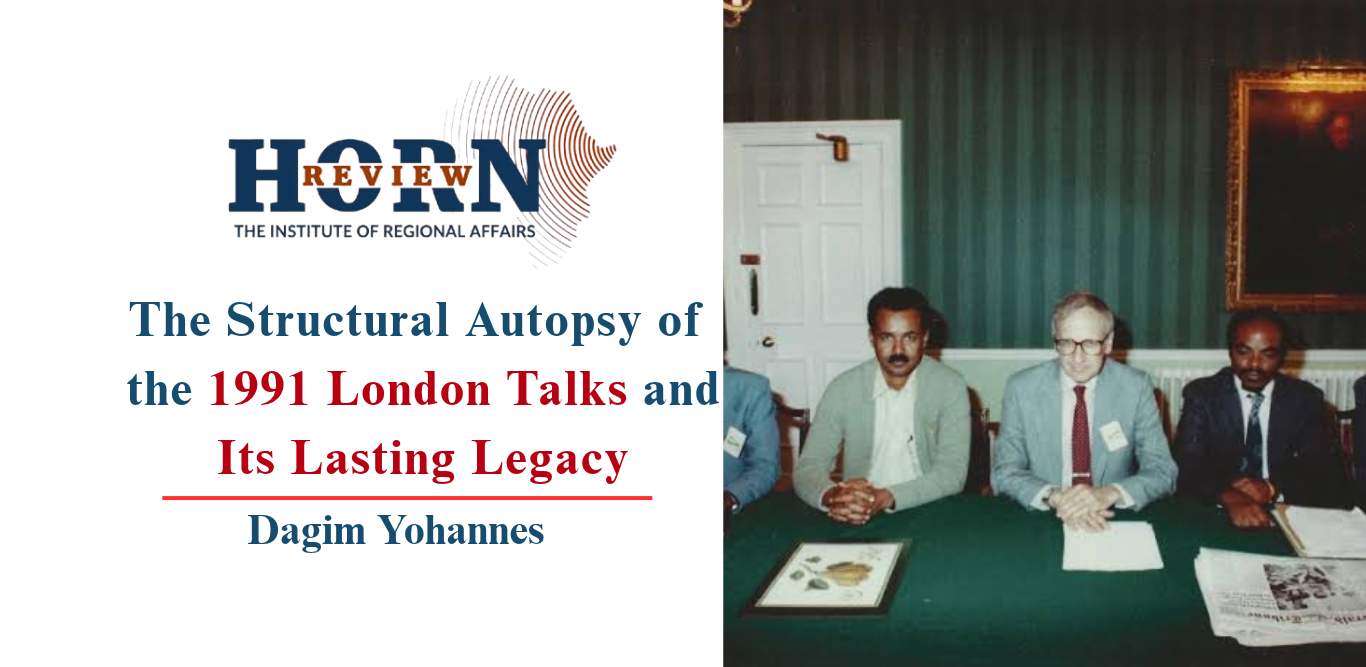
The conference convened on May 27–28, 1991, in London, mediated by Assistant Secretary of State for African Affairs Herman J. Cohen. While bilateral consultations occurred at the Berkeley Hotel and formal sessions at the British Foreign Office, the event was fundamentally constrained by prior military outcomes on the ground. By the time delegations convened, military realities had rendered traditional diplomatic bargaining obsolete. Mengistu Haile Mariam had fled on May 21, leaving the residual Derg delegation under Acting Prime Minister Tesfaye Dinka with zero military leverage. The Eritrean People’s Liberation Front (EPLF), under Isaias Afwerki, held complete physical control over Eritrea, including the vital ports of Massawa and Assab. The Ethiopian People’s Revolutionary Democratic Front (EPRDF), commanded by Meles Zenawi, surrounded Addis Ababa.
The London meeting functioned not as a classic peace conference among equals, but as a mechanism of hegemonic stabilization. Primary accounts, including Cohen’s memoirs, expose the mechanics of this shift. Separate bilateral sessions established the baseline parameters on May 26. With Isaias, negotiations centered on the structure of an interim Eritrean administration and the procedural requirements for an internationally supervised referendum. With Meles, discussions focused on preventing a breakdown of order in the capital; Cohen indicated that the United States would not oppose an EPRDF entry into Addis Ababa to restore stability.
When public order deteriorated on the night of May 27–28, Cohen publicly endorsed the EPRDF’s entry into Addis Ababa. The Tesfaye Dinka delegation protested this action as a breach of neutrality and boycotted the remainder of the conference. From that point forward, international mediation effectively shifted into an advisory function for the victorious insurgent coalition. The final joint statement deferred the strategic issue of sea access to future bilateral talks between provisional authorities, leaving Ethiopia’s long-term maritime security unanchored in any durable legal framework.
The failure to negotiate a mutually beneficial, ironclad arrangement was not a mere administrative oversight; it was the direct output of the ideological frameworks and power alignments of the winning movements. For the EPLF, sovereignty over Massawa and Assab was non-negotiable. While willing to grant functional commercial concessions, the front rejected any framework implying shared sovereignty, long-term territorial leases, or joint administrative corridors. The Tigray People’s Liberation Front (TPLF), the core of the EPRDF coalition, approached the question through its foundational ideological doctrine of national self-determination “up to and including secession.” Having operated as a junior partner to the EPLF during key phases of the civil war, the TPLF prioritized fulfilling its ideological commitments and political debt to Asmara over preserving the historical maritime attributes of the central Ethiopian state. No major force within the transitional coalition advocated for long-term instruments such as an autonomous customs regime, reciprocal transit servitudes, or sovereign corridors.
Herman Cohen’s documented account clarifies the role of external powers: the United States did not force Ethiopia to abandon Assab. The decision to accept a deferred, goodwill-based agreement rather than insisting on legally protected, reciprocal rights was an explicit choice made by an unelected transitional leadership gripped by ethno-nationalist ideological imperatives.
The July 1–5 National Conference in Addis Ababa institutionalized the parameters set in London, converting informal understandings into operational policy as the EPRDF-EPLF alliance traded full backing of the 1993 referendum for promised “free-port access” to Assab. This occurred despite explicit warnings from dissenting figures: Professor Asrat Woldeyes challenged the sacrifice of Red Sea sovereignty, while Afar leaders, including representatives of Sultan Ali Mirah Hanfare, warned against severing the Afar coastal territory and the Assab corridor from Ethiopia. Sidelining these objections, the dominant axis built state rights solely on an inter-party guerrilla pact rather than UN-registered treaties, lacking the permanent transit servitudes, sovereign corridors, or binding arbitration standard in state partitions.
When states separate or partition, historical practice has often required the creation of permanent transit rights, sovereign port corridors, or long-term leaseholds embedded in binding treaties under international law. The structural arrangement of 1991–1993 contained a fatal flaw: strategic state rights were built solely on an inter-party agreement between two allied guerrilla movements, rather than an institutionalized treaty registered with the United Nations. No provisions were established for sovereign transit corridors, third-party international arbitration, or binding legal guarantees that would survive changes in political leadership or alliance.
Agreements that rest only on informal goodwill and personal relationships between leaders collapse when the underlying distribution of power shifts. The 1993 Transit and Port Services Agreement operated entirely on personalistic, intra-coalitional governance between the TPLF and EPLF leadership. When political and economic alignments fractured, culminating in the 1998–2000 Eritrean-Ethiopian War, the commercial arrangements collapsed overnight. Ethiopia lost physical and legal access to Assab, precipitating its permanent status as a landlocked state, a geographic vulnerability magnified by modern Red Sea choke points and global trade dynamics.
The 1991 settlement illustrates a recurring trap in statecraft: regimes and insurgent alliances are transient, but geographic imperatives remain permanent. The failure to embed enforceable maritime rights into the terms of separation substituted a temporary political understanding for a durable legal framework.
As the current Ethiopian state establishment attempts to navigate severe regional bottlenecks, macroeconomic integration, and external economic leverage, the 1991 transitional settlement stands out as the fundamental point of origin for its strategic constraints. That decision directly produced Ethiopia’s modern economic dependencies. More than 90 percent of the country’s foreign trade now moves through Djibouti, generating annual port and transit-related costs that exceed $1.5 billion. These outflows create persistent foreign-currency pressure, inflate logistics costs across the economy, and leave Ethiopia exposed to any disruption along a single corridor or shift in the political calculations of its coastal neighbor.
The contemporary diplomatic maneuvers of Addis Ababa across the Horn seeking diversified port access, commercial arrangements, and strategic partnerships should therefore not be read as sudden expansionism. They are the predictable structural reaction of a landlocked state attempting to escape the geographic trap engineered in 1991. However, because historical reassessments, legal audits, and national dialogue processes are now actively underway, the focus of Ethiopian statecraft must urgently shift from diagnosing the 1991 flaw to decisively resolving its legacy. Leaving this geographic bottleneck unaddressed guarantees that future economic gains will remain hostage to external geopolitical friction.
Solving this core structural problem demands that Ethiopia convert its historical reassessment into binding international instruments, codify sea access as a non-negotiable security doctrine, and secure multi-corridor geopolitical redundancy. The state must translate internal consensus into enforceable international agreements moving past temporary commercial contracts or informal understandings to establish legally binding transit servitudes, sovereign corridors, or long-term leaseholds backed by UN-registered treaties and mandatory arbitration under UNCLOS. Sovereign, maritime access and corridor security must be permanently embedded into a non-partisan National Security Doctrine, ensuring that Ethiopia’s strategic sea rights can never again be compromised for short-term domestic political consolidation or intra-coalition favors. Finally, by aggressively expanding physical infrastructure links and diversifying strategic access across multiple coastal access points, Ethiopia can permanently dismantle the single-point-of-failure vulnerabilities established in 1991 and reclaim its historical role as an enduring, self-sustaining regional power.
By Dagim Yohannes, Researcher, Horn Review