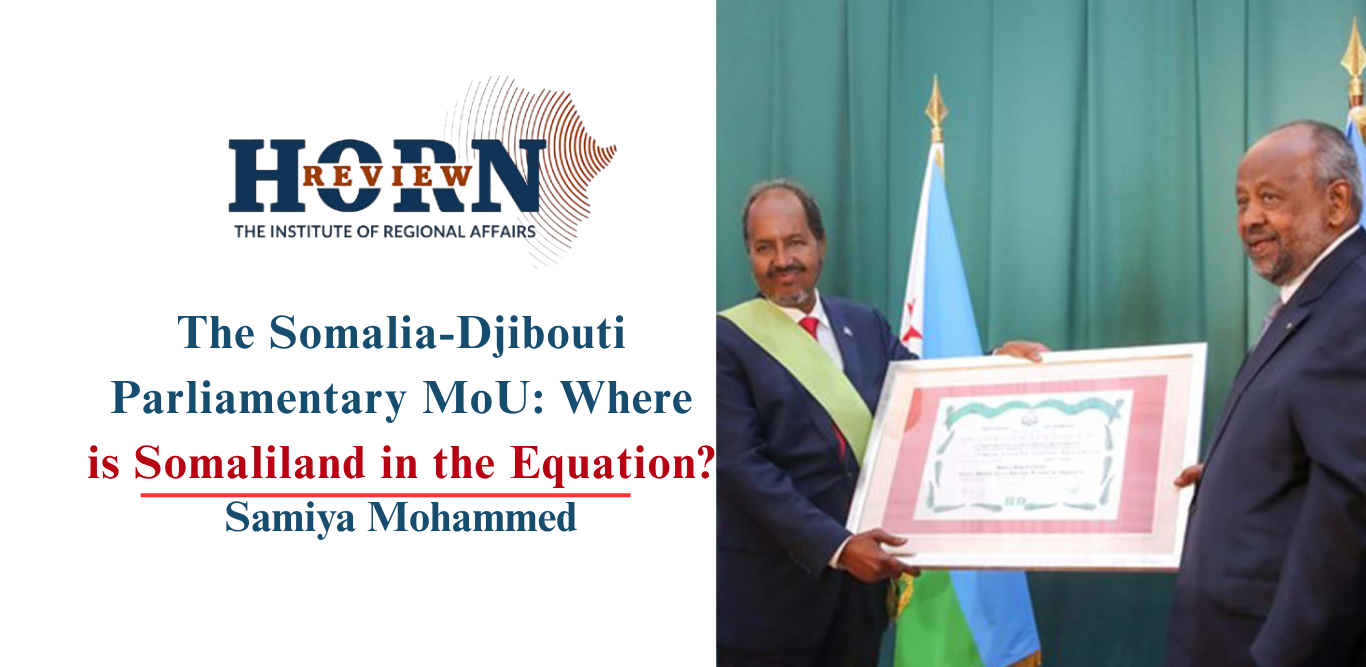
The recent signing of a parliamentary Memorandum of Understanding between Somalia and Djibouti has been greeted in most official statements as a natural expression of fraternal ties and a shared security agenda. The language surrounding the event has emphasised cultural and historical kinship, counter terrorism cooperation and the long record of Djiboutian support for Somali reconciliation from the Arta conference onwards. This framing is not false but it is incomplete to the point of being misleading. The agreement is better understood as one component of a larger posture maintained by Djibouti in which by keeping Somalia intact on paper so that Somaliland and the port of Berbera in particular does not become a real commercial competitor. The cultural and historical kinship is genuine but so is the economic maths and the signing treats the relationship as purely fraternal and security oriented while skipping this structural incentive.
The missing piece that is consistently glossed over is Somaliland and the competition over ports and Red Sea access. Djibouti’s economic model depends heavily on being Ethiopia’s primary outlet to the sea. Ethiopia’s seaborne trade still passes through Djiboutian ports and the rents from that traffic, alongside revenue from foreign military bases underpin the state’s finances and the political economy of the ruling establishment. Ethiopia has been openly seeking alternatives and Israel’s recognition of Somaliland and Emirati investments around Berbera threaten Djibouti’s near monopoly directly. In this context Djibouti aligned with China consistently backs Somalia’s claim to Somaliland and opposes recognition. Stability next door matters for Djibouti’s security and economy but so does the preservation of a legal and diplomatic status quo that keeps Berbera’s potential locked behind the Somali question.
Seen from Mogadishu the parliamentary agreement reflects continuity in the Hassan Sheikh government’s preference for regional partners and Turkish linked figures in key posts and not a sudden surge in Somali institutional strength. Somalia’s parliament is contested. Puntland and Jubaland boycotted the Speaker’s election over mandate and legitimacy questions and the chamber’s authority is disputed in parts of the country. The federal government still depends on external partners for security capacity, training and political cover. A memorandum on legislative exchanges, staff training and committee coordination is precisely the kind of soft agreement that weak institutions sign when they cannot deliver harder results. It highlights weakness rather than strength. It shows a federal government that is still mostly managing optics and external patrons dressing up dependency in the language of partnership.
The Speaker Abdulkadir Mohamed Nur is a revealing figure in this regard. Turkish educated, a former Defence Minister who signed the major Turkey defence framework and subsequently Ports Minister he was elected in a contested vote that Puntland and Jubaland boycotted. The chamber’s mandate is disputed. Taking a parliamentary delegation to Djibouti to sign a memorandum on training, exchanges and coordination is the classic move of a legislature that cannot impose real authority at home.It is an exercise in visibility and it substitutes for the harder work of building legitimacy that the government has not been able to accomplish.
For Djibouti weighs that the agreement is pure self interest dressed as kinship. Djibouti has a hard incentive to keep Somalia formally intact and to block Somaliland recognition. Supporting the One Somalia position, hosting reconciliation and keeping troops in Somalia serves that interest. The cultural and linguistic ties are genuine so is the calculation that a fragmented or internationally recognised Somaliland costs Djibouti money and leverage. The parliamentary pact is cheap diplomacy that locks in the preferred status quo at minimal cost and with maximum symbolic return.
Somalia still needs Djiboutian troops in Hiiraan under AUSSOM. It still needs external partners for security capacity. It still cannot run credible nationwide elections or resolve the federal state split. The memorandum does not fix any of that. It is institutional window dressing from a government whose legitimacy is thin outside Mogadishu and whose security model still depends on foreigners. The gratitude for Djibouti’s historical role from Arta to the troop contribution is real but it also shows dependency. The relationship is not between equals and the agreement does not pretend to make it one and it simply provides a respectable veneer for a familiar arrangement.
The structural reality is that the Somalia and Djibouti parliamentary MoU is a sideshow. It reaffirms an existing axis that both sides need for different mostly self interested reasons. It does not resolve Somalia’s internal legitimacy and capacity failures, does not change Djibouti’s port monopoly and does not touch the Somaliland recognition fight that is actually reshaping incentives across the Horn of Africa and the Red Sea. It is continuity not progress. To describe it as a milestone in bilateral relations is to mistake motion for movement and to accept at face value a diplomatic performance whose real function is to preserve a status quo that benefits the stronger partner and flatters the weaker one.
None of this is to deny that the relationship has genuine substance. Djibouti has hosted Somali reconciliation processes, contributed troops to African Union missions and provided a diplomatic voice that Mogadishu values. The cultural, linguistic and religious ties are not manufactured. But the presence of genuine sentiment does not rule out the presence of calculation in the Horn of Africa, the two routinely coexist and the most effective diplomacy is often the kind that dresses hard interest in the language of brotherhood. The parliamentary memorandum is a case in point. It is a low cost instrument that generates goodwill, reinforces a shared position on territorial integrity and asks nothing of either side that would disturb the underlying distribution of benefits. That is precisely why it was possible and precisely why it should not be read as evidence of institutional strengthening or regional transformation.
What is required then is a more honest accounting. The signing should be reported not only as a fraternal and security oriented event but as an episode in the longer contest over ports, corridors and recognition in the Red Sea and the Horn. Djibouti’s support for Somali unity is sincere in the sense that it is sincerely in Djibouti’s interest. Somalia’s embrace of Djibouti is sincere in the sense that it needs the troops and the diplomatic cover. The parliamentary agreement formalises neither of these truths and it just provides a respectable occasion for restating them. Until the coverage of such agreements acknowledges the economic and strategic incentives that structure them, the public understanding of regional politics will remain incomplete and the real drivers of stability and instability in the Horn will continue to operate below the threshold of commentary.
The memorandum will not change the path of Somaliland’s recognition debate will not alter Ethiopia’s search for port alternatives and will not make Somalia’s parliament more legitimate in the eyes of Puntland, Jubaland or its own citizens. It will however allow both governments to claim a diplomatic success and to continue the policies they were already pursuing. That is what continuity looks like in practice,and it is more useful to describe it accurately than to celebrate it as progress.
By Samiya Mohammed, Researcher, Horn Review