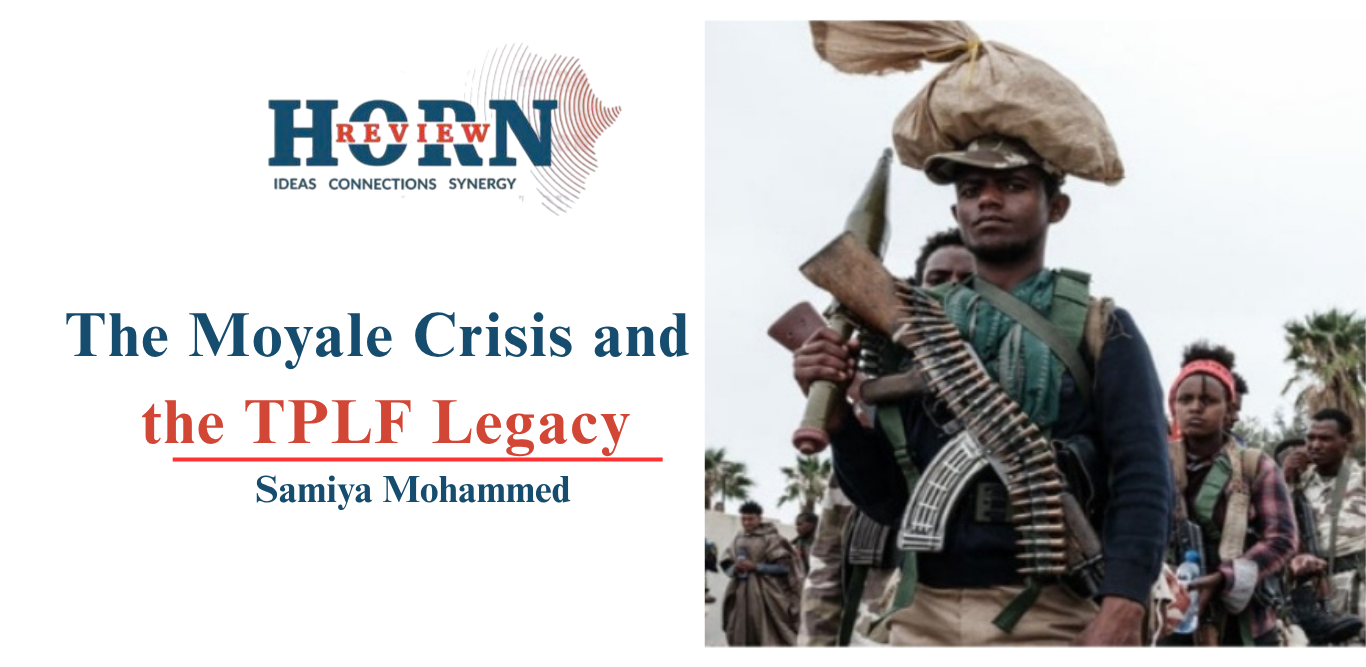
The eruption of violence in Moyale demands an analysis that resists the temptation of reductionist ethnic framing. While the proximate trigger in which a dispute over the hoisting of a flag in a contested neighbourhood that escalated into a shooting and the death of a young female student appears localized but the deeper causality lies in a layered convergence of historical administrative manipulation, cyclical resource competition and contemporary geopolitical information warfare.
Central to this is the role of the Tigray People’s Liberation Front whose historical governance of the borderlands engineered the structural vulnerabilities now being exploited. The TPLF’s erstwhile strategy of stoking divisions along the Oromia and Somali administrative seam was not incidental but instrumental when it served to control and constrain Oromo Liberation Front activities in the border corridor by ensuring that local communities remained locked in zero sum contests over land, administrative boundaries and political representation.
The 2004 referendum process and the broader ethnic federal structure shaped under TPLF led EPRDF rule effectively split Moyale between the Somali and Oromia regions bisecting the town along the highway and creating a permanent institutional fault line. This arrangement manufactured the conditions for recurrent disputes by placing two regional administrations with competing claims and security forces in immediate proximity, transforming a shared urban space into a jurisdictional friction. The TPLF understood that a divided borderland was a controllable borderland and that the OLF’s capacity to operate across the Oromia and Somali seam depended on the very communal solidarities that administrative fragmentation was designed to erode.
The period since the TPLF’s removal from federal power has witnessed a relative pacification of this specific fault with nearly eight years of comparative calm in Moyale. That calm has now been broken, and the timing is analytically important. Contemporary claims including those from former diplomatic figures suggest that TPLF elements have sought to open a southern front to divert federal attention and security resources away from the north where TPLF remnants and the broader Tsimdo alignment a loose coalition of anti Ethiopian government actors with divergent interests continue to pose challenges. The war between the Ethiopian government and the Tsimdo alliance alongside its external backers including Egypt, Eritrea, Sudan, and Somalia has generated a febrile information warfare environment in which localized clan disputes are rapidly securitized and amplified across social media. The exploitation of the Moyale incident by external actors and diaspora networks seeking to inflame Oromo and Somali tensions is evident yet the analytical priority must remain on the local dynamics that provide the combustible material for such manipulation.
The Garre and Borana conflict is not a recent invention nor a simple proxy war. It is Skeptical, wired into the political economy and conflict system of the borderlands and aggravated by climate stress and resource scarcity. The Borana and Garre are closely related communities sharing language and intermixed settlements across southern Ethiopia and northern Kenya yet their disputes possess deep anthropological and historical roots involving territorial claims, historical grievances and competition over the southern trade corridor. Changing settlement patterns, migration and the politics of demographics have intensified these pressures. The dispute over the flag in Kebele 02 is symptomatic rather than causal and it represents a contest over administrative presence and symbolic sovereignty in a space where the delineation between Oromia and Somali regional authority remains contested at the level of everyday practice. A shot fired during a wrangling among kebele militia, resulting in the death of a young female student, provided the spark, but the fuel had been accumulating through decades of unresolved structural contradictions.
It is imperative to categorically reject narratives that seek to internationalize and ethnicize this conflict beyond its local parameters. While Somali Regional Police have been deployed in recent days , there is no tangible evidence of involvement by any other armed group from within the Somali region or from Somalia proper. The conflict remains primarily a matter of competition over resources, dominance of the southern trade corridor and the politics of demographics. The attempt by Somalis in Kenya and Somalia to latch onto this conflict, inflame local sentiments and claim the two Moyales as Somali territory is unacceptable and analytically counterproductive. Such external framing ignores the complex interdependence and social heterogeneity of the borderlands, where communities have historically traded, intermarried, and shared wells and grazing lands even amid episodic violence. The borderland is not a zone of discrete, antagonistic ethnic blocs but a textured landscape of overlapping claims, shared practices and negotiated coexistence that external actors flatten into a binary narrative of Oromo versus Somali.
The starting point for any durable peace settlement must be the recognition of this complexity. The administrative status of Moyale and Ethiopia as part of Oromia Regional State is a legal and political reality that cannot be wished away nor should it be altered through armed contestation. Extremist ethnic nationalism and exclusive narratives that seek to other one community are retrogressive and must be censured with the utmost clarity. Leaders operating from afar who use their influence to fan the flames of ethnic discord must be held accountable for the consequences of their rhetoric. The resolution of this conflict ultimately belongs to the Oromo and Borana on one side and the Garre Somali elders on the other facilitated by federal and regional authorities but owned locally. Any settlement imposed from above or from outside without the genuine consent and participation of these local stakeholders will just postpone the next cycle of violence.
The TPLF’s historical role in weaponizing administrative boundaries and stoking divisions for political control must be acknowledged as part of the etiology of the present crisis. The current conflict is a localized clan dispute that has been escalated by external manipulation and information warfare into a wider Oromo and Somali confrontation. The task of peace building is to reverse that escalation, to restore the primacy of local dispute resolution mechanisms and to ensure that the borderlands are governed through arrangements that recognize heterogeneity rather than seeking to impose homogeneity through force or exclusion.
The alternative is a continuation of the cyclical violence that has made Moyale a center of suffering for decades with each iteration deepening grievances and rendering reconciliation more distant. The flames in Moyale are not inevitable but they will not be extinguished by slogans or by the instrumentalization of grief for geopolitical ends. They require a clear eyed reckoning with the structures that the TPLF built, the divisions it cultivated and the responsibility of all who now seek to profit from those divisions to lay down their rhetorical weapons and allow the borderlands to heal.
By Samiya Mohammed, Researcher, Horn Review