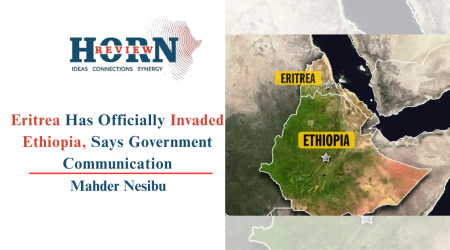
Eritrea has answered, in kind, a letter that Ethiopia sent to the United Nations Security Council on 9 October. Addis Ababa’s letter described the entry of Eritrean forces deep into Ethiopian territory, by its account up to 60 kilometres, as a “blatant act of aggression”. Asmara’s reply turned the charge back on Ethiopia, accusing it of preparing for a war that has been declared “for over three years now”.
The present escalation follows years of tension that set in as the previous conflict in Ethiopia’s northern region of Tigray drew to a close with the 2022 Pretoria agreement, a cessation of hostilities between the Tigray People’s Liberation Front (TPLF) and the Ethiopian government. The agreement’s shaky implementation unfolded alongside the unravelling of the 2018 rapprochement between Addis Ababa and Isaias Afwerki’s regime in Asmara.
The dynamics now at play developed gradually in the years after the agreement. Its terms required the TPLF to disband its armed wing and called for the restoration of federal authority and a new regional government in Tigray. The TPLF split over the decision to sign, and its hardliner faction, dissatisfied with what it viewed as a surrender document, began taking steps to unpick the deal on the ground. The hardliners sidelined the faction that backed Pretoria and gradually consolidated power in the region. They also warmed to Eritrea, which had intervened against the group in the fighting, a sharp reversal of the regional order.
As the TPLF and Isaias grew closer, relations between Addis Ababa and Asmara deteriorated, also for a mix of reasons. Eritrea’s intervention in the Tigray conflict was brutal and, the Ethiopian prime minister told parliament in February this year, was a major cause of the rupture between the two capitals. Ethiopia also began publicly stressing its aim of regaining the access to the sea it lost when Eritrea seceded more than three decades ago. Asmara took that claim as an affront, even as the Ethiopian government ruled out the use of force in pursuing it.
The current fighting broke out in late September after a series of clashes that had fallen short of igniting a war, and this time it pitted the Ethiopian government against a coalition of seven rebel groups inside the country, spearheaded by the TPLF. The coalition took shape from the alignment between the TPLF and Eritrea, which drew in groups such as the Amhara Fano National Movement (AFNM) in Amhara, Tigray’s neighbouring region, and the Afar Revolutionary Democratic Unity Front (ARDUF), a smaller Afar group, as well as the Oromo Liberation Army in Oromia.
For Eritrea, the coalition marked the revival of a long-held strategy against its much larger and more powerful neighbour, proxy politics. Isaias Afwerki, Eritrea’s strongman, has long fostered armed groups inside Ethiopia and across the Horn of Africa to offset Eritrea’s relative limitations and to project power and influence over its neighbours. That pattern held in Ethiopia during the 18-year “no war, no peace” period that ended with the 2018 rapprochement. In the months before the coalition was announced, reports identified the TPLF-Asmara partnership widening to take in other rebels. The AFNM received logistical support from Eritrea and held military and political contacts through neighbouring Sudan, while the leadership of the ARDUF relocated to Eritrea before taking part in the September offensive.
The letters to the Security Council came in the wake of a lightning counteroffensive by the Ethiopian National Defence Force (ENDF), which reversed the early course of the fighting. On 28th of September, as the ENDF pushed back against the TPLF and the ARDUF in the Afar region neighbouring Tigray, the head of the region told reporters that Eritreans were fighting directly on the side of the rebels. Intelligence reports had earlier pointed to the Eritrean Defence Forces (EDF) mobilising along the Afar border. As the ENDF advanced deeper into Tigray itself, further evidence of Eritrea’s direct involvement began to emerge.
The most significant piece of evidence was the EDF’s movement into Adigrat, the region’s second largest city and not far from the capital, Mekelle. Knowledge of the growing Eritrean presence likely led Ethiopia’s foreign minister to notify the Security Council and invoke the country’s right to self-defence.
Eritrea’s move deeper into Ethiopia appears to be a reaction to the speed at which the rebel offensive collapsed and the ENDF made gains. With its buffer zone collapsing, Asmara has likely resorted to direct intervention in support of the rebels, primarily the TPLF, against federal forces.
This nonetheless exposes a contradiction in Asmara’s position. Its reply to the Security Council invoked the same narratives that cast Ethiopia as the aggressor, chiefly Addis Ababa’s designs on direct access to the sea, which Asmara has methodically used to portray its neighbour as a destabiliser harbouring expansionist ambitions against it. By sending troops inside Ethiopia, however, Eritrea commits direct aggression against a sovereign state, a breach of one of the most fundamental principles of international law. Ethiopia’s position, by contrast, appears to rest on Article 51 of the UN Charter. Its letter reported to the Security Council that it was taking measures of self-defence, a right the Charter recognises.
By Mahder Nesibu, Researcher, Horn Review