The United States is attempting a precarious balancing act in the Horn of Africa, warming ties with Ethiopia, its longtime ally, while simultaneously rekindling contact with Eritrea, a country with which its relationship has rarely been smooth. The two neighbours are now locked in a sharply deteriorating relationship, which explains Washington’s rationale. The administration is wary of another war breaking out in an already conflict-prone region, particularly with Sudan, their shared neighbour, already three years into a civil war that the United States has struggled without success to resolve. The full shape of Washington’s approach remains unclear, as do its underlying motivations, which extend well beyond peace-making. Its efficacy, at least on that peacekeeping front, looks increasingly doubtful in its own right.
The engagement with Eritrea has in fact unfolded alongside another of Washington’s current preoccupations, its confrontation with Iran. That conflict exposed the strategic vulnerability of two narrow waterways in the region, the Persian Gulf with its outlet at the Strait of Hormuz, and the Red Sea with its gateway at the Bab-el-Mandeb, as Iran and its allies demonstrated their capacity to choke both routes and disrupt shipping, oil cargoes included.
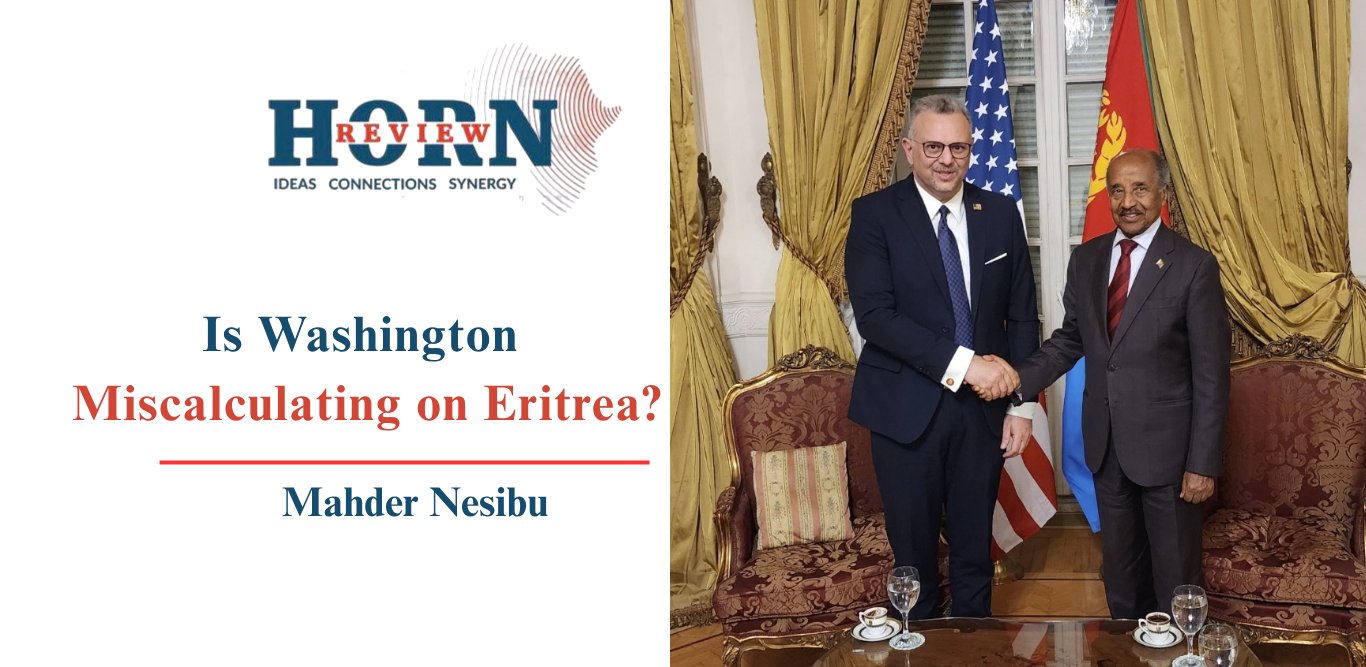
Contact between American officials and Asmara’s leadership developed on a parallel track. Before its confrontation with Iran, Washington had engaged the Houthis in Yemen in mid-2025 to break the blockade the Iran-aligned group had imposed on the Red Sea. Later that year, in September, Massad Boulos, the top American diplomat for the region, met Eritrean foreign minister Osman Saleh in an effort to re-establish a relationship that had been strained for more than two decades. The war with Iran subsequently clarified Washington’s priorities, as it emerged that the administration had offered to lift sanctions on Eritrea’s leadership, which it ultimately did when the 2021 executive order underpinning them expired in September this year. The stated rationale centred on Red Sea security calculations, though the timing suggests it was also shaped by developments inside the Horn of Africa.
The sanctions lapsed at roughly the same moment Washington lifted its restriction on arms sales to Ethiopia, allowing Addis Ababa to purchase American defence equipment once more. Both restrictions traced back to the conflict in Tigray, which had placed the armies of both countries in opposition to the Tigray People’s Liberation Front (TPLF).
From Washington’s perspective, adapting to a regional landscape transformed since the Tigray conflict’s conclusion in 2022 makes sense on its own terms. The United States had taken a critical position on the Ethiopian government’s campaign to crush the TPLF rebellion during that conflict, a position that strained a strategic partnership built over decades. Even after Addis Ababa signed a peace deal with the TPLF, emerging from the conflict arguably stronger and more consolidated, the relationship with Washington had remained constrained. The lifting of sanctions developed alongside a broader effort to rebuild ties, with Washington eyeing investment opportunities in Ethiopia and seeking to strengthen counterterrorism cooperation, long a pillar of the relationship.
The more difficult question is the deterioration in relations between Ethiopia and Eritrea itself. One consequence of the Tigray conflict was the collapse of the 2018 rapprochement between the two countries, driven by Asmara’s dissatisfaction with how that conflict ended. In a near-complete reversal, Eritrea is now aligned with the TPLF and a wider range of rebel groups operating against Addis Ababa.
Washington’s balancing act appears aimed at engaging both Addis Ababa and Asmara diplomatically to avert a slide into war.
Its diplomacy, however, seems to be lagging behind events on the ground. Rather than discouraging Asmara from pursuing a proxy strategy against Ethiopia, Washington’s engagement has done little to check it. Backed by Eritrea, the rebel groups inside Ethiopia formed a coalition on 20 September, only days after Eritrea’s sanctions expired, and launched an offensive against the Ethiopian National Defence Force shortly afterward. Addis Ababa responded with the head of the ENDF criticising Eritrea, alongside Egypt and Sudan’s army, of backing the rebel offensive, expelling several diplomats from the Eritrean mission along with one diplomat from Egypt’s embassy. Eritrea cut off diplomatic ties entirely in response.
Although the American ambassador to Ethiopia criticised the TPLF for launching the offensive, Washington’s contacts with Asmara have continued regardless, evident in a meeting on 2 October between Frank Garcia, Assistant Secretary of State for African Affairs, and Osman Saleh. Those contacts have done little to discourage Eritrea’s backing of the TPLF and the broader rebel coalition. A direct confrontation between Eritrean and Ethiopian forces is instead becoming an increasingly real possibility.
None of this should come as a surprise. Eritrean foreign policy has consistently defied American strategy and has proven conflict-prone under Isaias Afwerki, the country’s current and only president. Isaias has recently argued that the strained relationship between Eritrea and the United States owes less to Eritrean conduct than to what he calls Washington’s “misguided” foreign policy, one he insists the United States needs to reconsider.
Eritrea’s divergence from American interests extends beyond its hostility toward Ethiopia and shows in Asmara’s broader conduct across the Horn of Africa and the Middle East. In Sudan’s civil war, where Washington’s stated goal is to press the warring parties toward ending the fighting, Eritrea is one of the principal backers of the Sudanese Armed Forces, supplying training and personnel and serving as a key corridor for weapons shipments, including those sourced from Iran. Osman Saleh has also displayed open antagonism toward Israel and the United Arab Emirates, both close American allies, in recent public remarks.
It remains similarly unclear how Eritrea could serve American interests along the Red Sea. Eritrea has maintained visibly closer ties with Iran than opposition to it, and Asmara has signalled that confronting the Houthis holds little appeal, reflected in its absence from the Saudi-led coalition of Red Sea states formed to counter the group, which now controls the Bab-el-Mandeb and the ability to disrupt shipping through it more easily as a result. What’s more, the United States already operates a military base in neighbouring Djibouti, sitting at the Bab-el-Mandeb crossing, a base it established in 2002 after passing over Eritrea for the same strategic incompatibilities still evident today.
As the region’s dynamics continue to shift, the United States may find that its engagement with Eritrea only emboldens Asmara’s position in the Horn of Africa. That pattern is already visible in how Eritrea has wielded the diplomatic standing it has shored up since emerging from long isolation in 2018. Rather than using these openings to build partnerships, Asmara has used them to justify and pursue its characteristically aggressive foreign policy with greater tenacity.
By Mahder Nesibu, Researcher, Horn Review