
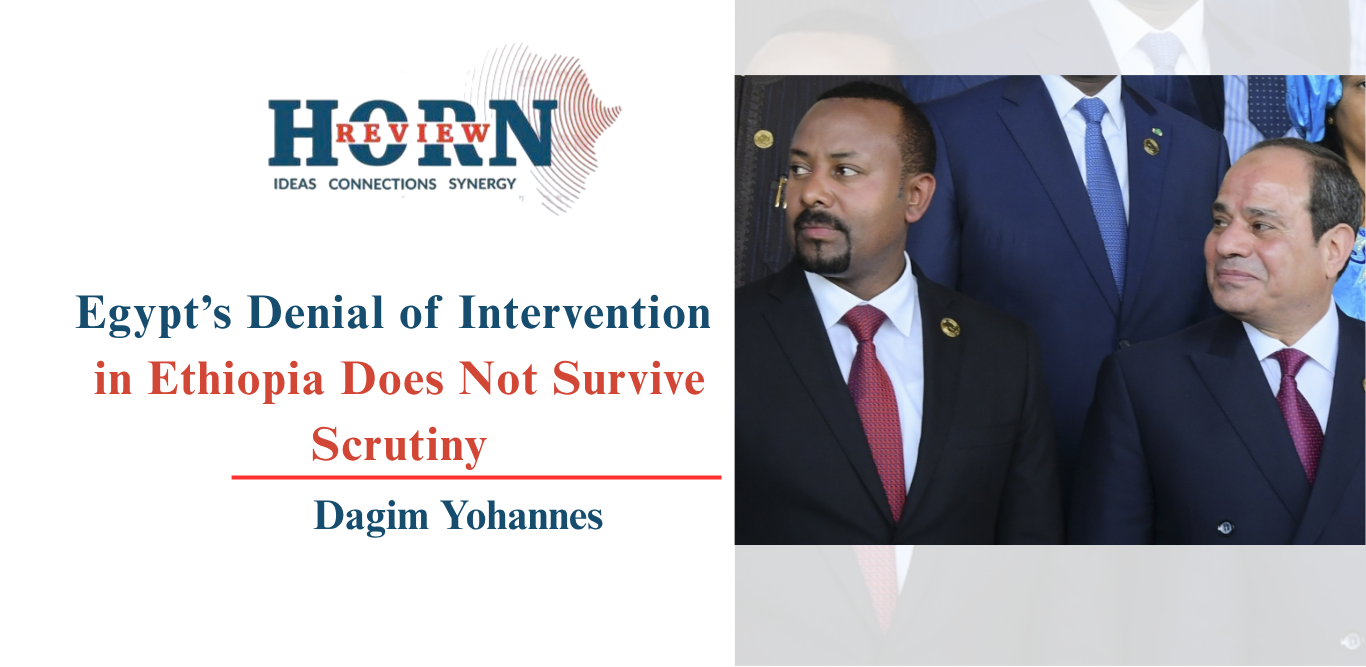
Egypt’s Denial of Intervention in Ethiopia Does Not Survive Scrutiny
Egypt’s Foreign Ministry has answered Ethiopian charges of external interference with a carefully worded assertion of principle. Its spokesperson stated that Egyptian foreign policy is founded on firm respect for the sovereignty of states, the unity and territorial integrity of nations, and non-interference in the internal affairs of other countries, and that any claims casting doubt on this commitment are null and void. The formulation is elegant and absolute. It is also incompatible with the accumulated record of Cairo’s actions across the Horn of Africa and the Red Sea since 2024. What emerges from that record is not a series of disconnected bilateral initiatives, but a deliberate, multi-layered campaign of strategic containment directed at Ethiopia. This campaign is best understood as a form of indirect intervention: the systematic construction of a client-patron network that enables and sustains internal challenges to a rival government while preserving plausible deniability. Ethiopia stands on the receiving end of this pressure. Its response has been one of measured strategic restraint and the disciplined exercise of its inherent right to self-defence.
The core driver of Egyptian policy remains the Nile water. Unable to halt the projects through negotiation or international pressure, Cairo has shifted to a broader strategy of regional isolation and internal destabilisation. The October 2024 tripartite summit in Asmara between Egypt, Eritrea, and Somalia marked the formalisation of this approach. The joint statement emphasised security cooperation, support for Somali state institutions, and the principle of non-interference language that, in context, functioned as a collective rejection of Ethiopian influence. The gathering can be described plainly as the construction of a counter-coalition against Addis Ababa. Egypt did not leave the arrangement on paper. It moved rapidly to operationalise it through a defence and military cooperation protocol with Somalia and successive deliveries of military equipment, including artillery, anti-aircraft systems, and other capabilities intended to strengthen Mogadishu’s hand in its dispute with Ethiopia over the Somaliland port arrangement. By arming and elevating a state locked in territorial contention with Ethiopia, Cairo increased pressure on Addis Ababa’s southern and eastern flanks at the precise moment northern fronts were being prepared.
This diplomatic and material architecture has been sustained through continuous high-level coordination. In late September 2026, Egyptian Foreign Minister Badr Abdelatty met his Eritrean counterpart Osman Saleh on the margins of the United Nations General Assembly. Their discussions focused on Red Sea security, Horn of Africa developments, and the further deepening of bilateral ties. Parallel Egyptian military and defence engagement with Somali counterparts has kept the arms and training relationship active. These are not ceremonial encounters. They maintain a working alignment whose primary shared strategic interest is the constraint of Ethiopian power projection and the limitation of Ethiopia’s sovereign options, particularly regarding sea access and regional influence. The result is a ring of adversarial partnerships that reduces Ethiopia’s strategic depth and raises the premium on internal cohesion.
The irony is stark. Egypt’s Foreign Ministry insists that Egyptian foreign policy is founded on firm respect for the sovereignty of states, the unity and territorial integrity of nations, and non-interference in the internal affairs of other countries. Yet Egypt’s willingness to engage in overt cross-border intervention is demonstrated most clearly in Sudan. Independent investigations by the New York Times, drawing on satellite imagery, flight data, and official sources, have established that Egypt has operated advanced Turkish Bayraktar Akinci combat drones from a base at East Oweinat near the Sudanese frontier. These drones have conducted sustained strikes against Rapid Support Forces positions and supply convoys deep inside Sudan for months. This is not ambiguous support. It is direct military intervention across an international border. The Sudanese Armed Forces, the principal beneficiary of this assistance, function as one element in a wider client-patron network that Cairo has cultivated to manage its regional environment and constrain Ethiopian influence. Just as Egypt has invested in the SAF to shape outcomes in Sudan, it has invested in Eritrea as the primary client charged with upholding Cairo’s interests with respect to Ethiopia. Eritrea supplies the geographic proximity, the historical antagonism, and the operational capacity to keep pressure on Ethiopia’s northern frontier. Egypt supplies the diplomatic cover, the strategic depth, and the regional architecture that makes sustained pressure viable.
During the 2020–2022 Tigray conflict, reports and statements by Ethiopian officials referred to the presence of foreign fighters on certain fronts, including occasional speculation about individuals of North African or Arab appearance. Egypt has consistently denied any military involvement, and no independent verification of Egyptian combat units has entered the public record. What the episode nevertheless reveals is a longer pattern of strategic interest: Cairo has historically viewed Ethiopian internal fragmentation as a potential lever in its broader contest over the Nile and regional hierarchy. The absence of confirmed battlefield participation in that earlier war does not erase the continuity of purpose. Rather, it underscores a preference for indirect methods, methods that have since matured into a more structured client-patron architecture. Eritrea now functions as the principal client charged with sustaining pressure on Ethiopia’s northern frontier, while Egypt supplies the diplomatic cover, regional coordination, and strategic depth. The earlier reports, limited as they are, sit within this longer arc of competitive statecraft rather than as isolated anomalies.
It is against this background that the formation of the Ethiopian Peoples’ Forces Coalition for Survival must be assessed. Formally announced on 20 September 2026, the coalition is the same entity often referred to as the seven-group alliance. It brings together the Tigray People’s Liberation Front, the Amhara Fano National Movement, the Oromo Liberation Army, the Ogaden National Liberation Front, an Afar formation, the Benishangul Peoples’ Liberation Movement, and the Gumuz Peoples’ Democratic Movement. Several of these organisations were, until recently, mutual adversaries or regionally confined. Their unification into a single political-military framework aiming to remove the federal government and install a transitional administration is not a spontaneous domestic phenomenon. It is the product of an external environment that made sustained multi-front coordination possible. Reports indicate that coordination meetings among the groups took place over preceding months, including in the presence of Eritrean and Sudanese security representatives. Eritrea, acting as Cairo’s principal client on the Ethiopian file, provides the geographic hinge and the most direct logistical access along Ethiopia’s northern frontier. Egypt’s contribution remains upstream and structural: the diplomatic cover of the tripartite alignment, the material strengthening of other adversaries, the continuous high-level coordination with Asmara, and the consistent strategic signalling that a preoccupied Ethiopia is preferable to a consolidated one.
Recent public commentary by Habib Mohamed Osman, media advisor to the Eritrean Embassy in Cairo, speaking on the Egyptian channel Al-Qahera News, crystallises this shared strategic outlook. In a recorded appearance, Osman delivered what was presented as a conscious strategic reading of Ethiopia’s current situation. He stated that the risk of Ethiopia’s strategic collapse would be extremely costly, yet the survival of the current regime would ignite war in the Horn of Africa, a difficult equation in which Eritrea would by no means stand alone. This is not neutral analysis. It is a diplomatic signal issued from Egyptian soil by an official representative of Eritrea. It treats Ethiopian internal political continuity itself as a regional problem requiring external management. It openly contemplates that the survival of Ethiopia’s government is a trigger for wider conflict, and it confirms that Eritrea does not expect to face the consequences of that conflict in isolation. Coming from Cairo’s principal client on the Ethiopian file, the statement reveals the underlying logic of the alignment: Ethiopian stability is the obstacle; internal fragmentation or regime change is the preferred outcome.
In the language of conflict analysis, this constitutes classic indirect intervention through a client-patron structure. Egypt is not required to exercise day-to-day operational command over Tsimdo in order to bear responsibility for the permissive conditions that enabled it. Indirect intervention operates by raising the cost of governance for the target state, fragmenting its coercive capacity, and forcing it to divert resources inward, all while retaining plausible deniability. Cairo has invested in precisely this architecture. It has armed Somalia. It has supported the Sudanese Armed Forces with cross-border drone strikes. It has elevated Eritrea as the main client responsible for sustaining pressure on Ethiopia. The stronger documented supply lines in the current northern fighting point toward Eritrea; specific allegations of Egyptian combat personnel alongside the TPLF remain unverified in open sources and must be treated with caution. Yet the absence of public proof of direct Egyptian troops does not negate the strategic logic. The broader charge of external enablement fits the established pattern of Egyptian competitive statecraft, now reinforced by the explicit strategic framing offered by Eritrea’s own diplomatic representative in Cairo.
Parallel to these material and diplomatic efforts runs a sustained information campaign. In recent weeks, fabricated and exaggerated claims have circulated with notable intensity: assertions that Ethiopia’s air force has been penetrated, and warnings that Asmara and Cairo stand ready to crush the country unless it abandons its sovereign agenda of securing sea access. These narratives function as force multipliers. They aim to erode confidence, amplify domestic anxiety, and narrow the space for calm strategic calculation in Addis Ababa. Information operations of this character are consistent with a broader grey-zone strategy of pressure that seeks to achieve through psychological and political means what cannot yet be achieved through open military confrontation.
Throughout this multi-vector campaign, Ethiopia has remained on the receiving end. It has not sought to export conflict or to match external intervention with reciprocal adventurism beyond its borders. Its policy has been one of strategic restraint coupled with the firm exercise of self-defence. That self-defence encompasses the protection of territorial integrity, the security of the Djibouti trade corridor that carries more than ninety percent of the country’s international commerce, and the rejection of external attempts to re-engineer Ethiopia’s internal balances of power. Restraint in the face of sustained pressure is not passivity. It is the disciplined choice of a state that understands the costs of uncontrolled escalation while refusing to accept the erosion of its sovereignty.
Egypt’s formal declaration of non-interference therefore functions less as a description of policy than as a diplomatic shield. The 2024 tripartite architecture, the continuous high-level coordination with Eritrea and Somalia, the material empowerment of Mogadishu, the documented cross-border drone campaign in support of the Sudanese Armed Forces, the elevation of Eritrea as Cairo’s principal client on the Ethiopian file, the creation of the permissive regional conditions that made the anti government alliance both feasible and strategically valuable, and the explicit strategic framing offered by Eritrea’s diplomatic representative on Egyptian television together form a coherent strategy of containment through indirect intervention. The objective is unambiguous: to keep Ethiopia strategically constrained, internally preoccupied, and diplomatically isolated. Ethiopia, standing on the receiving end of this multi-vector pressure, has responded with strategic restraint and the firm exercise of its right to self-defence, protecting its territorial integrity, securing the vital Djibouti trade corridor, and rejecting external attempts to re-engineer its internal balances of power. Restraint in the face of sustained pressure is not passivity; it is the disciplined choice of a state that understands the costs of uncontrolled escalation while refusing to accept the erosion of its sovereignty. The region will be better served by an accurate accounting of these interests and actions than by rhetorical formulas that the evidentiary record does not sustain.
By Dagim Yohannes, Researcher, Horn Review

RELATED
Posts
2
Oct
Kisha in Cairo: Eritrea's Money Man in Egypt's Calculations
Egypt’s Foreign Ministry has answered Ethiopian charges of external...
2
Oct
Ethiopia and Libya Rebuild a Bilateral Channel
Egypt’s Foreign Ministry has answered Ethiopian charges of external...
2
Oct
Why the Ethiopian Prime Minister and Sudanese Armed Forces Commander Must Meet
Egypt’s Foreign Ministry has answered Ethiopian charges of external...
2
Oct
Ethiopia Expels Egyptian Diplomatic Staff Member as Regional Tensions Escalate
Egypt’s Foreign Ministry has answered Ethiopian charges of external...
2
Oct
Ethiopia Closes its Embassy in Asmara, What Could this Mean?
Egypt’s Foreign Ministry has answered Ethiopian charges of external...
2
Oct
From Djibouti to Lamu: Ethiopia’s Push for Strategic Connectivity
Egypt’s Foreign Ministry has answered Ethiopian charges of external...
2
Oct
Eritrea's Diaspora Opposition and the Politics of the Coming Transition
Egypt’s Foreign Ministry has answered Ethiopian charges of external...
2
Oct
Structural Reading of the Somali President visit in Ethiopia
Egypt’s Foreign Ministry has answered Ethiopian charges of external...
2
Oct
The Damerjog-Dewele Pipeline and Ethiopia's Energy Security
Egypt’s Foreign Ministry has answered Ethiopian charges of external...
2
Oct
What Strategy Should the Eritrean Opposition Pursue Against the PFDJ?
Egypt’s Foreign Ministry has answered Ethiopian charges of external...