The Horn of Africa Should Not Become an Arena for External Rivalries
By Inshar Mohamed Dolal
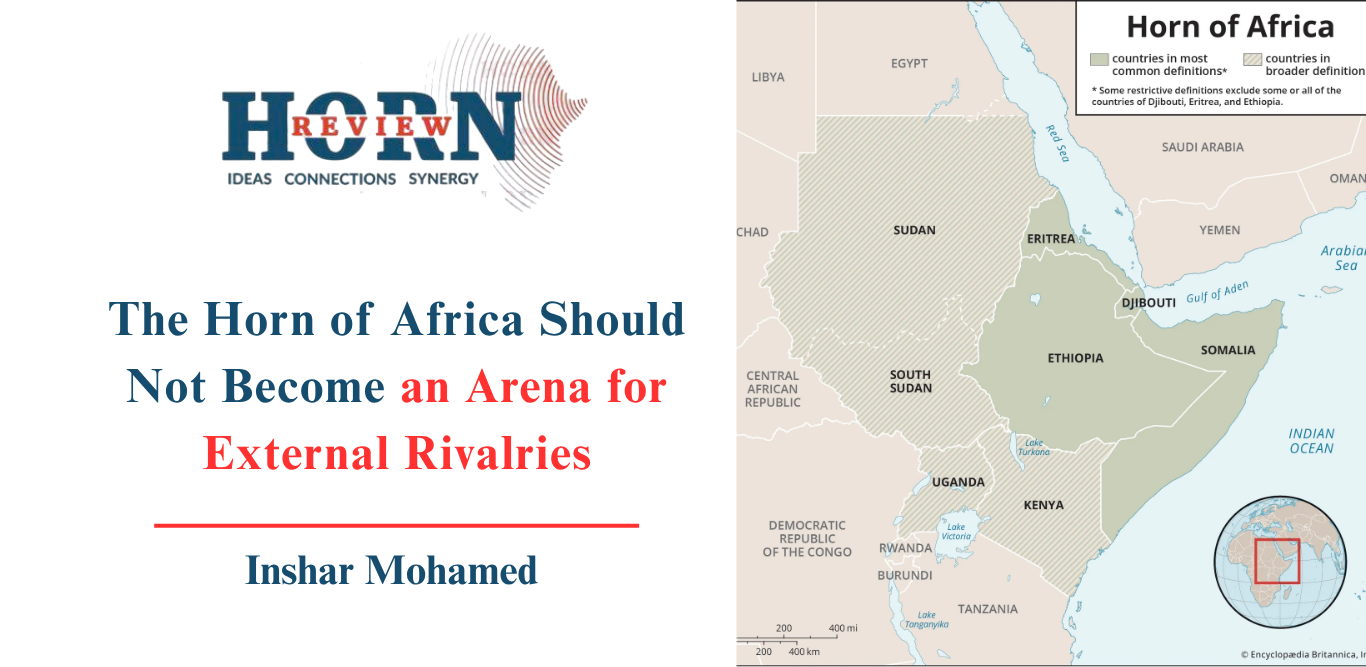
The Horn of Africa is entering another period of intense geopolitical competition. Its strategic location, stretching from the Red Sea and Bab el-Mandeb to the Gulf of Aden and the western Indian Ocean, has made the region increasingly important to global trade, maritime security and the strategic calculations of powers far beyond Africa. Over the past decade, countries from the Middle East and beyond have expanded their political, economic and security relationships across the Horn. Ports, military cooperation, diplomatic alliances, infrastructure and access to strategic waterways have all become part of a much larger contest for influence.
There is nothing inherently wrong with international engagement. Countries in the Horn require investment, technology, security assistance and diplomatic partnerships, and external support has contributed in important ways to counterterrorism, maritime security and economic development. The problem emerges when external interests become intertwined with unresolved disputes between neighbouring countries. At that point, disagreements that might otherwise be managed through diplomacy can acquire a much wider strategic dimension. A bilateral dispute can become connected to the interests of several outside powers, making compromise more difficult and escalation more dangerous.
This is increasingly visible in the changing relationship between Egypt and Somalia. They elevated their bilateral relationship to a strategic partnership in January 2025, following an earlier military cooperation agreement, while Egypt subsequently became involved in the African Union’s Support and Stabilization Mission in Somalia. From Cairo’s stated position, its engagement is intended to support Somali sovereignty, counterterrorism and regional security. These objectives cannot simply be dismissed. Somalia faces a genuine security crisis, and strengthening its national institutions and security forces is essential to its future. Egypt, like any sovereign state, has the right to develop partnerships that it believes serve its national interests. Yet foreign policy cannot be understood only through official declarations. It must also be considered within the broader strategic environment.
Egypt’s expanding role in Somalia comes at a time when Cairo remains locked in a major strategic dispute with Ethiopia over the Nile and the Grand Ethiopian Renaissance Dam. Egypt is also increasingly attentive to developments around the Red Sea and the Horn of Africa. At the same time, Ethiopia and Somalia have experienced serious tensions over sovereignty, territorial integrity and Ethiopia’s efforts to secure reliable access to the sea. These developments do not necessarily prove that one country is using another as an instrument against a rival. Such a conclusion would require evidence. But it would also be naïve to assume that these strategic developments exist independently of one another. The more important question is therefore not whether Somalia should cooperate with Egypt. Somalia is a sovereign state and has every right to develop relations with Egypt, Ethiopia, Türkiye, Kenya, the Gulf states or any other country according to its national interests. The real question is whether these partnerships strengthen Somalia’s sovereignty and institutional capacity or whether Somalia risks becoming another arena through which wider regional rivalries are played out.
This concern becomes more important when examining the different external actors involved in Somalia’s security. There has been criticism from some Somali political actors, including figures associated with the administration of President Hassan Sheikh Mohamud, regarding the role of the United Arab Emirates. Such disagreements deserve to be examined on their substance rather than through political rhetoric. If Somalia’s security is the central concern, then the contribution of each external partner should be assessed by what it has actually delivered in terms of counterterrorism assistance, security capacity, training, institutional support and economic engagement.
The UAE has developed security relationships with Somali actors and has supported counterterrorism efforts in Puntland, Jubaland and other areas confronting Al-Shabaab. Its engagement has not been limited to diplomatic statements; it has also involved practical security and economic relationships. None of this means that the UAE’s policies should escape scrutiny or that its motives should automatically be regarded as purely altruistic. States do not conduct foreign policy without strategic interests. The same principle applies to every external actor operating in the Horn.
What Somalia needs, therefore, is not a competition over which foreign power should have the greatest influence. It needs partnerships that increase Somali capacity. There is a fundamental difference between strategic partnership and strategic dependence. International assistance becomes sustainable when it strengthens national institutions rather than when institutions become dependent on the political calculations of external sponsors. The same principle should be applied when considering Somalia’s immediate neighbours. Ethiopia and Kenya have paid significant costs in Somalia’s security over many years. Their forces have fought Al-Shabaab and suffered casualties in military operations. Djibouti has also played an important role in Somalia’s security architecture and in regional stabilization. These contributions should not be treated simply as historical footnotes. They reflect the reality that Somalia’s security is inseparable from the security of its neighbours.
Geography cannot be negotiated away. Somalia, Ethiopia, Kenya and Djibouti share borders, commercial networks, communities, migration routes and security threats. Armed groups do not necessarily respect political boundaries, and instability in one country can quickly generate consequences in another. Somalia therefore has every right to diversify its international partnerships, but regional security cannot be built as though its immediate neighbours were distant powers whose interests can simply be excluded. This does not mean that Somalia should subordinate its foreign policy to Ethiopia, Kenya or Djibouti. Nor should regional security become an excuse for interference in Somalia’s domestic political affairs. Sovereignty remains fundamental. The challenge is to reconcile sovereignty with the unavoidable reality of shared security interests.
That challenge has become more urgent because the major disputes in the Horn are increasingly interconnected. The Nile dispute between Egypt and Ethiopia, Ethiopia’s search for maritime access, Somalia’s concerns over sovereignty and territorial integrity, the question surrounding Somaliland, instability in Sudan, the conflict in Yemen and insecurity around the Red Sea are no longer entirely separate strategic issues. They exist within the same regional environment, and developments in one arena can influence calculations in another.
This is where the danger of external rivalry becomes particularly serious. The history of the Horn demonstrates that security competition rarely remains confined to the original dispute. Political disagreements can become militarized. Military partnerships can change perceptions of threat. Governments can begin to interpret their neighbours’ relationships with outside powers as hostile strategic alignments. Once this happens, mistrust can become self-reinforcing, with each side responding to the other’s security measures by seeking additional alliances and military support.
The region has already experienced too much conflict to repeat this cycle indefinitely. The disagreement between Ethiopia and Somalia over maritime access illustrates both the danger and the possibility of a different approach. Somalia’s insistence on sovereignty and territorial integrity is legitimate. Ethiopia’s economic and strategic interest in obtaining reliable access to the sea is also understandable. These interests should not automatically be treated as mutually exclusive. The real question is how they are managed. If maritime access becomes a matter of military pressure, competing alliances and strategic confrontation, it could become a long-term source of instability. If it is addressed through negotiation, commercial agreements and mutually beneficial economic arrangements, it could instead become an opportunity for cooperation. This is why the diplomatic process facilitated by Türkiye deserves attention. The Ankara Declaration demonstrated that even serious disagreements can be brought back into a diplomatic framework.
A sustainable solution should seek to protect Somalia’s territorial integrity while allowing Ethiopia to obtain reliable and commercially viable access to maritime facilities through arrangements acceptable to both sides. Such an approach would not require either country to abandon its national interests. It would require both to recognize that national interests are sometimes better protected through negotiated interdependence than confrontation.
For Ethiopia, Somalia is not simply another foreign-policy file. The relationship is shaped by geography, history, trade, communities and a shared security environment. The same is true, in different ways, of Kenya and Djibouti. Any Somali security strategy that ignores this interconnectedness will struggle to address the region’s underlying realities. But interconnectedness must not be confused with entitlement. Ethiopia’s security interests do not give it unlimited authority over Somalia, just as Somalia’s sovereignty does not erase Ethiopia’s legitimate concerns about security and maritime access. The same principle applies to Kenya, Djibouti and every other regional state.
This is precisely why the Horn requires stronger regional institutions rather than more competing external alignments. The region also needs to reconsider the relationship between security and economics. One of the Horn’s greatest weaknesses is its limited economic integration despite its enormous geographical and commercial potential. Ethiopia possesses a large market and significant productive capacity. Somalia has an extensive coastline and maritime potential. Djibouti has developed itself as a major logistics hub, while Kenya possesses significant commercial infrastructure and regional markets. Yet these assets remain insufficiently integrated.
The strategic conversation should therefore move beyond competition over individual ports and toward the creation of interconnected economic corridors. Roads, railways, ports, energy systems, telecommunications and logistics networks can connect the economies of the region in ways that make stability economically valuable. Ethiopia’s landlocked position, Somalia’s maritime geography, Djibouti’s logistics infrastructure and Kenya’s commercial networks do not have to produce competition. Properly managed, they can become complementary assets within a regional economic system.
This is more than an economic argument. It is also a security strategy. Countries that are deeply connected through trade, infrastructure, investment and supply chains have stronger incentives to manage political disputes peacefully. Economic interdependence does not eliminate conflict, but it raises the cost of confrontation and creates constituencies with an interest in stability. The Horn needs precisely this kind of strategic interdependence. The same principle should extend beyond governments. The peoples of Ethiopia, Somalia, Kenya and Djibouti have interacted for centuries through trade, culture, family relationships and migration. These relationships existed long before modern borders divided the region into separate political units. Yet regional politics often treats neighbouring societies primarily through the language of national security and territorial competition. That needs to change.
Educational exchanges, business partnerships, youth programmes, academic cooperation, cultural initiatives and cross-border commerce can create relationships that governments alone cannot build. Regional integration should not remain an elite diplomatic project. It should become something experienced by ordinary citizens.
There is no realistic possibility of removing external powers from the Horn, nor should that necessarily be the objective. Egypt has interests in the Red Sea and regional security. Türkiye has developed extensive political, economic and security relationships across the region. The Gulf states have significant commercial and strategic interests. The United States, China and European countries also have important interests connected to maritime security, trade and counterterrorism.
The issue is not whether external powers should be present. The issue is who defines the terms of their engagement. External partnerships should complement African strategic interests rather than substitute for them. International actors can contribute to counterterrorism, economic development, maritime security and diplomacy, but regional governments should be careful not to allow external partnerships to transform local disputes into broader strategic confrontations.
The distinction is important. An outside power helping neighbouring states resolve a dispute can strengthen regional stability. An outside power becoming deeply embedded in that dispute can make compromise more difficult. This is where institutions such as IGAD and the African Union have an important role. The Horn needs stronger mechanisms for intelligence sharing, counterterrorism, maritime security, border management and crisis diplomacy. More importantly, regional governments need permanent channels through which sensitive issues can be discussed before they become crises.
Diplomacy should not begin only after military tensions have already escalated. It should be an ordinary and permanent feature of regional politics. Somalia’s internal political debate is also connected to this wider security question. The experience of leaders who have spent years confronting Al-Shabaab, particularly in frontline administrations, deserves serious consideration in discussions about the country’s future. Ahmed Mohamed Islam, widely known as Madobe, has built his political and security profile around Jubaland’s prolonged confrontation with Al-Shabaab. Whatever one’s political assessment of his administration, the experience of governing a region directly exposed to the militant group provides a relevant perspective in Somalia’s national debate about counterterrorism and state-building.
The broader issue, however, should not be reduced to whether any particular individual deserves national leadership. Somalia’s political system should be asking more fundamental questions about the qualities required from those entrusted with the country’s future. Can they strengthen national institutions? Can they build effective security forces? Can they confront terrorism? Can they defend Somalia’s sovereignty while maintaining constructive relations with neighbouring states? Can they turn regional competition into economic cooperation?
These questions should apply equally to every political leader, regardless of faction or regional affiliation. The Horn of Africa is not short of strategic importance. What it lacks is a sufficiently integrated regional strategy for managing that importance. The alternative to greater regional cooperation is not difficult to imagine. Local disputes could increasingly attract competing external powers. Military partnerships could deepen political mistrust. Governments could respond to one another through counter-alignments, creating a cycle in which every new partnership is interpreted as a threat by another country.
There is another possibility. Ethiopia has legitimate economic and security interests. Somalia has legitimate concerns over sovereignty and territorial integrity. Kenya has legitimate interests in regional security. Djibouti has legitimate economic and strategic interests. Egypt has legitimate interests in the Red Sea and the wider regional environment. None of these realities needs to disappear for cooperation to become possible.
The task of diplomacy is not to eliminate national interests. It is to create conditions under which competing national interests can coexist. The Horn should therefore resist the temptation to view every regional relationship through a zero-sum lens. Ethiopia and Somalia do not have to become strategic adversaries simply because they have unresolved disagreements. Egypt’s relationship with Somalia does not necessarily have to be interpreted exclusively through the prism of Egypt’s dispute with Ethiopia. The Gulf states, Türkiye, the United States, China and European countries can engage with the region without the Horn becoming a battlefield for their wider strategic competition.
Ultimately, the countries of the region must retain the capacity to decide what kind of partnerships they want and what strategic purposes those partnerships should serve. The Horn of Africa is too important to be permanently shaped by rival external agendas, but it is also too interconnected to remain trapped in cycles of political mistrust. Its future cannot be determined primarily in Cairo, Ankara, Riyadh, Abu Dhabi, Washington or Beijing. External powers will continue to have interests in the region, but the strategic direction of the Horn should be defined first by the countries and peoples who live there.
That does not require rejecting international partnerships. It requires entering those partnerships with greater regional confidence, stronger institutions and a clearer understanding of collective interests. The Horn needs fewer zero-sum calculations and more economic interdependence. It needs stronger regional security mechanisms rather than competing security alignments. It needs diplomatic channels that remain open even when political relations deteriorate. It needs infrastructure that connects rather than divides. And above all, it needs a political vision that recognizes Ethiopia, Somalia, Kenya, Djibouti and the wider IGAD region as parts of an interconnected security and economic environment.
The most durable peace in the Horn will not come from choosing one external power over another. It will come when the countries of the region have developed enough shared economic interests, diplomatic mechanisms and security cooperation to make confrontation increasingly costly and cooperation increasingly beneficial. The Horn of Africa should not become an arena in which others compete for influence. It should become a region capable of defining, on its own terms, how it engages with the world.
Note: Inshar Mohamed Dolal is a security expert specializing in Horn of Africa security. He holds a Master’s degree in Security Studies from the Ethiopian National Defense College. He can be reached at Inshardolal@gmail.com.

RELATED
Posts
21
Oct
Egyptian Offer of Troops to Saudi Arabia: Why Now?
When President Abdel Fattah el-Sisi asked Egypt's parliament on 18...
21
Oct
Where Would Eritrea’s Future Lie in a War with Ethiopia?
After a succession of escalations, the armies of Ethiopia and...

21
Oct
The Sodere Initiative and Ethiopia’s Role in Somali State-Building
Ethiopia’s initiative at Sodere brought Somalia’s rival factions into a...
21
Oct
Khartoum's Conditional Peace Offer and the Egyptian Shadow over Ethiopia-Sudan Relations
Sudan's Foreign Minister, Mohi-Eddin Salem, told French Special Envoy...
21
Oct
Egypt's Strategic Desperation Reaches Djibouti
Egypt's expanding involvement in Djibouti's maritime infrastructure has acquired renewed...
21
Oct
Somalia's Misattribution of Security Failure and the fonts of Federal Overreach
The federal government of Somalia under Hassan Sheikh Mohamud faces...
21
Oct
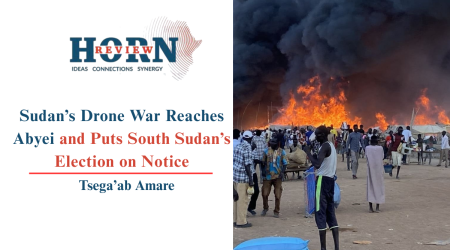
Sudan’s Drone War Reaches Abyei and Puts South Sudan’s Election on Notice
The drone strike on the Amiet market inside the disputed...
21
Oct
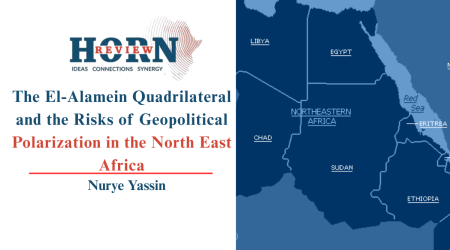
The El-Alamein Quadrilateral and the Risks of Geopolitical Polarization in the North East Africa
The rapid changes that are taking place in the North...