How SAF–Eritrea Cooperation and TPLF Mobilization Are Reshaping the Regional Security Environment
For most of its history, the Sudan–Ethiopia border has functioned as a pressure valve: porous enough for trade, refugees, and the occasional militia to pass through, but rarely a theatre in its own right. That arrangement is becoming harder to sustain. Sudan’s civil war is no longer simply a contest between the SAF and the RSF. It is becoming a regional security environment in which neighboring states like Ethiopia, Eritrea, and Chad are pulled into a shared and increasingly volatile security environment.
The risk this poses to Ethiopia is not primarily spillover in the conventional sense, fighting or refugees crossing a line on a map. It is conflict convergence: the Sudanese battlefield is becoming a shared operating environment for actors connected to Ethiopia’s own unresolved western and northern security problems, without those actors forming anything like a coordinated bloc. SAF is deepening a military relationship with Eritrea. Fighters and networks tied to Ethiopia’s Tigray conflict are active on Sudanese soil. Neither development required the other, and the actors involved have little in common beyond the war that now connects them. That is what makes the pattern dangerous: actors with different, sometimes contradictory interests can generate the same strategic pressure on Ethiopia without needing to coordinate at all.
By Ethiopia’s strategic space, this piece means something specific: Addis Ababa’s ability to avoid direct involvement in Sudan’s war while still protecting its western border, managing its unresolved northern security environment, and maintaining working relationships with Khartoum and Asmara at the same time. That space is what is narrowing.
The geography makes convergence hard to contain. Blue Nile state borders Ethiopia’s Benishangul-Gumuz region, home to the Grand Ethiopian Renaissance Dam, one of Ethiopia’s most strategically sensitive assets. Fighting there has displaced tens of thousands of people through August alone, compounded by seasonal flooding that has forced families to cross rising floodwaters to reach safety.
Since early 2026, Kurmuk and Geissan have changed hands repeatedly. RSF and its allied SPLM-N, operating under the Tasis alliance, captured Kurmuk in March, displacing nearly 100,000 people before SAF recaptured the town in July. The reversal did not last: RSF and SPLM-N retook Geissan and Kurmuk in August, and by month’s end had seized two more army bases, Bakori and Surkum, restoring their grip on the crossings into Ethiopia.
The point is not who holds Kurmuk on a given day. It is what the repeated fighting is doing to the border itself: militarizing a frontier adjacent to Ethiopia and creating repeated openings for weapons, combatants, and displaced civilians to move across it. Benishangul-Gumuz risks becoming less of a buffer and more of a vulnerable transit and staging environment for cross-border military networks, though the evidence for that shift remains suggestive rather than conclusive.
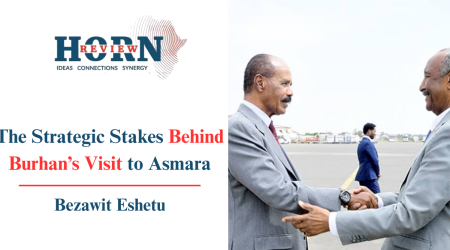
The most visible sign that this entanglement runs deeper than Blue Nile is the growing military relationship between SAF and Eritrea. Researchers tracking Sudan’s war have independently documented SAF’s use of Eritrean territory and the presence of Eritrean troops alongside SAF forces. That relationship is established with reasonable confidence. What is less established, and should not be assumed, is that Eritrea is using its role in Sudan specifically as a mechanism to pressure Ethiopia. The more defensible claim is narrower: Eritrea has its own unresolved security interests involving Ethiopia and a long history of confrontation with the TPLF, so its deepening involvement in Sudan’s war adds a layer of strategic pressure on Addis Ababa regardless of Asmara’s intent.
Tigrayan mobilization in Sudan is now better documented than a single capture claim. A unit known as Army 70, a major contingent of the TPLF’s armed apparatus that was stranded in eastern Sudan after being cut off from Tigray during the 2020–2022 war has reportedly fought alongside SAF and Eritrean forces in the fight for Kurmuk, with most of its leadership among the casualties. Separately, Prime Minister Abiy Ahmed told parliament in July that Tigrayan youth were being forcibly recruited to fight in Sudan’s war, without identifying who was responsible.
This is where the pattern becomes the central concern for Ethiopia, and where the language matters. Calling this an axis would imply a degree of coordination the evidence does not establish. SAF is deepening ties with Eritrea for its own reasons; Tigrayan fighters and networks are active in Sudan for reasons that have little to do with SAF’s war against the RSF; Eritrea and Tigrayan forces have found some working ground despite the deep antagonism they have toward each other. But Sudan’s battlefield is creating the space in which these otherwise unconnected relationships overlap, and Ethiopia has to manage the consequences regardless of whether anyone intended them.
The danger is therefore less an alliance than an ecosystem; SAF’s relationship with Eritrea gives Sudan’s military a partner on Ethiopia’s northern flank, Tigrayan fighters give Sudan’s war access to personnel with direct experience of Ethiopia’s own recent conflict, and the fighting in Blue Nile supplies the geography through which weapons, fighters, and networks can move. None of it needs central coordination to produce consequences for Ethiopia.
Shererina supplied a preview of how this works in practice. On August 1, a Tigrayan unit identified as Army 70 crossed from Sudan near Legudi, outside Humera, displacing farmers and looting property before Ethiopian federal forces and allied Amhara militia pushed it back with artillery and drone strikes, the ENDF’s first drone strikes on Tigrayan forces since the Tigray war ended. Tigrayan forces reportedly used drones of their own, and the exchange killed several Ethiopian refugees in a camp across the border in Sudan. Accounts differ over who fired first, but the fighting lasted roughly a day before an uneasy calm returned, and Ethiopian forces have since reinforced Humera with new checkpoints.
Addis Ababa has so far responded with restraint: denying direct involvement in Sudan’s war, avoiding formal alignment with either SAF or RSF, and maintaining its posture as an African Union host and potential mediator while keeping channels open with Khartoum despite deteriorating bilateral relations. That restraint is rational, direct intervention would expose Ethiopia’s western regions to retaliation, complicate an already difficult internal security environment, and weaken its credibility as a mediator.
An alternative reading would treat all of this as largely compartmentalized: SAF’s Eritrea relationship driven by Khartoum’s immediate military needs rather than any Ethiopia-facing strategy, Tigrayan participation as individual fighters and splinter networks rather than an organized TPLF structure, Kurmuk as principally a Sudanese contest with limited capacity for sustained cross-border effects. That reading is worth taking seriously but it does not eliminate the risk, because strategic consequences do not require strategic coordination. Ethiopia does not need SAF, Eritrea, and Tigrayan networks to be acting in concert for their simultaneous presence in the same conflict environment to narrow its options. The paradox is that the restraint designed to keep Ethiopia outside Sudan’s war may become harder to sustain precisely as that war penetrates deeper into the security environment surrounding it.
None of this amounts to Ethiopia being surrounded. The more accurate description is compression, not encirclement: several largely independent conflicts are becoming spatially and institutionally interconnected around Ethiopia’s borders, narrowing Addis Ababa’s room to maneuver without any single actor engineering that outcome. For Addis Ababa, the dilemma is therefore becoming sharper. Intervention risks entanglement in Sudan’s war. Continued non-intervention risks allowing the surrounding security environment to deteriorate on its own terms, while Ethiopia absorbs the consequences without controlling the forces producing them.
For now, Ethiopia’s restraint has kept Sudan’s war from becoming its own. But restraint depends on maintaining separation between conflicts, and that separation is precisely what is eroding. The greatest danger may therefore not be Sudan’s war crossing the border in a conventional sense. It is the border ceasing to separate Ethiopia’s conflicts from Sudan’s.
Tsega’ab Amare, Researcher, Horn Review