
3
Sep
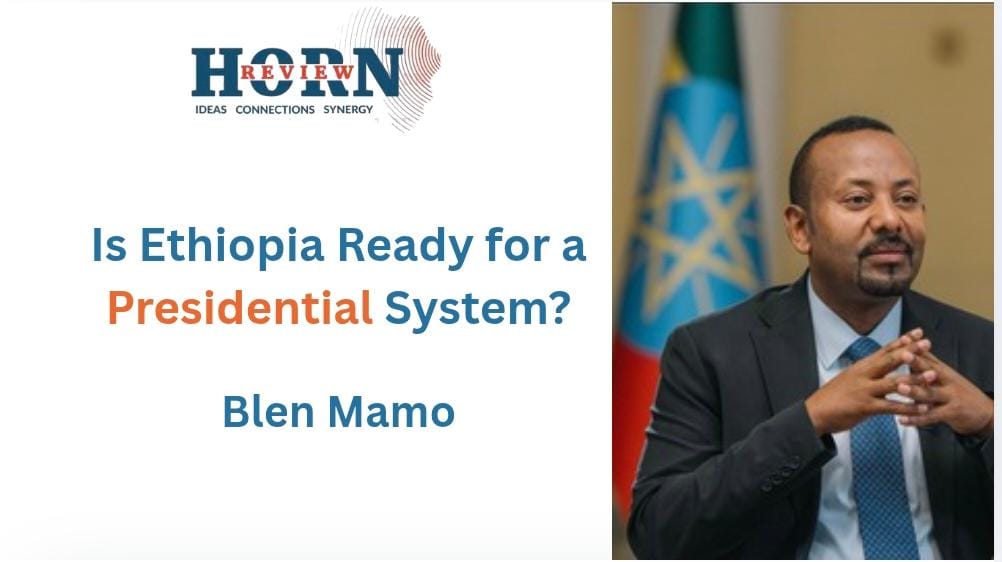
Is Ethiopia Ready for a Presidential System?
By Blen Mamo
Ethiopia has spent much of its modern political history attempting to answer the same underlying question in different constitutional languages: where should political authority reside, how should it be legitimised, and what institutional arrangement can hold together a state whose political communities do not always agree on what the state itself ought to be? Every Ethiopian constitutional order has been born from a crisis of political authority. The imperial constitutional experiments of 1931 and 1955 sought to reconcile an ancient monarchy with the institutional vocabulary of the modern state without fundamentally displacing imperial sovereignty. The revolutionary settlement of 1974 repudiated that order altogether, replacing constitutional monarchy with revolutionary legitimacy and, eventually, the highly centralized socialist state of the Derg. The 1987 Constitution attempted to give that revolution a juridical form, but its constitutional architecture collapsed with the political order that sustained it. In 1991, the problem was again posed from first principles. The Transitional Period Charter and, ultimately, the 1995 Constitution sought to reconstruct Ethiopia not around the supremacy of a centralized executive, but around a radically different conception of political sovereignty: the sovereignty of the nations, nationalities and peoples.
The constitutional architecture that emerged from that rupture has now governed Ethiopia for more than three decades. Yet the political settlement it was designed to stabilize has itself become the object of contestation. The question confronting Ethiopia is no longer simply whether the post-1991 order can be preserved, but whether the institutional grammar through which that order has expressed itself remains capable of organizing the political community that has emerged from it. This is the deeper significance of the debate over presidentialism. To describe the issue merely as a choice between a parliamentary and a presidential form of government is to strip it of its historical substance. In Ethiopia, the organization of executive power has always been inseparable from the more fundamental question of who is entitled to speak in the name of the Ethiopian state. The imperial state answered that question through the sovereignty of the Crown. The revolutionary state answered it through revolutionary authority. The post-1991 order attempted to answer it through the constitutional recognition of Ethiopia’s constituent peoples and the institutionalization of ethnic federalism. What remains unsettled is how a political community constituted through such profound plurality can produce a form of national executive legitimacy that is neither inherited from above nor monopolized by a particular political establishment. Presidentialism enters this history not as a technical adjustment to the machinery of government, but as a possible answer to that unresolved problem of legitimacy.
The proposition is controversial for obvious reasons. Ethiopia’s modern history contains too many examples of concentrated authority for anyone to approach an empowered presidency innocently. The African experience offers its own warning: the presidential office has frequently become the institutional site at which electoral legitimacy is converted into executive predominance, particularly where legislatures are weak, courts lack autonomy and political competition is organized around access to state power. For Ethiopia, therefore, the attraction of presidentialism cannot plausibly rest on the fantasy of a benevolent or unusually capable executive. A constitutional order that depends upon the character of the person occupying the presidency has already failed its most elementary test under the Dergue regime. Yet the opposite conclusion, that Ethiopia’s institutional fragility disqualifies presidentialism from serious consideration, is equally unpersuasive. It mistakes the imperfections of the present constitutional order for an argument against constitutional evolution. Institutions are not merely prerequisites for political development; they are also products of political development. No Ethiopian constitutional settlement has ever emerged from conditions of institutional perfection. Each has been an attempt to create new political possibilities out of an existing crisis of authority. The question, then, is not whether Ethiopia is sufficiently “ready” for presidential government in some abstract sense. It is whether the country has reached the point at which the inherited parliamentary settlement should be reopened, and whether a transition toward presidential government can be designed in such a way that the acquisition of a direct national mandate by the executive is accompanied, not followed, by the construction of institutions capable of restraining it.
The case for a presidential government in Ethiopia is not fundamentally a case for a stronger executive. It is a case for a different source of executive legitimacy. The 1995 Constitution deliberately separated the symbolic presidency from the effective executive. The president is head of state; the prime minister exercises the highest executive authority and derives political survival from the parliamentary majority. This arrangement reflected the political logic of the post-Derg settlement. The central danger was conceived as excessive concentration at the center, and the constitutional response was to disperse authority through federalism and parliamentary government. But the historical problem has not disappeared merely because the institutional response remains in place. Ethiopia’s political development since 1995 has exposed another dilemma: a state can possess extensive mechanisms for recognizing political plurality while simultaneously struggling to generate a sufficiently persuasive form of national political legitimacy. This is where presidentialism may offer something parliamentarism has not fully supplied.
A directly elected national executive would create a political mandate that is neither derivative of parliamentary arithmetic nor reducible to the organizational dominance of a ruling coalition. It would oblige political actors seeking the highest federal office to construct a constituency larger than their immediate regional or communal base. Properly designed, the presidency could therefore become not an instrument for suppressing Ethiopia’s plurality but an institution through which that plurality is compelled to negotiate a common political horizon. The qualification, “properly designed”, is decisive. A presidential system constructed around simple majoritarian victory could intensify precisely the centrifugal pressures it is supposed to overcome. In a country in which political identity remains closely intertwined with territory, language, historical memory and competing conceptions of statehood, the presidency could become the prize toward which every political antagonism converges. Losing the presidency could then be experienced not as the ordinary alternation of democratic government but as the temporary exclusion of an entire political community from the state.
The Ethiopian presidency would therefore have to be conceived as a mechanism of coalition formation before it is conceived as an instrument of executive power. The electoral system would have to reward geographical and political breadth. A second-round election, meaningful thresholds of dispersed support and constitutional guarantees for federal autonomy would not be peripheral technicalities; they would be the institutional means by which presidentialism could be made compatible with the country’s plural political sociology. The objective is not to manufacture a homogeneous Ethiopian political identity. It is to create incentives for political actors to discover that national authority cannot be secured through the permanent mobilization of particularistic identities alone. This is also why the present historical moment matters.
The accession of Abiy Ahmed in 2018 marked more than the replacement of one prime minister by another. It represented the visible rupture of a political architecture that had appeared remarkably durable since 1991. The EPRDF’s internal equilibrium had become increasingly unsustainable under the pressure of mass mobilization and growing political assertiveness, most particularly in Oromia and Amhara constituencies, and mounting disagreement within the ruling coalition itself. Abiy’s emergence from within that system and his subsequent dismantling of the EPRDF’s coalition structure signaled the exhaustion of a mode of political organization that had mediated Ethiopian national politics for nearly three decades. The significance of Abiy’s tenure therefore lies less in the political personality of Abiy Ahmed than in the historical transition it embodies. His premiership occupies the interval between two constitutional epochs: the exhaustion of the political settlement that emerged after 1991 and the still-unresolved search for an institutional arrangement capable of succeeding it. That makes the present period unusually consequential. The question is not simply what government Abiy leads, but whether his generation of political leadership will leave Ethiopia with another temporary equilibrium or with institutions capable of accommodating political competition after the present political generation has departed.
There is a strong argument that this transformation should occur under Abiy precisely because it should be designed to transcend him. As it is now, the presidential reform is not conceived as a mechanism for enlarging the authority of the incumbent, something that would reproduce the oldest pathology of Ethiopian political development: the identification of the state with the political actor who temporarily commands it. But if Abiy’s tenure becomes the occasion for constructing a presidency whose powers are defined, limited and institutionalized before they are exercised, then the reform could mark the gradual separation of political office from personal authority. The distinction is not semantic. It is the difference between constitutional reform and constitutional capture. Abiy is not set to become the constitutional exception to the rules Ethiopia is trying to establish. He is only attempting to establish rules under which neither he nor his successors can become exceptions.
Hence such a transition undertaken during Abiy’’s tenure is more legitimate as the prime minister is a career politician who accepts the possibility that the institutional architecture he helps create may eventually remove him from power. The ultimate proof of Abiy’s constitutional seriousness is not whether he could win a presidential election under the new system. It is rather that he has the political will to accept a system in which his successor could defeat him, his parliament could constrain him, his courts could overrule him, and his constitutional term could end without the political order itself being endangered. Hence, Abiy’s role in the transition would acquire a significance quite different from the personalization of presidential authority. His historical contribution would lie in converting the political capital of an incumbent moment into the institutional capital of a post-incumbent republic. This is the constitutional opportunity that Ethiopia should not squander.
The country is already engaged in a broader reconsideration of the political architecture inherited from the 1990s. Questions concerning the form of government, political representation, electoral arrangements, federal-regional relations and the distribution of powers have re-entered national deliberation under the now completed National Dialogue. Public opinion, too, does not suggest that Ethiopians welcome constitutional change. It reveals a population that strongly values democracy while expressing considerable dissatisfaction with the institutions through which democratic accountability is presently mediated. The majority of Ethiopians do not appear to be asking for less federalism. They are asking why the federal system they have now in place is failing to provide sufficiently credible accountability.
Presidentialism cannot answer that question by itself. But it can provide one possible institutional response if it is constructed around the principle that the executive should possess a direct electoral mandate while remaining constitutionally vulnerable to institutional scrutiny. The question is consequently not whether Ethiopia should exchange a prime minister for a president. It is whether Ethiopia can move from a political system in which national executive authority is principally mediated through a dominant parliamentary organization toward one in which executive legitimacy is directly contested by the electorate, while simultaneously ensuring that no electoral victory becomes a license for political domination. That is a much more demanding project than presidentialisation. It is, in fact, a project of constitutional maturation. And it is one for which Ethiopia may now be historically prepared, not because its political institutions are complete, but because the settlement that produced those institutions is itself being reconsidered. The country should therefore resist both the romanticism of presidentialism and the conservatism of constitutional immobility. It is not to create a presidency because Ethiopia needs a stronger man. It is to create the possibility of a presidency because Ethiopia needs a stronger relationship between national political authority and the citizens.
Ethiopia therefore does not need to argue today that presidentialism will solve the country’s political crisis. It needs to decide whether its constitutional order should begin moving toward an executive model that more directly connects national political authority to the electorate. That movement should be slow enough to permit institutional learning, deliberate enough to protect federalism, and constitutional enough to ensure that the rules are established before the political stakes become even higher. The most important question is consequently one of political maturity. Can Ethiopia change the architecture of executive power without reproducing the political habits that have historically made institutional change so dangerous? Can it create an office powerful enough to govern, legitimate enough to represent the national electorate, and constrained enough to remain subordinate to the Constitution? That is the real test of presidentialism.
As Ethiopia has already entered a period in which the constitutional settlement is being reconsidered, the choice is increasingly between deliberate institutional evolution and another cycle in which political transformation arrives only after the existing order has broken down. Abiy Ahmed has an opportunity that few Ethiopian leaders have possessed, and he has used his concentrated reservoir of political authority to begin a constitutional transition whose ultimate purpose is to distribute and institutionalise that authority rather than merely preserve it. So the significance of his presidency, if he is ever to become one, will lie not simply in how long he governed or how much power he accumulated, but in whether he helped Ethiopia establish a form of national executive government capable of surviving the politics of succession. Hence the presidentialism project under Abiy not a project for Abiy, rather a project through which his political era could be converted into a more durable constitutional order. Ethiopia is ready to begin that journey. It is not ready to rush to its endpoint. The task is to build the constitutional foundations of a presidential republic while there is still enough political authority to make reform possible and enough historical distance to ensure that the resulting presidency belongs not to an individual, a party or a moment, but to the Ethiopian republic itself.
Authors Bio
Blen Mamo is Executive Director of Horn Review and a researcher specializing in law, international security, and geopolitics in the Horn of Africa. She holds an LL.B and an M.Sc. in International Security and Global Governance.

RELATED
Posts
28
Aug
Ethiopia-U.S. Strategic Defense Partnership
The recalibration of United States–Ethiopia relations recently reflects a deeper...
20
Aug
Eritrea’s Buffer Zone Politics from Eastern Sudan to Ethiopia's Tigray
The most consequential development in the Horn of Africa may...
14
Aug
Ethiopia’s Withdrawal from Burhakaba and What Comes Next for Al-Shabaab?
The recent handover of the Burhakaba forward operating base...
13
Aug
What Another War Against Ethiopia Could Mean for Eritrea’s Future
Another Ethiopia–Eritrea war would not be a replay of 1998....
4
Aug
How Ethiopia Turned its Mega-Projects in to Diplomatic Capital
political economy of Ethiopia in Dr Abiy’s Era is defined...
1
Aug
Northern Ethiopia Fault Line and the TPLF’s Renewed Military Push
Following the popular movements that swept parts of the country...