
2
Sep
A Decade of Saudi Miscalculation in Yemen
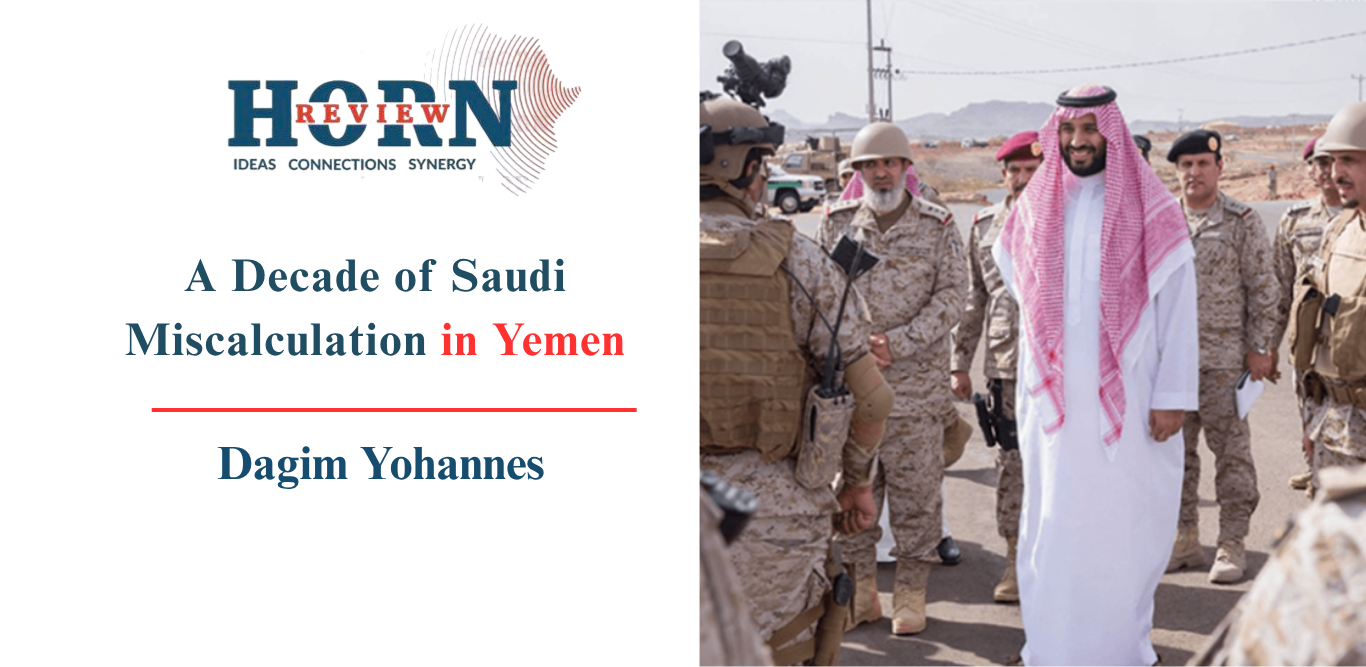
On March 26, 2015, Mohammed bin Salman, then a thirty-year-old defense minister two months into the job, launched a war on Yemen. Operation Decisive Storm was framed publicly as a campaign to restore Abdrabbuh Mansur Hadi’s government and reverse the Houthi takeover of Sanaa. Functionally, it was the inaugural act of a new center of power inside the Saudi state, and its design reflected that purpose more than it reflected any calibrated theory of how to defeat an entrenched territorial insurgency. Riyadh assembled the broadest coalition it could recruit ten states, Western matériel and intelligence support, a UN resolution and substituted that breadth for the harder work of matching military instruments to adversaries. A decade on, having tried both open war and managed de-escalation, Saudi Arabia has still not corrected that original error. It has only changed the register in which the error now costs it: from a stalemated ground war to a live chokepoint-coercion crisis on one of the world’s most important shipping lanes.None of this means Riyadh entered the war with unlimited strategic freedom. The intervention was shaped by genuine constraints: the political costs of allowing the Houthi takeover to consolidate on Saudi Arabia’s southern border, the difficulty and potential costs of deploying large numbers of Saudi ground forces, dependence on external military and intelligence support, the risk of escalation with Iran, and the domestic political priorities that increasingly accompanied Mohammed bin Salman’s economic transformation agenda. These constraints help explain why Riyadh repeatedly preferred coalition-based and airpower-heavy instruments. They do not, however, remove the central strategic question: whether those instruments were capable of delivering the political outcome Saudi Arabia had defined as victory.
The coalition’s founding flaw was not merely operational; it was strategic incoherence dressed as unity. Saudi Arabia entered Yemen to restore a specific outcome, the internationally recognized government under Hadi, later the Presidential Leadership Council. The United Arab Emirates, its indispensable partner and the only coalition member willing to commit meaningful ground capability, entered pursuing a different and ultimately incompatible endgame: cultivating southern secessionism through the Southern Transitional Council. Riyadh needed a unified Yemeni state to hand back to a friendly government. Abu Dhabi was arming and training the very actor most likely to prevent that state from being unified. This was not a coordination problem to be smoothed over in a joint operations room. It was two patrons building two different Yemens under a single coalition flag, and Riyadh treated it as manageable friction rather than what it actually was: a structural guarantee that Saudi Arabia would never have a coherent ground partner capable of translating Riyadh’s air campaign into territorial control.
The consequence of that guarantee surfaced repeatedly, and never more starkly than in January 2026, when Saudi-backed Presidential Leadership Council forces retook Aden from the STC by force, a full decade after the intervention began, Riyadh was still expending military resources not against the Houthis but against the fracture inside its own coalition. The 2025 STC offensive that preceded it, and the Saudi-backed counteroffensive that reversed it, is not a footnote to the Yemen war. It is the clearest evidence available that the client side of this conflict was never a side at all, it was two competing projects that Riyadh’s coalition design made permanent rather than provisional. Every sortie, dollar, and diplomatic hour spent re-subordinating the STC was a sortie, dollar, and diplomatic hour not spent concentrating force against the actor that mattered.
Even setting the coalition’s internal fracture aside, the war would likely have stalemated on its own terms. The Houthis’ source of power was never the kind of target airpower degrades efficiently: decentralized command structures, terrain in the northern highlands that favors dispersed defense, and a movement embedded in the social fabric of the areas it controls rather than dependent on fixed infrastructure a coalition could simply bomb into surrender. Degrading that kind of adversary requires sustained ground pressure, political co-optation, or both instruments that depend on having a reliable, unified local partner. Riyadh’s coalition design had already foreclosed that option. What remained was an air campaign that could punish but not dislodge, prosecuted by a coalition whose ground component was pursuing its own war within the war. The stalemate that followed was therefore not simply bad luck, nor was it attributable to Houthi resilience alone. It reflected the interaction between an adaptive insurgent movement, difficult political and geographic conditions, and a coalition whose internal divisions severely constrained the instruments available to Riyadh. A different coalition architecture or a sustained ground campaign might have altered the trajectory of the war, but there is no basis for assuming that either would have guaranteed a decisive Saudi victory. This lhowever, should not obscure the agency of the Houthis themselves. Their resilience was not simply a product of Saudi strategic failure or favorable terrain. The movement demonstrated an ability to adapt its military organization, absorb sustained pressure, preserve territorial control, and progressively expand the range of instruments through which it could impose costs on its adversaries. Saudi Arabia therefore confronted not merely a poorly matched military problem, but an adaptive opponent capable of exploiting the coalition’s political divisions and adjusting to changes in the conflict. The persistence of the stalemate was consequently produced by the interaction between Saudi strategic limitations and Houthi strategic adaptation, rather than by either factor in isolation.
The 2022 truce, the 2023 China-brokered détente with Iran, and the reorientation around Vision 2030 are conventionally read as Riyadh’s pivot toward maturity, a kingdom choosing prosperity over an unwinnable war. That reading is not wrong, but it is incomplete in a way that matters. The pivot did not resolve the mismatch between instrument and adversary; it capitulated to it. Riyadh did not negotiate the Houthis out of the territory they controlled. It negotiated a pause that left the Houthis in permanent command of the northern highlands and, decisively, of most of Yemen’s Red Sea coastline, Hodeidah included. In 2015, that coastal control was a domestic military fact difficult to reverse, but strategically inert beyond Yemen’s borders. Riyadh’s truce did not just fail to reverse it. It converted an unresolved military stalemate into a settled status quo, at precisely the moment the Houthis were about to discover that the same coastline gave them reach over something Riyadh could not de-escalate its way around.
That reach materialized once the Houthis pivoted from a domestic insurgency logic to a regional coercion logic, using the Red Sea shipping campaign that began alongside the Gaza war as the template. What had been a frozen territorial fact Houthi command of Yemen’s coast became a lever against global shipping, Saudi infrastructure, and by extension Vision 2030 itself, whose giga-projects, tourism calendar, and investor-confidence narrative all sit within range of exactly the capability Riyadh’s truce had left undisturbed. The Sanaa airport strike of July 13, 2026, the Houthi missiles on Abha, the Saudi retaliation against Hodeidah, and the subsequent run of strikes on Aramco facilities at Jizan and Yanbu are not a new war breaking out. They are the same unresolved territorial fact from 2015 being weaponized in a new register, the register Riyadh’s economic transformation made it most vulnerable to. Vision 2030 did not cause this exposure, but it did raise the price of the exposure Riyadh already carried and had never actually resolved, only shelved.
Riyadh’s answer to the 2026 escalation has been a Red Sea security coalition of fifty-one states invited, forty-three attending the initial meeting, fourteen actually joining. The pattern should be recognizable, because it is the same pattern as 2015: assemble the widest possible coalition, let breadth stand in for capability, and choose an instrument shaped by what is diplomatically achievable rather than by what the adversary’s actual source of power requires. A naval-security architecture is a reasonable response to a shipping-lane problem. It is not a reasonable response to a territorial insurgency that happens to have acquired shipping-lane leverage, because the leverage is downstream of a land-based reality ports, launch sites, command infrastructure that a coalition of navies cannot touch without doing the thing Riyadh spent a decade discovering it cannot do: durably contest Houthi-held territory. The coalition dresses a familiar strategic gap in newer vocabulary. It does not close it.
The Mecca collective defense pact with Turkey and Pakistan, signed within days of the Houthi strike on the Yanbu oil facility, is the clearest illustration of how little Riyadh’s coalition-diplomacy has learned from the last decade. The pact was a deterrence signal aimed at distant, capable patrons. The Houthis answered it with a strike that had nothing to do with Turkish or Pakistani military capacity, because the pact was never aimed at the actor doing the coercing. This is the same category error restated: Riyadh continues to build instruments that impress other states rather than instruments that alter the calculus of the one actor whose calculus actually needs altering. Ten years, two strategies, and one unresolved strategic problem. The kinetic phase from 2015 to roughly 2020 failed to achieve Riyadh’s political objectives in large part because Saudi Arabia relied on airpower and a coalition whose members pursued incompatible political projects, while confronting an adaptive Houthi movement that proved capable of absorbing pressure and exploiting its adversaries’ divisions. The managed de-escalation phase from 2022 to 2025 represented a rational response to the costs of continued war, but it froze rather than resolved the underlying territorial reality. That unresolved reality subsequently acquired greater strategic significance as the Houthis developed the capacity to connect control of Yemen’s coastline with regional coercion, while Vision 2030 increased Saudi Arabia’s economic exposure to disruption. The 2026 crisis is therefore not simply the inevitable consequence of decisions made in 2015, but the product of unresolved strategic choices interacting with an adversary that adapted to them. Riyadh’s challenge is no longer merely to assemble another coalition, but to ensure that the instruments it builds are capable of addressing the source of the threat rather than only its latest manifestation.
Dagim Yohannes, Researcher, Horn Review

RELATED
Posts
2
Sep
Mahamat Déby or Burhan: Who Can Win the US?
On March 26, 2015, Mohammed bin Salman, then a thirty-year-old...
2
Sep
What the Decline of Multilateralism Could Mean for Africa
On March 26, 2015, Mohammed bin Salman, then a thirty-year-old...
2
Sep
Who Gets a Seat in Saudi Arabia’s Red Sea Security Order?
On March 26, 2015, Mohammed bin Salman, then a thirty-year-old...
2
Sep
Asymmetric Attrition in Hormuz: Decoding the Escalation Against State Energy Assets
On March 26, 2015, Mohammed bin Salman, then a thirty-year-old...
2
Sep
Egypt Skipped the Mecca Pact Because It Lacks the Leverage to Join
On March 26, 2015, Mohammed bin Salman, then a thirty-year-old...
2
Sep
How the Iran and Israel Conflict Recalibrates the Algeria-Morocco Structural Antagonism
On March 26, 2015, Mohammed bin Salman, then a thirty-year-old...
2
Sep
The Mecca Pact Claims Iran Isn't the Target, So Who Is?
On March 26, 2015, Mohammed bin Salman, then a thirty-year-old...
2
Sep
Deconstructing the Eastern Defence Pact and the Rise of the Sunni Colossi
On March 26, 2015, Mohammed bin Salman, then a thirty-year-old...
2
Sep
The Structural Logic of Türkiye–Israel Rivalry in a Fragmented Regional Order
On March 26, 2015, Mohammed bin Salman, then a thirty-year-old...
2
Sep
Turkiye’s Defence Diplomacy Amidst Middle Power Competition in the Horn
On March 26, 2015, Mohammed bin Salman, then a thirty-year-old...