Among the array of middle powers for whom the Horn is fast becoming a proving ground for influence, Turkiye increasingly holds a predominant role. It sits geographically further from the region than contemporaries such as Israel and the Gulf monarchies, states that view the Horn as bearing directly on their own security. Yet Ankara projects a comparable degree of leverage. This trajectory reflects the singular position Turkiye occupies in international relations. It is also a manifestation of a worldview increasingly shaped by President Recep Tayyip Erdogan.
In 2011, Erdogan, then prime minister and short of the authority he would go on to accumulate, made his first trip to Somalia, a state then reeling under famine and decades of conflict. The visit drew international attention to the crisis and brought with it Turkish humanitarian aid. What it laid down was the foundation for a presence that has since grown into one of the most consequential in Turkish foreign policy. Fifteen years later, in April this year, Turkiye sent its drillship Cagri Bey to begin the country’s first overseas deep-sea drilling operation, striking the Curad-1 well off the Somali coast under naval escort, a venture that secured Ankara significant offshore resource concessions. More significant still, Somalia now hosts Turkiye’s largest overseas military base, Camp TURKSOM in Mogadishu, where Turkish officers train the Somali National Army, and, as of this year, Turkish F-16 fighter jets have taken to Somali skies, striking al-Shabab targets and reinforcing the federal government against the insurgency and rival factions alike.
This build-up of influence has unfolded alongside a broader shift in Turkish foreign policy thinking, itself a consequence of Erdogan’s rise and his steady accumulation of state power. That rise is often judged as consequential as the presidency of Kemal Ataturk; a legacy Erdogan has borrowed from in form but departed from in substance. Where Ataturk entrenched the military’s guardianship of the state, Erdogan curbed it, surviving an attempted coup in July 2016 and emerging politically stronger, using its aftermath to push through changes that further consolidated presidential power. He has also recast the place of religion in Turkish identity. Where Ataturk pursued a strict secularism, Erdogan brought Islam and its traditions back to the centre of public life, a shift that helped ease Turkiye’s entry into Somalia under the banner of Islamic solidarity.
More broadly, Erdogan has pulled Turkiye out of what many once considered a cautious, inward-looking foreign policy. Ataturk anchored the republic’s future firmly in the West, tying it to NATO and largely confining its ambitions to the Middle Eastern neighbourhood, once the country’s domain either directly or by extension under Ottoman rule. Erdogan, drawn to that Ottoman inheritance, reversed this posture, building a foreign policy that positions Turkiye as an active player across a shifting international order, one that exploits its unique location straddling Europe and Asia while responding to the volatile security dynamics of the Middle East.
Erdogan’s ambition for Turkiye as a great power has extended that reach well beyond its immediate neighbourhood. Since returning to the Horn of Africa through Somalia in 2011, more than a century after Ottoman authority receded from the region, Turkiye has established itself as a major regional actor. Across Ethiopia, Sudan, Djibouti and, to a lesser extent, Eritrea, Turkish foreign policy is an increasingly visible presence. Ankara now competes for influence and concessions with fellow middle powers such as Saudi Arabia and the UAE, backing governments and political actors whose interests align with its own.
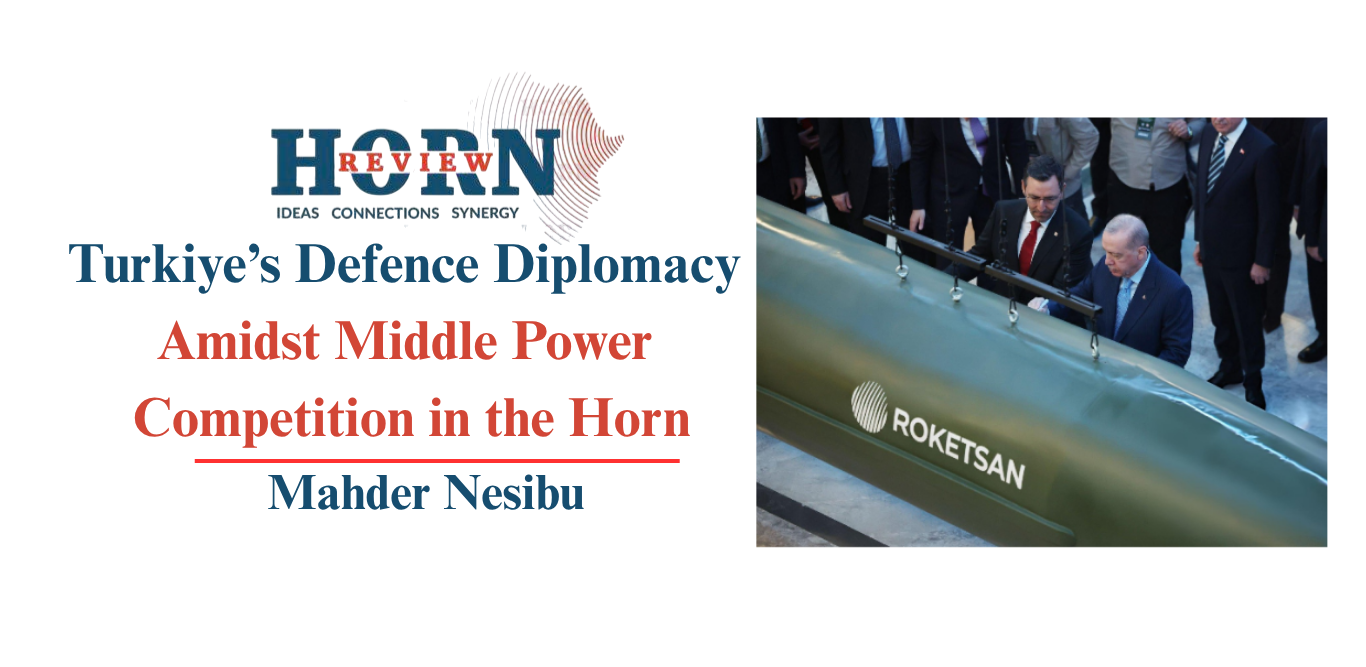
What distinguishes Turkiye’s approach, however, is its growing willingness to deploy its defence industry as an instrument of that influence, one that simultaneously generates export revenue for the Turkish economy. This pattern extends across Ankara’s broader diplomatic footprint. Beyond securing Turkish interests directly, as in Syria and Libya, its defence exports have elevated Turkiye’s standing in the global balance of power, evident in its arms sales to Ukraine in the war against Russia. Turkish defence capability is now increasingly visible in the West too, where Erdogan hopes the country’s place in NATO will position the country as a supply hub for European militaries.
In the fragile security landscape of the Horn, Turkish exports have proven far more consequential and far more visible. Their first major display came in Ethiopia in 2021, when the appearance of the Bayraktar TB2 helped tip the balance in the government’s favour against rebel forces that had threatened to reach Addis Ababa. The episode cemented Ankara’s standing in the eyes of the Ethiopian government and marked its emergence as a strategic partner for the region’s most powerful country.
In Sudan, which descended into civil war in 2023, Turkish-made Bayraktar TB2 and Akinci drones now form the backbone of the Sudanese Armed Forces’ aerial arsenal, with Turkish arms and technical support central to General al-Burhan’s war effort against the Rapid Support Forces (RSF).
Drones remain the flagship of Turkish defence exports and power projection in the region, but they are unlikely to remain the only consequential one. As Ankara’s reach across the Horn deepens and its defence industry matures, Turkiye is positioning itself as the principal supplier of weapons to a growing list of regional partners, an arrangement that hands it substantial, and unique influence.
That influence, however, is complicated on two fronts. The first lies in the complicated relationships Ankara has cultivated. For example, Turkiye maintains favourable standing in both Cairo and Addis Ababa, governments locked in a rivalry of their own over the Nile. The second lies beyond Ankara’s control, in the interests of the fellow middle powers active in the region. Chief among these is Israel, whose rivalry with Turkiye now poses the sharpest challenge to Ankara’s influence in the region. Tensions between the two Middle Eastern powers have sharpened in recent years, with Israel increasingly viewing Turkiye as a threat to its security and Erdogan emerging as the most outspoken critic of Tel Aviv’s regional policy, particularly on the Palestinian question.
That rivalry spilled directly into the Horn late last year, when Israel became the first country to formally recognise Somaliland’s independence, a move Mogadishu and its Turkish partner both rejected. Erdogan had previously persuaded Addis Ababa to shelve a similar recognition plan of its own, one driven by Ethiopia’s pursuit of sea access. Israel’s recognition, and speculation over a prospective military foothold on Somaliland’s coast, now complicate the balance of power Ankara has worked to construct, adding a further fault line to its designs for regional influence.
Israel’s moves to counter Turkish influence did not stop there. When Erdogan made a historic visit to Addis Ababa to meet Prime Minister Abiy Ahmed in February, Israel dispatched President Isaac Herzog a week later to meet the same Ethiopian leadership, a country with which Israel maintains longstanding ties of its own. The Israeli rivalry is the most acute challenge to Turkish power projection, though hardly the sole one. Gulf powers are similarly entangled in Sudan’s civil war, which has become both a staging ground for middle power competition and a source of strain in intra-Gulf relations, evident in the friction between the United Arab Emirates and Saudi Arabia over their respective positions in the conflict.
Amid this crowded landscape, Turkish defence prowess will likely remain a prominent foreign policy tool. Erdogan’s influence in the Horn will, however, not solely rest on the sophistication of the weapons technology Ankara can offer and but also on his ability to sustain the balancing act he has long applied to Eurasian geopolitics. Turkish foreign policy in the region will be measured by how well Ankara navigates that same complexity alongside the array of middle powers competing for influence there.
By Mahder Nesibu, Researcher, Horn Review