
The Mecca Pact Claims Iran Isn’t the Target, So Who Is?
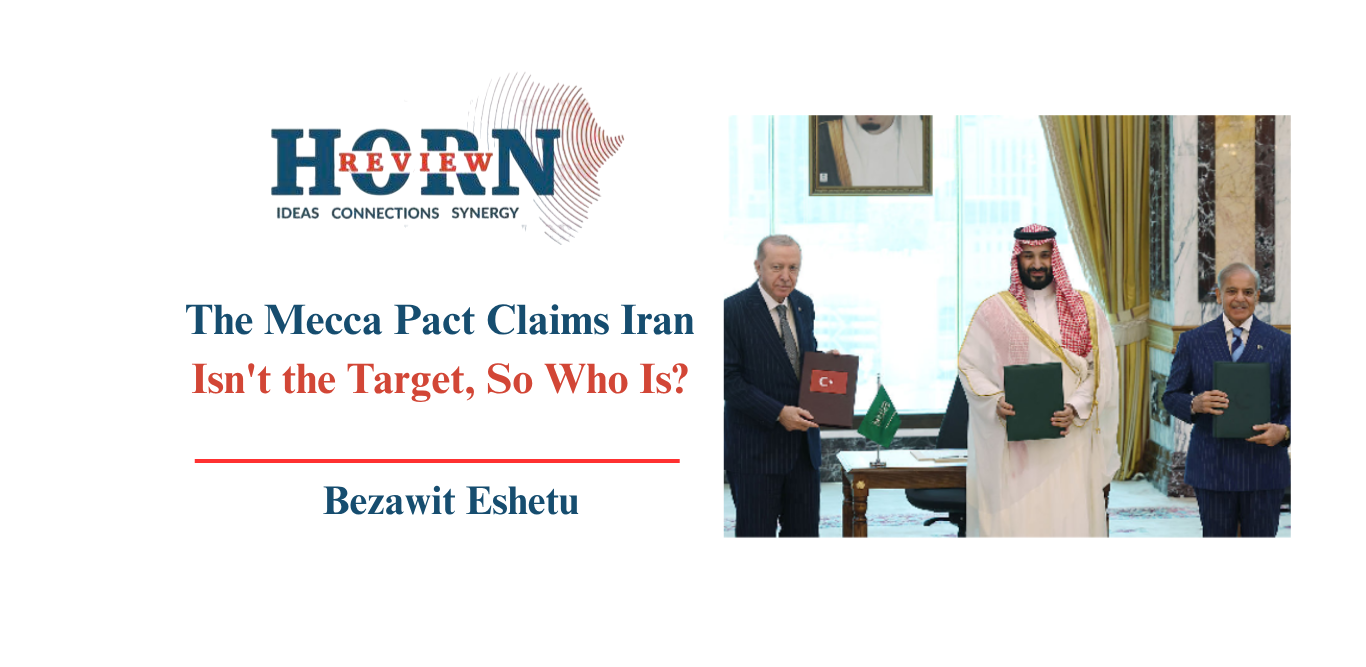
On August 7, 2026, in the holy city of Mecca, Saudi Crown Prince and Prime Minister Mohammed bin Salman, Turkish President Recep Tayyip Erdogan, and Pakistani Prime Minister Shehbaz Sharif signed the Mecca Joint Defense Agreement, a trilateral mutual defense pact under which an armed attack against any one signatory is treated as an attack against all three. The arrangement is grounded in the logic of Article 51 of the United Nations Charter and modeled, in the words of Turkish Foreign Minister Hakan Fidan, on the collective defense clause that anchors NATO.
It builds directly on the bilateral Strategic Mutual Defense Agreement that Riyadh and Islamabad concluded on September 17, 2025 at Al Yamamah Palace, a pact that formalized decades of Pakistani training and advisory support to Saudi forces dating to a 1982 security cooperation agreement. Turkey’s accession in 2026 transforms what had been a bilateral floor into a broader trilateral security architecture, one whose secretariat will sit in Saudi Arabia and whose ministerial and military committees are meant to institutionalize joint training, intelligence sharing, and defense industrial cooperation among the three states.
The timing of the September 2025 bilateral pact is itself analytically significant. It followed by eight days an unprecedented Israeli airstrike on September 9, 2025 in Doha, Qatar, aimed at Hamas negotiators as they weighed a ceasefire proposal, an operation that killed Hamas officials and a Qatari security officer and drew condemnation from Saudi Arabia, the United Arab Emirates, and even a rare public rebuke from Washington. The strike was Israel’s first known attack on a Gulf Cooperation Council member and demonstrated, to Gulf capitals watching closely, that sovereign airspace in the region could be violated on short notice and with little diplomatic cost.
Reporting from Al Jazeera traces the origins of trilateral discussions further back still, to the period soon after the October 7, 2023 Hamas attack and the ensuing Gaza war, with negotiations gaining momentum amid the wider US and Israeli war against Iran that began on February 28, 2026. Fidan himself has said preparations for the trilateral framework were underway for roughly two years and eight months before the Mecca signing, and separate Turkish officials have described nearly two years of quiet persuasion among the three capitals. This chronology matters because it places the genesis of the pact well before the February 2026 escalation with Iran, a fact that complicates any account that treats the alliance as a reactive response to Iranian aggression alone.
Placed against the region’s twentieth century experiments in collective security, the Mecca Pact reads as a departure rather than a repetition. The Baghdad Pact of 1955 and its successor the Central Treaty Organization were externally sponsored instruments of Cold War containment, designed in London and Washington more than in Baghdad or Tehran, and they collapsed for want of indigenous legitimacy once regional politics shifted. The Islamic Military Counter Terrorism Coalition and the security committees of the Organization of Islamic Cooperation offered intelligence exchange and symbolic solidarity but stopped well short of a binding commitment to fight on a partner’s behalf. The Mecca Joint Defense Agreement supplies exactly the element those earlier frameworks lacked, a formal, mutual, and indigenously negotiated commitment to collective defense that does not route through a Western command structure.
each partner brings something strategic to the table. Turkey supplies NATO’s second largest standing military, an increasingly self-sufficient defense industrial base spanning drones, naval combatants, and missile systems, and years of operational experience across Syria, Libya, and the Levant. Pakistan supplies the Muslim world’s only operational nuclear deterrent, a large standing army, and expeditionary depth that has already become tangible, with reports of roughly eight thousand Pakistani troops, alongside fighter aircraft, drones, and an air defense system, already deployed inside the Kingdom, even as Islamabad negotiates a parallel security for investment arrangement with Kuwait.
Saudi Arabia supplies capital, the custodianship of Islam’s two holiest cities, and the diplomatic convening power to host the pact’s secretariat and to lead a wider regional maritime coalition. So, Mecca did not so much invent a new alliance as formally merge two bilateral relationships that were already converging, the decades old Saudi-Pakistan military relationship and a separate Turkey-Pakistan track built on warship and pilot exchanges and a large 2023 Saudi order for Turkish drones. Agreements layered onto pre-existing operational cooperation tend to outlast changes of government more reliably than treaties negotiated from a cold start, which gives the trio a structural durability that a purely transactional coalition would lack.
Each signatory arrives at Mecca carrying a distinct, and only partially overlapping, threat perception of Iran and Israel. Saudi Arabia’s rivalry with Tehran is long standing and concrete, rooted in the proxy war in Yemen and in contests over Gulf maritime security, and it deepened sharply after February 28, 2026, when the United States and Israel launched their war against Iran and the Kingdom itself came under direct fire from Iranian forces and their Houthi allies, threatening its oil exports and its long-term development ambitions. Yet Saudi strategic anxiety toward Israel runs on a separate track that predates the Iran war, anchored in the demonstration effect of the Doha strike.
Turkey’s threat matrix inverts the emphasis. Ankara competes with Iran for influence in northern Iraq and post-Assad Syria, but its structural confrontation is increasingly with Israel. Turkey has backed the effort to rebuild a unified Syrian state under President Ahmed al-Sharaa, a project that collides directly with an Israel that dismantled much of Syria’s remaining military infrastructure after the Assad government’s fall. Ankara’s Blue Homeland doctrine, known domestically as Mavi Vatan, asserts Turkish maritime and energy rights across the Eastern Mediterranean against a bloc of states, Israel prominent among them, contesting the same waters. Former Israeli Prime Minister Naftali Bennett has described Turkey as the new Iran and accused Ankara of building a hostile Sunni axis alongside nuclear armed Pakistan, language that itself signals how seriously segments of the Israeli security establishment now weigh the Turkish relationship.
Pakistan’s posture is the most triangulated of the three. Islamabad maintains no diplomatic relationship with Israel, manages a delicate and occasionally tense border with Iran, and depends heavily on Gulf capital and remittances, a dependency that gives Riyadh real leverage over Pakistani foreign policy even as it gives Islamabad a route to greater international standing through its role as the alliance’s nuclear guarantor. A comparative reading of these three postures complicates the conventional narrative that treats the Mecca Pact chiefly as an instrument of Iranian containment. The pact is aimed at counterbalancing Iranian power while simultaneously building deterrence against Israel, describing it as preparation for neither confrontation with Tehran specifically.
Fidan has gone further still, stating publicly that Iran is not the alliance’s target and that no state which refrains from attacking the signatories has anything to fear from it, a position consistent with the pre-February 2026 origin of the negotiations. Taken together, the timeline and the official Turkish framing point toward a structural driver broader than Iran alone, one centered on deterring the kind of unconstrained regional strike capacity, the kind Israel has. At the same time, Iranian officials have publicly dismissed the pact, with members of parliament’s national security committee calling it a paper guarantee that offers Riyadh no more real protection than decades of dependence on Washington provided, a reminder that the empirical picture remains genuinely contested rather than settled in either direction.
The most direct evidence that the Mecca Pact functions as more than an anti-Iran instrument comes from the coalition Israel itself has begun assembling in response. On February 22, 2026, addressing his own cabinet ahead of Indian Prime Minister Narendra Modi’s visit to Jerusalem, Prime Minister Benjamin Netanyahu unveiled what he called a hexagon of alliances, linking Israel with India, Greece, and Cyprus, alongside unnamed Arab, African, and Asian partners, in a system he said was meant to stand against both a radical Shia axis led by Iran and what he explicitly termed an emerging radical Sunni axis. The framework builds on an existing trilateral defense relationship among Israel, Greece, and Cyprus that was reaffirmed at their tenth summit in late 2025 and that already includes joint air and naval exercises in the Eastern Mediterranean.
Every principal member of the Hexagon carries an active rivalry with a member of the Mecca Pact. Greece and Cyprus dispute Turkish maritime claims across the Eastern Mediterranean, contests that sit directly crosswise Ankara’s Blue Homeland doctrine, while India’s rivalry with Pakistan needs no elaboration. The symmetry appears deliberate. The Hexagon may be better understood as a branding exercise layered atop a patchwork of pre-existing bilateral ties than as a deliverable NATO style treaty, noting that no government has publicly endorsed either its membership list or its sectarian framing, and that two of Netanyahu’s named partners, Greece and Cyprus, are International Criminal Court members obligated in principle to arrest him were he to set foot on their territory.
That skepticism to call it a deliverable NATO style treaty is a fair caution against overreading the Hexagon as an operational alliance on par with Mecca. Yet the framing itself, articulated in Netanyahu’s own words as explicitly directed at a rising Sunni axis alongside a Shia one, is difficult to reconcile with an account of the Mecca Pact that treats Iran as its sole or even primary target.
A senior Israeli official, discussing the Mecca signing with the press, offered a similar diagnosis from the other side, observing that the Shiite axis has weakened while the Sunni axis has been steadily strengthening, and describing the new pact as an alliance aimed against Israel. When both sides of a rivalry independently describe the same structure in axis versus axis terms, the case for reading Mecca as a systemic counterweight to a Hexagon centered on Israel gains real weight, even if the Hexagon itself remains more aspiration than treaty for now.
The Mecca Pact’s maritime ambitions extend well beyond its three signatories through the Red Sea Security Initiative that Saudi Arabia launched in Riyadh in late July 2026. Representatives from forty-three countries and the European Union attended the founding meeting, and fourteen governments, including Saudi Arabia, Turkey, Pakistan, Egypt, Kuwait, Bahrain, Qatar, Jordan, Yemen, Bangladesh, Nigeria, Sudan, Djibouti, and Somalia, signed the joint statement establishing the coalition, whose stated purpose is to protect freedom of navigation and energy shipments through the Bab al-Mandeb Strait, the Red Sea, and the Gulf of Aden.
The initiative’s public framing centers on Houthi attacks on shipping rather than on Israel specifically, within that broader fourteen state grouping, however, a tighter core of Saudi Arabia, Turkey, Pakistan, and Egypt, sometimes described regionally as the R4, is increasingly coordinating its own security posture and views both Israel and Iran, in varying degrees, as sources of regional risk.
Egypt’s position illustrates how contingent the alliance’s further growth remains. Fidan, articulating what he described as Erdogan’s own vision, told Turkey’s state news agency that Ankara expects Egypt to join the Mecca Pact once a small number of technical issues are resolved, calling Cairo a natural partner on all matters and noting that the two countries already act as if they were alliance members. Egypt notably did not join at the August 7 signing, and the technical problems Fidan mentioned might be Egypt’s formal peace treaty with Israel, its dependence on American military assistance, and a general wariness about binding collective defense commitments that could constrain its freedom of maneuver.
Egyptian and Turkish officials have nonetheless kept channels open, with the two foreign ministers speaking by phone within days of the signing to discuss regional security arrangements and to follow up on a strategic cooperation council the two countries established in Cairo earlier in the year. Egyptian accession, should it eventually happen, would extend a belt of coordinated deterrence from the Eastern Mediterranean to the Arabian Sea, though its more immediate significance may lie in what Cairo’s caution reveals about the limits of the bloc’s appeal even among natural candidates.
Underlying all of this is a broader and more structural shift, the gradual thinning of guaranteed American security coverage across the region. the Pact is basically operationalizing the principle that external powers should not be able to unilaterally revise the region’s political order, a status quo minded logic shared by all three signatories even as their individual grievances differ. The Trump administration had issued no formal response to the pact within its first days, a silence that is further an evidence of Washington’s reduced appetite for shaping outcomes it once would have moved quickly to manage. Whether that drawdown produces a more dangerous, multipolar scramble or a steadier, self-regulating balance of power among credible regional actors remains an open and genuinely contested question, one that the pact’s first real test, will eventually answer.
By Bezawit Eshetu, Researcher, Horn Review

RELATED
Posts
9
Oct
Could the Riyadh Airport Strike Reshape the Yemen Conflict?
A series of claimed missile and drone strikes on King...
8
Oct
The Makkah Pact and the Limits of Collective Defence
The Makkah Joint Defence Agreement rests on an ambitious...
28
Sep
Saudi-led Multinational Maritime Defence Coalition and the Changing Security of Bab el-Mandeb
On 2 September, the Saudi-led Multinational Maritime Defence Coalition...

28
Sep
The AI Disinformation War in the Horn and the Economics of Digital Conflict
In September, Marc Owen Jones, an Associate Professor of...
24
Sep
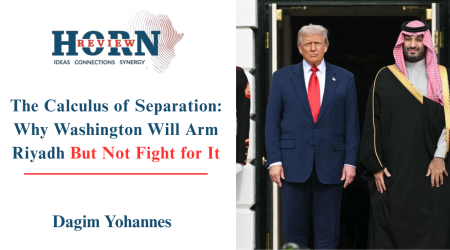
The Calculus of Separation: Why Washington Will Arm Riyadh But Not Fight for It
The episode reveals a distinction in the U.S.-Saudi security relationship...
21
Sep
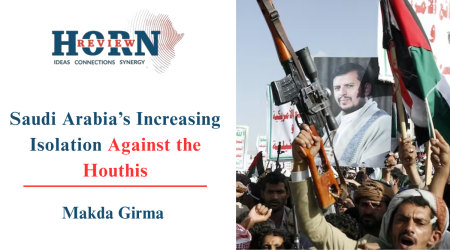
Saudi Arabia’s Increasing Isolation Against the Houthis
Saudi Arabia’s renewed confrontation with Yemen’s Houthis has exposed how...
21
Sep
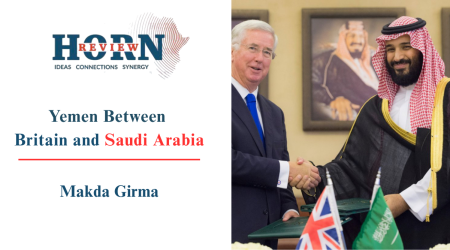
Yemen Between Britain and Saudi Arabia
The Houthi advance along Yemen’s Red Sea coast has exposed...
21
Sep
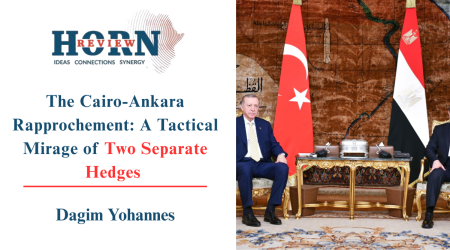
The Cairo-Ankara Rapprochement: A Tactical Mirage of Two Separate Hedges
The recent run of headlines out of Cairo and Ankara,...
20
Sep
The African Union Was Designed to Stand Outside Sudan's War
Every time Sudan's war comes up in public discussion, mentioning...
2
Sep
A Decade of Saudi Miscalculation in Yemen
On March 26, 2015, Mohammed bin Salman, then a thirty-year-old...