
31
Aug
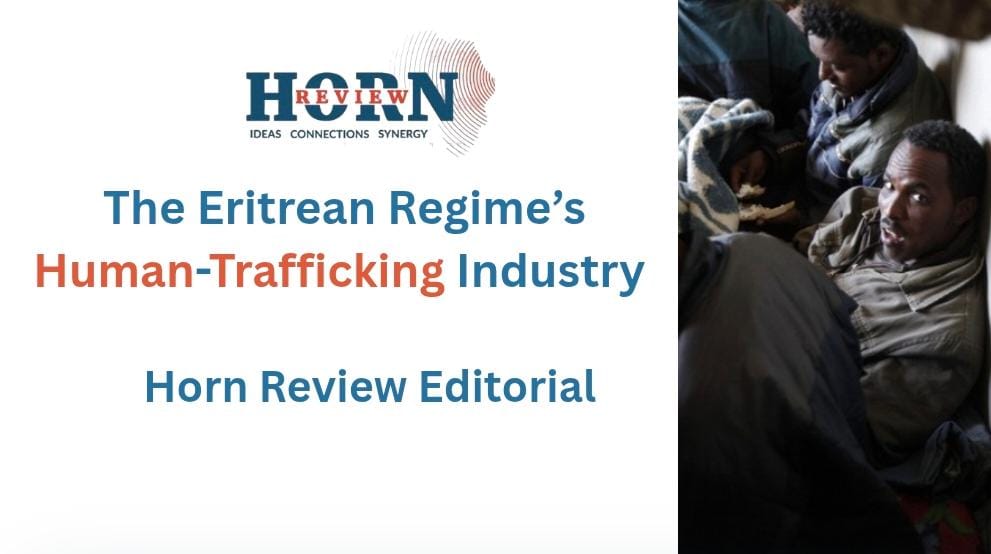
The Eritrean Regime’s Human-Trafficking Industry
For more than two decades, Isayas Afeworki’s regime has presented the mass departure of its young population as an existential problem: a haemorrhage of the country’s human capital, a consequence of hostile foreign intervention, and, above all, an illegal act that the state claims to prevent through an elaborate system of surveillance, checkpoints, border controls and punishment. Yet the scale and continuity of Eritrea’s exodus raise a question that cannot be reconciled with the regime’s public narrative. How can a government that exercises such pervasive control over territory, movement and the lives of its citizens fail to know that thousands of young Eritreans are leaving the country every month? And if the regime knows – as the architecture of its security state makes it unavoidable – why does it allow some to pass while pursuing others who attempt to do precisely the same thing? The answer lies in the distinction between those who escape and those who are permitted to escape through the regime’s own channels.
Eritrea is not a state in which an uncontrolled mass movement of people can simply occur unnoticed. The country is governed through an extraordinarily dense security architecture. Movement is regulated through checkpoints; military and civilian populations are subject to surveillance; the western and eastern frontiers are heavily securitised; and the regime has historically exercised decisive control over the routes through which Eritreans attempt to leave. International reporting has repeatedly documented the severity of these controls, including restrictions on passports and exit visas and, at various periods, the use of lethal force against unauthorised border crossings. Yet alongside this regime of prohibition exists another system: a controlled economy of exit. The contradiction is only apparent. The regime does not need to prevent every Eritrean from leaving. It needs to control the conditions under which Eritreans leave. Once this distinction is understood, the extraordinary persistence of the exodus takes on a different meaning.
The clandestine route is not necessarily an escape from the regime’s reach; for many, it is a route whose passage is made possible by elements within that very apparatus. The migrant and the family financing the journey may believe they are dealing with smugglers operating in defiance of the Eritrean state, while the people arranging the passage, negotiating the price and ensuring safe passage through checkpoints are themselves connected to the security networks that control those checkpoints. This is the hidden architecture of Eritrea’s exit economy. Accounts collected in research on the trafficking of Eritreans have described precisely such arrangements. One detailed study of the Sinai trafficking cycle, The Human Trafficking Cycle: Sinai and Beyond (Reisen, Estefanos & Rijken – Tilburg University and Wolf Legal Publishers, 2013) reported that, because of the density of checkpoints and the difficulty of obtaining legal travel documents, leaving Eritrea without the involvement of the Border Surveillance Unit was extraordinarily difficult. It documented testimony that members of the Eritrean diaspora paid between $5,000 and $7,000 to secure the safe departure of relatives and described arrangements in which a high-ranking official ensured that the person was not stopped at checkpoints and was transported toward Khartoum, where payment was made. The same research cited reports of Eritrean military officers receiving substantial payments for smuggling services.
This transforms the meaning of the border. The border is not simply a barrier separating Eritrea from Sudan or Ethiopia. It is a point of economic extraction controlled by the same security apparatus that publicly claims to defend it. The checkpoint becomes a toll gate. The exit permit becomes a commodity. The Eritrean intelligence officer becomes an intermediary. The smuggler becomes a front. And the family’s desperation becomes the source of foreign currency for the regime. The power of such an arrangement lies precisely in its concealment. The family outside Eritrea does not know that the person arranging the journey is connected to the regime. The young Eritrean preparing to cross the border does not know who has authorised the passage. Both remain convinced that they are dealing with independent smugglers who are themselves afraid of the Eritrean authorities. The apparent danger of being caught by the regime becomes part of the theatre through which the operation protects itself. The migrant is therefore permitted to believe that escape is an act of defiance. The family is permitted to believe that it is paying criminals who have successfully outmanoeuvred the state. The intermediary is permitted to present himself as an independent smuggler. And the regime retains control over the decisive infrastructure through which the person must pass.
This is not merely an ingenious smuggling arrangement. It is a mechanism of political and economic control. By controlling the border while allowing selected people to pass through intermediaries, the regime can simultaneously preserve the appearance of prohibition and capture the economic value created by the prohibition itself. The illegality of departure is what makes the transaction lucrative. The fear of arrest is what makes the “safe passage” valuable. The very restrictions imposed by Isayas Afeworki’s regime create the premium that can subsequently be extracted from the migrant’s family abroad. The $5,000–$7,000 payment reported in the trafficking research is therefore not simply a smuggler’s fee. It represents the monetisation of a political restriction. This also explains the extraordinary cruelty surrounding the journeys. The fear experienced by the migrant and the family is not necessarily evidence that the regime has lost control of the process. Fear is part of the mechanism. The young person leaves knowing that capture could mean detention, punishment or forced return. The family abroad is told that anything could happen before the relative reaches Sudan or Ethiopia. Every checkpoint becomes a potential death sentence. Every phone call becomes a moment of terror. Every delay creates the possibility that the money has disappeared and the migrant has been captured or handed over to traffickers. Yet for those who have paid the right intermediary, the journey can proceed. The apparent randomness is therefore itself deceptive. What looks to the outside observer like an uncontrolled trafficking environment can, from the perspective of the regime’s security architecture, constitute a system of selective permeability: the border is closed to those without the required connections or payments and penetrable for those who have secured the appropriate arrangement. The regime does not relinquish sovereignty over the border. It commercialises access to it.
The implications extend far beyond the border crossing itself. Once the Eritrean migrant reaches Sudan, the individual enters a regional trafficking economy in which kidnapping, ransom, forced labour and onward smuggling have become deeply interconnected. International reporting has repeatedly documented the vulnerability of Eritreans to trafficking after leaving the country and has recorded allegations of Eritrean military involvement in migration-related and possibly trafficking crimes along the Sudanese frontier. Research on the trafficking cycle has likewise documented allegations that Eritrean security personnel participated in or facilitated the movement of people across the border. The significance of these allegations is not confined to individual officers. Their importance lies in what they reveal about the institutional permeability between the regime’s security apparatus and the business of human movement. If the officials responsible for preventing unauthorized exit are simultaneously able to facilitate selected crossings for payment, then smuggling ceases to be merely an external criminal enterprise. It becomes an informal extension of the state’s border economy.
And this is where the diaspora enters the equation. The Eritrean diaspora is not merely a community of exiles supporting relatives at home. It has become one of the regime’s most important sources of foreign currency. The same families living in Europe, North America, the Middle East and elsewhere who are compelled to raise thousands of dollars to secure the escape of relatives are subsequently subjected to another form of extraction: the two-percent diaspora tax. Eritrean citizens abroad have long been required to demonstrate payment of the two-percent tax in order to access a range of consular and other services, including passport renewals and certain property transactions. The regime therefore extracts value at both ends of the migration process. First, the family pays to get the young Eritrean out. Then, once that young Eritrean has established himself abroad, the regime claims a continuing share of his income. Escape does not end the economic relationship with the state. It changes its form. The migrant who was once a conscript becomes a member of the diaspora.
The labour that could no longer be extracted directly through national service can now be monetised indirectly through taxation, remittances and the broader financial obligations imposed upon Eritreans abroad. The person who was driven out by the coercive system becomes, paradoxically, a source of foreign currency for the same political structure from which he fled. The two-percent tax is consequently not simply a tax policy. It forms part of the regime’s broader architecture of extraterritorial control. The U.S. State Department has documented that Eritreans abroad must provide proof of payment of the tax to obtain various government services and documents, while people who left illegally have also been required to sign a “regret form.” Earlier legal and human-rights assessments documented the use of the tax as a mechanism of pressure over diaspora Eritreans and linked access to official documents and rights of return to compliance with the regime’s financial demands. Thus the economic cycle begins before departure and continues long after arrival. What appears to be a refugee crisis can therefore also be read as a system of transnational extraction.
This is the context in which the Red Sea Trading Corporation becomes indispensable to understanding the wider regime economy. The corporation is not a peripheral commercial entity. The U.S. Treasury has explicitly described RSTC as managing the property and financial interests of the People’s Front for Democracy and Justice, acting as its funder and providing it with business assistance. The Treasury also identified Hagos Ghebrehiwet, the PFDJ’s economic adviser and RSTC’s chief executive, as materially supporting the ruling party. The corporation is therefore part of the regime’s economic machinery through which political authority, commercial activity and financial accumulation are fused. The significance of RSTC in the trafficking story lies precisely here. The regime does not maintain separate compartments labelled “security,” “politics,” “diaspora taxation,” “smuggling” and “commerce.” Its system of power is organised through overlapping networks of officials, political structures, security institutions and commercial entities. The same political order that determines whether an Eritrean can leave the country also controls the institutions through which significant commercial activity is conducted. The same regime that extracts foreign currency from its diaspora operates commercial structures designed to generate and control additional revenue. Human trafficking, in this configuration, is not an isolated criminal aberration. It becomes one more frontier of economy for Isayas Afewroki’s regime in which political control is repeatedly converted into financial value.
The most important question is consequently not whether the regime publicly condemns trafficking. Of course it does. The regime can condemn illegal migration while controlling the channels through which illegal migration occurs. It can denounce smugglers while its own security personnel allegedly participate in smuggling. It can portray the mass departure of youth as a national tragedy while allowing selected departures to proceed through arrangements that generate hard currency. It can describe the migrants as victims of foreign traffickers while extracting revenue from the diaspora they create.
The contradiction is not between what the regime says and what happens on the ground. The contradiction is the mechanism. The regime’s public prohibition creates scarcity. The security apparatus controls access to the scarce commodity. The smuggling network monetises access. The diaspora supplies the foreign currency. The migrant becomes the source of the transaction. And the regime’s broader commercial apparatus provides the economic infrastructure through which the resulting wealth can circulate. This is why the Eritrean regime’s human-trafficking industry must be understood as an industry of controlled exit. The decisive commodity is not simply the human being. It is permission to move. The regime’s power derives from its ability to deny that permission, selectively provide it, and thereby capture the enormous economic premium created by the prohibition. The young Eritrean who leaves the country is therefore not necessarily escaping the regime’s economic system when he crosses the border. In many Isayas Afeworki’s regime thus does not merely preside over a country from which people flee. It has constructed an economy in which the flight of its own citizens can itself become a source of revenue.
Horn Review Editorial

RELATED
Posts
31
Aug
The Geopolitics of Legitimacy and Saudi’s Recalibration in Sudan and the Red Sea area
The presentation of diplomatic credentials is ordinarily a procedural formality...
30
Aug
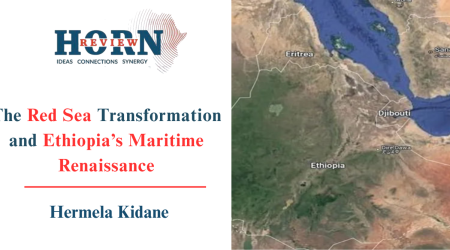
The Red Sea Transformation and Ethiopia’s Maritime Renaissance
The formation of the Horn of Africa is undergoing a...
30
Aug
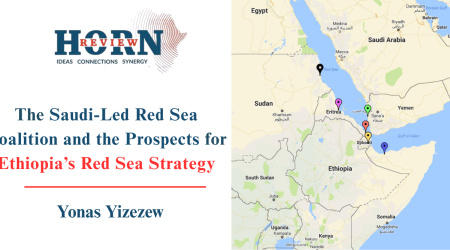
The Saudi-Led Red Sea Coalition and the Prospects for Ethiopia’s Red Sea Strategy
The Houthi declaration of a maritime blockade against Saudi Arabia...
29
Aug
What Is Driving the SAF's War of Narratives Against Ethiopia?
Unfounded claims linking Ethiopia to the Rapid Support Forces (RSF),...
28
Aug
Russia and China's Objections to the Boulos Resolution Go Beyond Sudan
Massad Boulos outlined a four-point resolution before the United...
28
Aug
Ethiopia-U.S. Strategic Defense Partnership
The recalibration of United States–Ethiopia relations recently reflects a deeper...
27
Aug
Interconnectedness of Conflict in the Horn of Africa and its Trajectories
The recent intense fighting erupted at Sherarina near the...
25
Aug
Sudan's Civilians Are Building the Peace al-Burhan Can't
On 22 and 23 August, the Forces of the Sudanese...
24
Aug
Will the New Saudi-SAF Supreme Council Strengthen or Weaken Peace Prospects?
The formalization of the Supreme Council for Strategic Coordination and...
24
Aug
Egypt and Yemen in Ethiopia’s Security Architecture
The conventional geographic definition of the Horn of Africa no...