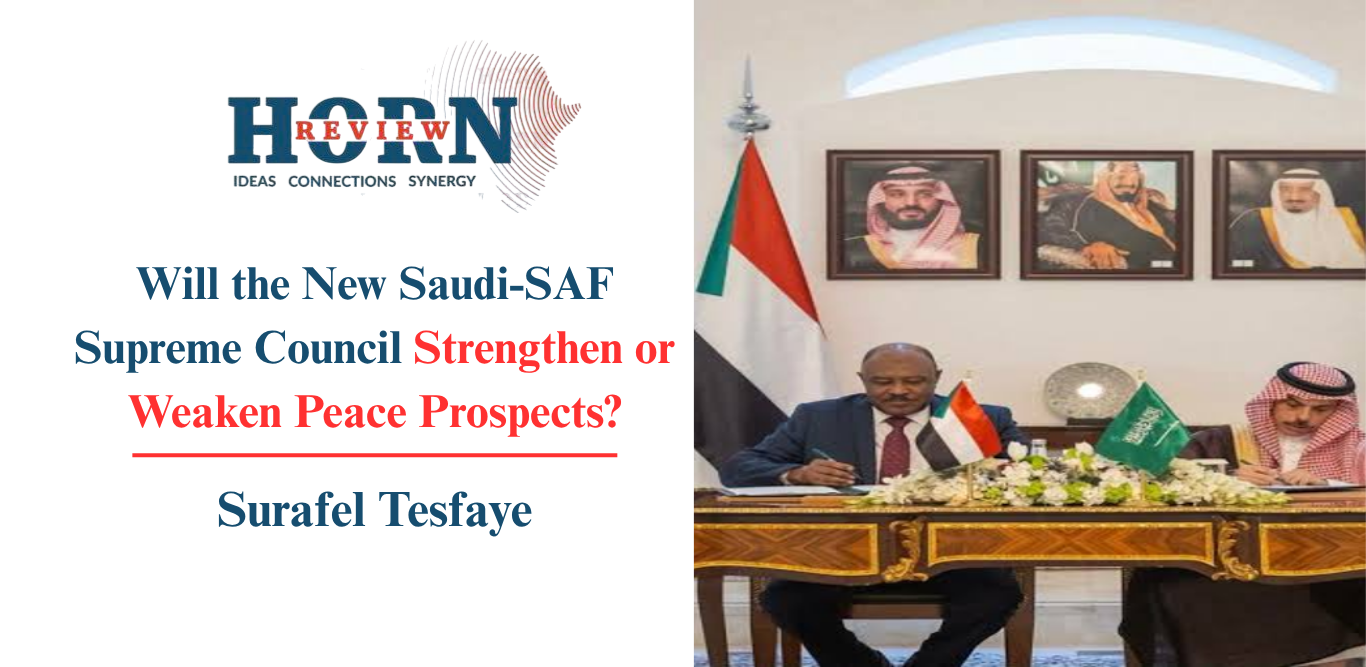
The formalization of the Supreme Council for Strategic Coordination and Cooperation between Riyadh and Khartoum inked by Saudi Arabia’s Prince Faisal bin Farhan and Mohieddin Salem, the foreign minister representing Sudan’s military-led administration is an exercise in deliberate diplomatic gravity, arriving at a critical geopolitical inflection point for the Red Sea basin. Superficially, the agreement presents itself as a routine, technocratic framework to standardize bilateral investments, trade corridors, and bureaucratic alignments across ten distinct administrative sectors. However, when parsed within the current landscape of the Horn of Africa, this institutional evolution serves a much more potent purpose: it functions as a highly calculated maneuver by the Sudanese Armed Forces to consolidate its external state legitimacy, secure its economic life support, and anchor itself permanently within Saudi Arabia’s maritime defense architecture.
By shifting their bilateral understandings into a formal, permanent council, Riyadh and Port Sudan are moving beyond the era of volatile personal diplomacy that previously defined relations under Abdel Fattah al-Burhan and Crown Prince Mohammed bin Salman. For the embattled Sudanese state, this institutional embrace is a masterclass in survivalist statecraft. Facing staggering national recovery costs estimated at nearly a trillion dollars, the SAF-led administration desperately needs to build a firewall around its fragile formal economy. By institutionalizing this partnership under a supreme council, the SAF achieves a dual victory: it signals to international capital that its state apparatus remains intact and investable, while securing a direct channel to Gulf development funds that bypasses Western-led multi-party mediation networks.
For Saudi Arabia, the calculus is deeply rooted in its enduring anxiety over the security and stability of the Red Sea littoral. Riyadh views the African coastline not through the lens of short-term political preference, but as an existential maritime flank that must be systematically managed against external penetration. Minister Salem’s explicit acknowledgment that security, defense, and Red Sea monitoring form the structural spine of this new council reveals the true nature of the pact. The Kingdom is increasingly wary of a chaotic security vacuum directly across its western shores one that could easily be exploited by rival regional heavyweights like Iran or Turkey, both of whom have actively courted SAFs institutions with diplomatic and military training agreements. By establishing a permanent, structured coordination body, Riyadh effectively positions itself as the primary external patron of Sudan’s sovereign maritime infrastructure, quietly checking the ambitions of rival middle powers before they can establish permanent naval or intelligence footprints on the shared waterway.
The timing of this agreement must also be understood against the backdrop of Saudi Arabia’s extensive mediation efforts since the outbreak of Sudan’s civil war in April 2023. Riyadh has led or co-hosted four major diplomatic interventions to broker peace, producing at least a dozen specific ceasefire declarations all of which collapsed almost immediately due to non-compliance by the SAF and the Rapid Support Forces. This persistent pattern of failed mediation directly explains the logic behind the current Saudi-Sudanese Coordination Council. Having witnessed four major international peace initiatives and over a dozen ceasefires crumble due to the bad faith of the belligerents, Riyadh has effectively abandoned both broad multilateral diplomacy and any bilateral engagements. The new council represents a pragmatic pivot away from trying to force peace between two hostile factions, choosing instead to secure its own strategic interests through a direct, state-to-state, transactional alliance with the military apparatus in Port Sudan.
The central contradiction of the agreement lies within the agreement itself. Its ten core pillars are entirely designed to function on an advanced, state-to-state level. Portfolios covering massive sovereign wealth investments, complex infrastructure projects, and integrated trade networks require a stable, fully functioning government to execute them. Making these long-term commitments with a military junta that does not even exercise full territorial control over Sudan makes the entire framework practically unworkable. A regime consumed by an active war of attrition cannot realistically manage large-scale agricultural investments or formalize national mineral sectors when it lacks authority over vast portions of the country’s territory and resources. Because these pillars rely on the illusion of a stable state partner, the entire diplomatic architecture is fundamentally flawed. History has repeatedly demonstrated that agreements made with unstable military rulers are inherently fragile and short-lived. By bypassing the inclusive political process demanded by regional and international bodies, these state-to-state portfolios completely fall apart when applied to the chaotic reality on the ground. Instead of building a durable economic and security partnership, this strategy locks both nations into a hollow framework that cannot survive the deep-seated domestic crises of a fractured Sudan.
The agreement has significant implications for Sudan’s future peace process. By formalizing a permanent institutional relationship with the SAF, Saudi Arabia is effectively legitimizing a faction that many international actors believe must be compelled to accept a political settlement. The agreement grants the military leadership in Port Sudan a level of external recognition that could prolong the peace process by enabling the SAF to bypass the economic and diplomatic pressures that might otherwise force it to negotiate. Rather than incentivizing the SAF to return to the negotiating table, the council may provide the military with the resources and political cover to sustain its current position. This is a logical consequence of the agreement’s structure.
Furthermore, this raises a fundamental question about the future of Sudan’s peace process. Can there be a viable path to civilian-led governance while one belligerent faction is being formally integrated into a Gulf state’s long-term strategic framework? The international consensus, reflected in the various peace roadmaps including the Quint initiatives, has consistently sought to create a roadmap that would lead to a democratic transition and the eventual removal of military leadership from Sudanese politics. Sudan has been under military rule for approximately 56 of its 66 years of independence, and any serious peace effort must confront this historical pattern. By legitimizing one faction through a permanent coordination council, Riyadh may inadvertently block the core concept of civilian-led governance that these international initiatives seek to achieve.
If any peace negotiation comes from the United States, or if the Trump administration ever comes to the point of putting Sudan again as a top priority as it did under the Obama and Bush administrations it would need to commit to building a civilian government. This approach might diverge with Saudi Arabia’s current policy, which appears to favor institutional engagement with the military faction in Port Sudan.
Previously, different reports indicated that the two active participants in Sudan have sustained the war by getting support from external backers. The financial survival of the two belligerent factions has depended on illicit weapons, financial support from external backers, and the extraction of natural resources. Now the entire approach is gaining weight through diplomatic means, and such arrangements provide diplomatic legitimacy. For any of Sudan’s military actors, this is an indirect and complex way of prolonging the conflict. Previously, the two Gulf States were allegedly accused for supporting these factions through illicit financial and weapon supply, and now they are doing so through diplomatic means. Since there is no military solution for Sudan, what the Kingdom is following right now will not be a long-term peace settlement for Sudan. The policy choice it will indirectly enforce is the idea that Sudan will remain under military rule.
It is important to note, however, that the Supreme Council’s agreement does not necessarily mean it will hurt or become an obstacle to any peace process, especially since the region is known for shifting alliances. Nevertheless, if this partnership becomes deeply entrenched, it might diverge with the peace plan for Sudan’s future, potentially making it more difficult for international mediators to push for a civilian-led transition.
The creation of this supreme council shows how geopolitical pragmatism often wins out over idealistic political arrangements. The international community has spent years trying to orchestrate peace processes that treat Sudan’s warring factions as equal partners, but the Riyadh pact suggests a different dynamic. External powers tend to prioritize their own strategic interests over the internal political outcomes that mediators seek to shape. In this case, maritime security, regional stability, and the imperative of countering regional rivals are driving Saudi Arabia’s engagement, even if the desire to resolve Sudan’s internal conflict remains present. The agreement does not necessarily close the door on peace, but it does suggest that any future settlement will have to account for the reality that Sudan’s military leadership has secured a durable partnership with a major Gulf power.
Rival actors are likely to respond, and as competition deepens, Sudan’s peace process will become longer and more a complex journey. Since there is no military solution to the conflict, any peace effort must challenge the reality on the ground. Legitimizing one faction will not bring stability, and ad hoc engagement will not resolve the crisis. External competition will only add new layers to the conflict. Over time, the situation will become more entrenched and harder to resolve. Sudan needs a new approach, one that prioritizes a transition away from military rule and addresses the deep structural issues that have kept the country under military leadership for most of its independent history. Whether the Saudi-Sudanese partnership ultimately helps or hinders this transition will depend on how it evolves in the years ahead.
Surafel Tesfaye, Researcher, Horn Review