

Egypt and Yemen in Ethiopia’s Security Architecture
The conventional geographic definition of the Horn of Africa no longer adequately captures the geopolitical, security, and economic realities of the present regional and global order. States across the region are pursuing assertive and sometimes aggressive foreign policies, engaging in proactive strategic interventions, and forming fluid alliances, all framed in terms of national interest. The Russia–Ukraine war, subsequent conflicts elsewhere, and the intensification of confrontations involving the United States, Israel, and Iran have accelerated shifts in the international system and shaped corresponding policy responses.
Security dynamics in the Horn are increasingly embedded in broader geopolitical and geo-economic agendas, including Gulf rivalries, Indo-Pacific security considerations, and the protection of global trade routes. In practical terms, a state situated across a body of water may exert greater influence on Ethiopia than an inland neighbor sharing a formal land border but possessing limited leverage over ports, shipping lanes, water resources, or coalition politics.
The prevailing environment is marked by complex and fluid geopolitical tensions, state fragility, insufficient preventive diplomacy, unresolved internal conflicts, simmering border disputes, contested sovereignties, and intensifying extra-continental competition. The roles and behaviors of state and non-state actors might overlap, rendering attribution, containment, and prediction more difficult. Actors pursue these approaches for varied reasons including advancing specific interests, to contain others, to preserve existing control, or to mitigate perceived vulnerabilities.
Trade corridors and other forms of leverage, whether geographic, technological or institutional, have gained heightened significance. Iran’s use of the Strait of Hormuz offers a clear precedent of how control over a chokepoint can secure concessions and exert influence across multiple domains. It also expresses its capacity to expand this influence into the Red Sea through the Houthis in Yemen. The same strategic logic extends beyond the movement of oil and trade to digital connectivity. The Red Sea likewise functions as a digital chokepoint, with an estimated 90 percent of undersea fiber-optic cables linking Europe and Asia passing through its waters. These cables constitute critical sovereign underwater infrastructure comparable in significance to oil and trade routes.
These compounding factors demonstrate that the evolving international order is transitioning from one defined by relatively fixed territorial neighborhoods toward relational and flow-based ones. Power is exercised through control of chokepoints, definition of institutional membership, management of hybrid networks, and the capacity to impose or mitigate cascading vulnerabilities in water, energy, food, and shipping. Borders are increasingly defined by intensity of consequence rather than by lines on maps. Recognizing Egypt and Yemen as de facto neighbors constitutes a form of strategic clarity. It requires Ethiopia to develop a full spectrum of instruments—including hard deterrence, hybrid engagement, institutional contestation, corridor governance, dual-track diplomacy, sustained strategic engagement, and the capacity to monitor developments closely and intervene in various ways when necessary to protect its interests. Treating actors whose activities can directly influence and affect Ethiopia’s strategic environment as neighbors helps build the necessary strategic depth.
Proximity is a function of exposure rather than geography alone. A state functions as a neighbor when its actions can materially alter another’s security environment without consent and with limited warning time. This operational reality arises from three interlocking developments: the weaponization of chokepoints (Hormuz as precedent, threats in the Bab el-Mandeb); the fusion of state and non-state agency that blurs attribution and response thresholds; and the conversion of previously separate domains—water, geography, energy, food, shipping, data, and arms—into a single surface of vulnerability.
Egypt, a long-standing rival, has viewed the completion of the Grand Ethiopian Renaissance Dam (GERD) as a setback to its efforts to shape, delay, and ultimately prevent the project from becoming a fait accompli. Having failed to secure its preferred outcome on Nile waters, Egypt has shifted toward a broader strategy of containment employing multiple instruments. Egypt does not act solely as a riparian competitor. It operates through regional institutions, alignments, and Red Sea politics. It has utilized the Arab League to advance its hydro-hegemonic position on the Nile. Egypt’s firm opposition to Ethiopia’s sea access question is also additional arena of competition. Egypt’s leverage therefore extends beyond bilateral water negotiations into the institutional definition of who belongs to the Red Sea order and on what terms.
Egypt should consequently be understood not only as Ethiopia’s downstream riparian rival, but also as an increasingly consequential strategic neighbour whose activities extend across multiple theatres. Its defense cooperation arrangements and presence in Somalia, involvement in the Sudanese conflict, its relationship with Eritrea, engagement on port matters in Djibouti, and continued efforts involving other Ethiopian neighbours have expanded its strategic presence in Ethiopia’s wider environment. Unable to constrain Ethiopia effectively through Nile negotiations alone, Egypt has broadened its containment approach across multiple theatres.
Yemen occupies a parallel yet distinct position in this relational geography. It constitutes a maritime neighbor primarily through the Bab el-Mandeb Strait, the narrow chokepoint through which the overwhelming majority of Ethiopia’s seaborne trade must pass en route to the port of Djibouti. Any sustained disruption—whether from Houthi attacks on commercial shipping, naval confrontations, or the imposition of exclusion zones—directly threatens Ethiopia’s import of critical commodities and export revenues, given the country’s near-total dependence on a single maritime corridor. In addition, Yemen’s strategic proximity to Ethiopia is defined by the fact that developments on the Yemeni side of the Red Sea can directly affect Ethiopia’s maritime access, trade flows, supply chains, and wider economic security. This combination of physical nearness and functional exposure elevates Yemen from a distant Arabian Peninsula state to a core element of Ethiopia’s security and economic environment.
Despite this exposure, Ethiopia has remained largely a bystander to the progressive militarization of Bab el-Mandeb. Houthi attacks on commercial vessels since late 2023, the subsequent formation of the Saudi-led Multinational Maritime Defense Coalition, and the broader contest among external powers for influence along the Red Sea littoral have unfolded with minimal Ethiopian institutional or operational involvement.
The main arena of power competition in the Horn of Africa is increasingly shifting toward the Red Sea coast, ports, and maritime routes in addition to the continental interior. Egypt and Yemen are directly connected to this strategic maritime space, while Ethiopia’s economic lifelines also depend heavily on it. This creates a strategic challenge for Ethiopia in which many of its core interests are increasingly shaped by developments in a region where it has limited formal representation and sustained engagement.
Arms proliferation across the Red Sea further illustrates the permeability of this maritime boundary. The Horn of Africa has long been characterized by the ready availability of small arms and light weapons. Yemen, for its part, has hosted one of the densest civilian armories in the world; estimates from the mid-2000s already placed the number of firearms in circulation at approximately 17 million. Weapons have historically moved in both directions across the strait through informal networks—Horn-origin arms entering Saudi Arabia via Yemen, and Yemeni or third-party weapons flowing southward into the Horn. These flows operate largely outside formal state control and contribute to the region’s persistent insecurity.
Institutional linkages reinforce the same pattern of interconnection. Djibouti and Somalia interact with Yemen as fellow members of the League of Arab States, embedding them in shared political frameworks from which Ethiopia is not a member. In 2002, Yemen, Ethiopia, and Sudan established the Sana’a Forum for Cooperation as an early attempt at structured trilateral engagement. Although the forum’s current operational status is unclear, it provides a historical foundation upon which Ethiopia could rebuild and expand direct engagement with Yemen, particularly on issues of maritime security, trade facilitation, and counter-smuggling.
Irregular and non-state dynamics deepen the connection. Beyond ordinary refugee movements, elements of various armed opposition groups originating in the Horn have at times sought refuge or temporary sanctuary in Yemen. The Islamic Courts Union, for example, reportedly regrouped there following its defeat by Somali government and Ethiopian forces in late 2006. Given the historical involvement of such networks in regional insurgency and extremism, this permeability carries direct implications for Ethiopian internal security. Eritrea’s strategic relationship with Iran and its proximity to the Houthi-controlled Yemeni coast create additional channels through which developments involving Iran, the Houthis, and the Red Sea can affect the Horn’s security environment. Collectively, these patterns demonstrate that the maritime boundary between Yemen and the Horn functions less as a barrier than as a connective corridor for people, materiel, and networks.
On the other hand, Ethiopia’s exclusion from the Saudi-led coalition of Red Sea littoral states compounds the problem. The country is arguably more economically exposed to disruptions in Bab el-Mandeb, in relative terms, than any formal member of that coalition, precisely because it possesses no alternative maritime outlet of its own. Exposure without institutional representation produces a particularly unfavorable strategic position: vulnerability without corresponding mechanisms for management, early warning, or mitigation.
In general, Yemen’s location adjacent to the Bab el-Mandeb Strait, its role in regional arms flows, its historical function as a refuge for Horn-based armed actors, and its participation in overlapping institutional and informal networks place it as an integral component of the broader Horn of Africa security environment. While conventional geographic definitions limit the Horn to Ethiopia, Eritrea, Djibouti, and Somalia, operational reality requires a wider aperture. Yemen’s proximity and functional impact establish it as a key neighbor in the relational sense.
Recognizing both Egypt and Yemen as close neighbors in this operational sense would enable Ethiopia to develop a more comprehensive and realistic strategic posture. Such recognition would support sustained monitoring of Red Sea dynamics, proactive engagement with relevant institutions and coalitions, dual-track diplomacy that addresses both state and non-state dimensions, and the construction of instruments capable of managing cascading vulnerabilities across water, shipping, arms, and institutional domains. In an era defined by flow-based rather than purely territorial neighborhoods, strategic clarity begins with an accurate mapping of exposure.
Yonas Yizezew, Researcher, Horn Review

RELATED
Posts
5
Oct
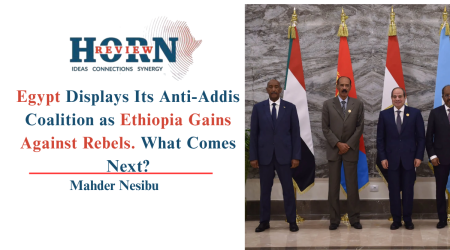
Egypt Displays Its Anti-Addis Coalition as Ethiopia Gains Against Rebels. What Comes Next?
Egypt's strategy of cultivating relationships around its chief rival in...

5
Oct
Eritrea’s Old Narrative in a New Red Sea Order
Eritrea’s historic framing of Ethiopia, Israel, and the Red Sea...

5
Oct
How Far Will Somalia Go to Keep Israel Away?
Somali President Hassan Sheikh Mohamud’s declaration that his country will...
5
Oct
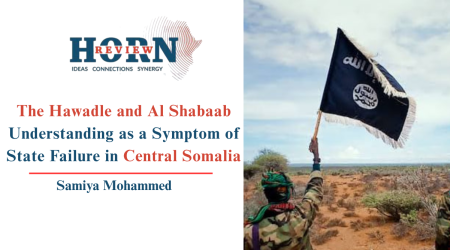
The Hawadle and Al Shabaab Understanding as a Symptom of State Failure in Central Somalia
The agreement between Al Shabaab and sections of the...

5
Oct
Eritrean Migrants & Ethiopia’s Unresolved Counterintelligence Vulnerability
Ethiopia may be approaching a security environment in which a...

5
Oct
The African Union’s Retreat for Egypt Exposes a Deeper Institutional Weakness
On October 1, African Union Commission Chairperson Mahmoud Ali...

4
Oct
Eritrea's Buffer is Collapsing: What Comes Next?
Ethiopian National Defense Force’s capture of Mekelle, if sustained, may...
4
Oct
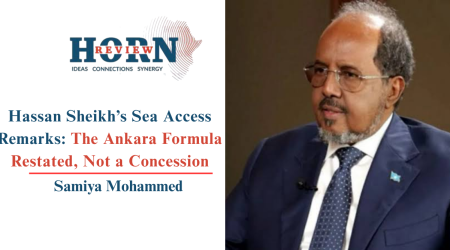
Hassan Sheikh’s Sea Access Remarks: The Ankara Formula Restated, Not a Concession
President Hassan Sheikh Mohamud’s remarks on 3 October 2026 that...
4
Oct
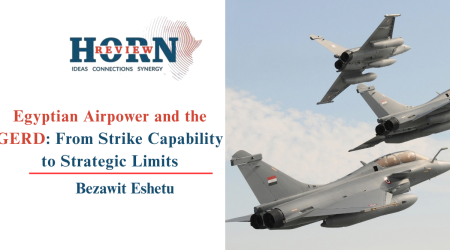
Egyptian Airpower and the GERD: From Strike Capability to Strategic Limits
The Grand Ethiopian Renaissance Dam is within the theoretical reach...
4
Oct
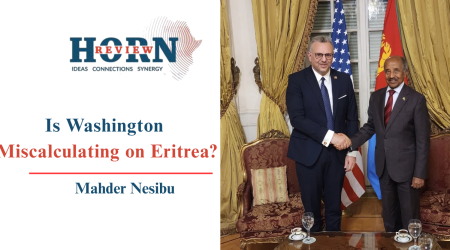
Is Washington Miscalculating on Eritrea?
The United States is attempting a precarious balancing act in...