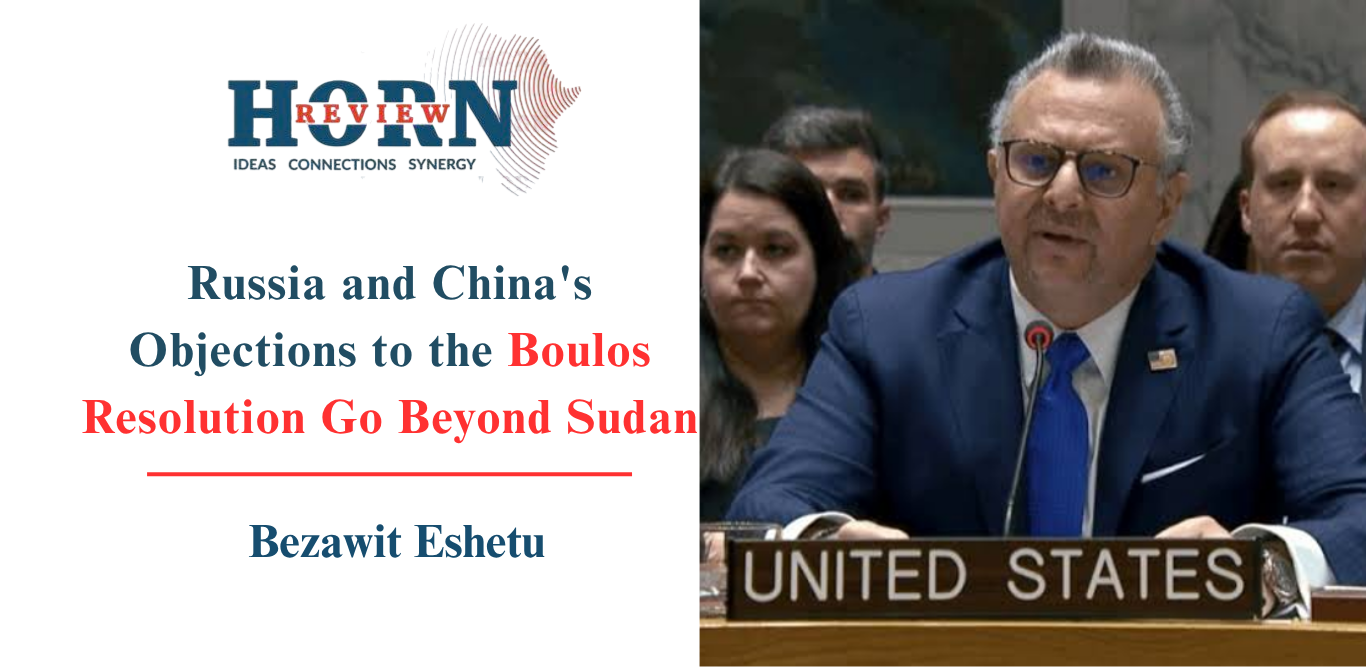
Massad Boulos outlined a four-point resolution before the United Nations Security Council. The proposal builds directly on the longstanding framework established by Resolution 1591 (2005), whose current mandate is set to expire on September 12. It would extend the existing Darfur-focused arms embargo to cover the entire territory of Sudan; explicitly include drones, drone systems, and related technologies within the embargo’s scope; expand the roster of experts serving on the sanctions panel; and instruct that panel to strengthen coordination with counterpart mechanisms monitoring other regional conflicts.
In presenting the initiative, Boulos emphasized the profound human cost of the ongoing conflict between SAF and RSF. He argued that the scale of violence had undermined both parties’ claims to legitimate governance and noted that external financial, political, and military support from multiple actors continued to sustain a stalemate in which neither side appeared positioned to achieve a decisive military victory. The statement thus offers insight into the United States’ approach to utilizing the Security Council’s remaining coercive instruments, while also illustrating the contrasting preferences of other permanent members, including the Russian Federation and the People’s Republic of China, regarding the calibration and scope of such measures.
This difference in approach intersects directly with the deeper dispute over how the two main armed actors should be characterized. Framing both belligerents as equally discredited governors carries particular weight in that debate. Sudan’s ambassador to the UN, Al-Harith Idriss, made the objection explicit at the same session, arguing that applying uniform restrictions nationwide would equate state institutions with a rebel militia and calling instead for a technical extension of the existing Darfur-only regime. His government’s position rests on the premise that formal equivalence between the two forces in a Council text amounts to substantive equivalence in international standing, regardless of what the drafters intend.
Boulos anticipated this objection directly, telling the Council that the proposed measures sought no advantage or disadvantage between the parties and no equivalence beyond a shared obligation to pursue peace and accountability. The claim holds as a statement of drafting intent, yet it grows harder to sustain as a description of practical effect. A nationwide embargo would land differently on the two main armed forces because of how each has sourced its weapons.
Amnesty International has reported that the Rapid Support Forces received arms through networks allegedly linked to the United Arab Emirates, which has consistently denied providing any support to the group. Egypt and Turkey have played comparable roles on the army’s side. Both channels already violate the existing Darfur embargo, which suggests that widening its geographic and technical scope changes the reputational and legal exposure of external patrons more than it changes the material flow of weapons on the ground.
Russia’s ambassador, Vassily Nebenzia, also used the word “equivalence,” but from the opposite angle. He rejected any suggestion of moral equivalence between the two sides’ use of weapons and drones. In his view, the army was fighting groups trying to destroy the state, while RSF were using strike drones indiscriminately against civilians. Boulos, by contrast, rejected the idea of equivalence in order to defend a text that treats both sides the same on paper. He wanted to show that a symmetrical draft does not mean the Council is treating a state and a militia as identical.
Nebenzia turned the same word against that approach. He argued that the formal symmetry itself creates a hidden form of equivalence: it limits the army’s options while leaving the paramilitary’s smuggling networks largely untouched. At bottom, the dispute is about which reading of a formally neutral text better captures its real-world effect on two forces that obtain weapons through very different channels.
Boulos also told the Council that armed drones killed more than 1,120 civilians in the first half of 2026 alone, close to eighty percent of the period’s recorded civilian deaths, consistent with the pattern of strikes on markets, hospitals, and aid convoys both forces have carried out. The war’s wider toll, now in its fourth year, is contested in exact figures, though independent trackers converge on comparable orders of magnitude. The Council split along familiar lines. Denmark, holding the August presidency, joined the United Kingdom and France in backing the American draft, with Denmark’s foreign minister separately calling for the International Criminal Court’s jurisdiction to extend across the whole of Sudan.
China urged caution, warning that wider sanctions risked undermining the country’s stability and economic recovery. Russia went further, with Nebenzia characterizing existing Western measures, including the European Union’s ban on Sudanese gold imports and American restrictions on international financial institutions’ lending to Sudan, as a policy of economic strangulation that punished ordinary Sudanese rather than the belligerents. Sudan’s government aligned with Moscow and Beijing in substance while framing its objection around sovereignty rather than sanctions relief.
Reading Russian and Chinese resistance as a Sudan-specific judgment understates what is actually happening. Sudan occupies a secondary position in both capitals’ strategic ledgers, which is precisely what makes it useful as leverage. Neither government treats a Council vote on a Darfur-era sanctions regime as worth its intrinsic weight alone. Both weigh it against the cumulative state of contests that matter more to them, and both extract value from the file regardless of how the vote ultimately falls.
For Russia, the calculus runs through Ukraine and through Sudan’s own strategic geography. Moscow’s central preoccupation remains sanctions relief and battlefield sustainability in its own war, and conceding ground on a Western-drafted enforcement mechanism in Sudan without compensation elsewhere would function as an unrewarded gift to the same enforcement architecture Russia is fighting to blunt on its own account.
Sudan continues to offer Moscow concrete strategic and economic stakes that go beyond the immediate conflict. Russian-linked networks have used Sudanese gold-trading channels to help offset the effects of Western sanctions, while long-running discussions with authorities in Port Sudan have kept alive the possibility of a permanent Russian naval facility on the Red Sea. Preserving the army’s freedom of action therefore advances both of these Russian interests at once. Russia’s veto, meanwhile, functions as a standing bargaining instrument: it can be withheld or deployed if Washington later seeks Moscow’s agreement on the Sudan file and is prepared to offer reciprocal concessions in other negotiations.
A parallel logic shapes Beijing’s approach. China’s stance on Sudan is best understood as the intersection of doctrinal consistency and concrete material interests. China treats any expansion of the Darfur arms embargo, especially one that would cover dual-use technologies and apply nationwide, as a potential precedent.
Once the Security Council normalizes intrusive controls over national defense supply chains under the banner of conflict management, the same logic can be invoked against other states whose military-industrial relationships Beijing values. Resisting that expansion therefore protects not only the specific Sudanese file but the broader principle that external regulatory regimes should not be allowed to penetrate sovereign defense and commercial channels. This is why Chinese representatives repeatedly frame sanctions as “a means, not an end” and insist on respect for Sudan’s institutions and ownership of any political process.
That doctrinal preference is reinforced by tangible stakes. Sudan sits on a Red Sea corridor that remains relevant to Chinese maritime trade security and logistics. Even after the disruption of earlier oil operations, Beijing has continued to deepen economic engagement with the authorities based in Port Sudan, extending a $50 million loan waiver in mid-2026, pursuing ongoing discussions on copper concessions on highly favorable long-term terms, expanding involvement in the gold sector, and signing a memorandum with China Harbour Engineering Company for port rehabilitation and possible new facilities. These moves secure preferential access to resources and infrastructure at a moment when Western capital is largely absent. A broad embargo that constrained dual-use flows or complicated commercial channels would raise the cost and risk of precisely these relationships.
Thus, China opposes measures that would equate the two-armed forces in a single restrictive regime because such symmetry threatens both the formal principle of state sovereignty it defends elsewhere and the practical access it has cultivated with one of the parties. Public calls for ceasefire and inclusive dialogue sit alongside continued economic engagement that privileges institutional continuity and predictable commercial partners. In short, Beijing’s resistance to expanded coercive instruments is simultaneously a defense of its preferred international legal order and a protection of the economic and logistical positions it has built along the Red Sea.
This pattern predates Sudan by well over a decade. The Council’s post-2011 experience with Libya hardened both Moscow’s and Beijing’s view that Western-sponsored embargoes function as the opening move in a sequence that erodes a government’s capacity, deepens humanitarian crisis, and eventually invites further intervention. Both governments have since treated sunset clauses, panel funding fights, and evidentiary disputes as tools for keeping enforcement architecture perpetually renegotiable, which is why the specific facts of any one conflict carry less weight in their calculations than the precedent a measure might set.
The practical outcome is that Washington retains tools independent of Council approval. Existing American restrictions under the International Traffic in Arms Regulations already deny most licenses for Sudan, and Treasury authorities can tighten sanctions on specific networks without a single additional vote. Yet analysts remain skeptical that unilateral measures can prove decisive when key regional actors, including the United Arab Emirates, Egypt, and Turkey, rely primarily on trade and financial networks beyond standard Western regulatory leverage.
Ultimately, the Security Council impasse illustrates the growing limitations of traditional sanctions regimes within a multipolar global order. When structural divergence among permanent members prevents enforcement consensus, standardized embargoes risk functioning as formal procedural exercises rather than effective conflict-resolution tools. Until key international actors coordinate targeted diplomatic and economic policies directly with external supply networks, multilateral resolutions will continue to have limited impact on battlefield dynamics.
Bezawit Eshetu, Researcher, Horn Review