Within the fragile yet strategic region of the Horn of Africa, the United States has always held a prominent role. Its most recent one was the strong relationship it held with Ethiopia, built on combating terrorist threats in Ethiopia’s neighbour, Somalia. This relationship, after it was tarnished by the outbreak of conflict in Ethiopia in 2020, marked the last major engagement of its kind for the United States, as the superpower has remained on the back foot ever since, a retreat catalysed by the second Trump administration’s decision to remove Africa from the list of its major priorities almost entirely.
From Washington, however, the view of Africa, and certainly of the Horn, is not as simple as Trumpian foreign policy on paper might suggest. The Trade Not Aid approach has Washington attempting to repackage its humanitarian commitments, including through controversial health deals, while clearing the way for American investment to flow. Layered on top of the interests that still draw the United States to the Horn is security, chief among them the persistent threat posed by al-Shabaab in Somalia. More significantly, American diplomacy has been active in pursuit of its declared aim of brokering peace across the theatre. In Sudan’s devastating civil war, Washington has been working through its representative, Massad Boulos, to engineer an end to the fighting, since the start of the second Trump presidency and the subsequent appointment of Boulos to the role of Senior Advisor to the President on Arab and Middle Eastern Affairs, a brief that has since expanded to take in the Horn as well.
Although active on the diplomatic front, the senior advisor has faced several obstacles in bringing the fighting to an end. For one, the conflict itself is embedded in a broader contest among middle powers that has come to shape politics across Sudan and the wider Horn. Boulos has struggled, it seems, to reconcile Washington’s aims with the realities on the ground in Sudan itself. The middle powers fuelling the conflict form the very group through which the peace-making effort is being carried out, among them Saudi Arabia, whose crown prince, Mohammed bin Salman, prompted President Trump’s interest in resolving the crisis in the first place, alongside Egypt and the United Arab Emirates, grouped together in the so-called Quad initiative. Washington’s approach has been to awkwardly bridge the demands of these interested states with those of the warring parties themselves, the Sudanese Armed Forces (SAF) and the Rapid Support Forces (RSF). The result has been a standoff, in which the belligerents remain unwilling to come to the table even as the flow of external support continues, since the middle powers backing them, all allies of the United States, appear equally reluctant to cut it off.
A resolution to Sudan’s war has continued to elude the special advisor. More recently, on top of his diplomatic footprint across the already fraught politics of the Middle East, Washington has dispatched him to address problems arising on the Red Sea and along both of its shores. As the United States wages its campaign against Iran, with the declared aim of preventing the Islamic Republic from acquiring nuclear weapons, Tehran has responded asymmetrically. Having already choked the Strait of Hormuz, a critical artery for global oil supplies, Iran, through its proxy the Houthis in Yemen, is now eyeing the Bab-el-Mandeb, the narrow crossing into the Red Sea, for a similar disruption.
To that end, Washington has been working to dust off its relationship with a troubling regime that runs a country possessing a long coastline along the Red Sea, Eritrea under Isaias Afwerki.
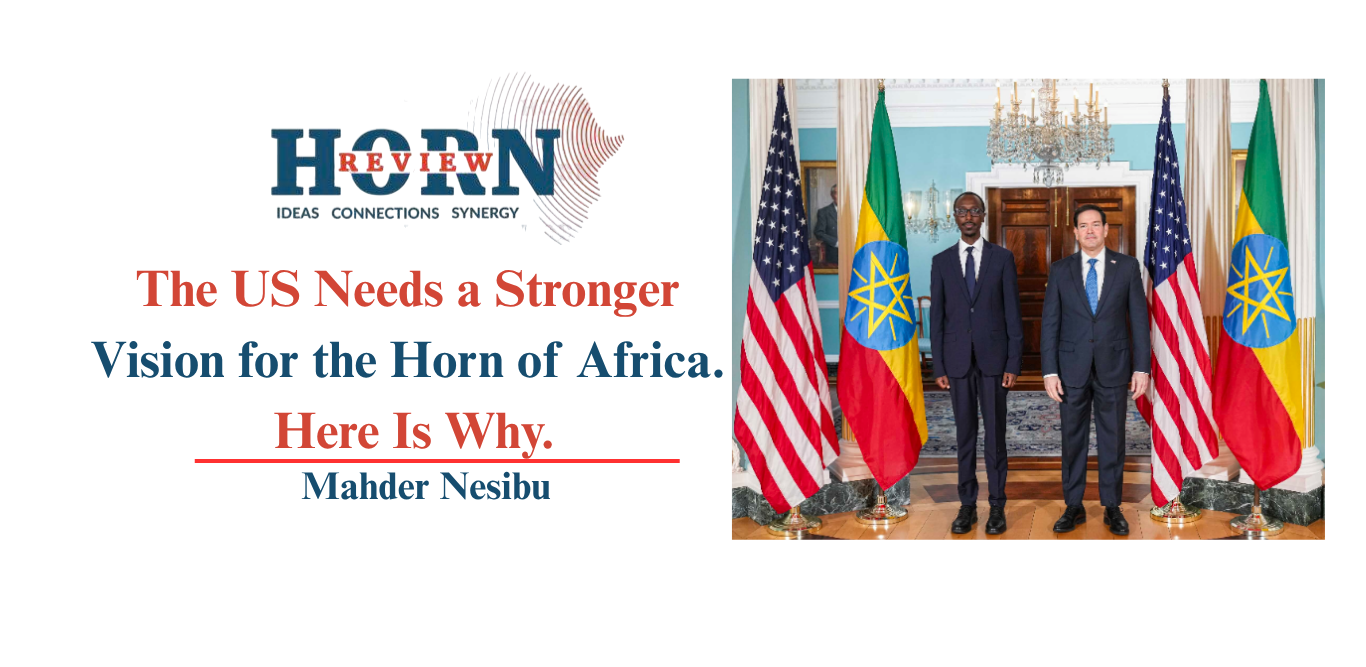
Boulos’s involvement here, similar to Sudan yet more fraught, amounts to an awkward fusion of Red Sea security interests with the geopolitics of the Horn itself. An additional aim of engaging President Isaias Afwerki seems to prevent a war between his country and its neighbour Ethiopia, tensions that have stood on the precipice of war for more than a year. In pursuit of keeping the two countries from fighting, Washington has reached out to both. It sought to repair ties with Ethiopia, hosting its foreign minister in May for extensive talks, and struck deals aimed at rehabilitating the relationship between the two countries.
At the same time, it has increasingly cultivated ties with Asmara, first with Boulos meeting President Isaias Afwerki in secret in Cairo in December 2025, then engaging publicly with Eritrea’s foreign minister, Osman Saleh, again in the Egyptian capital in July. Washington, in effect is blending mediation between Ethiopia and Eritrea with a parallel courtship of Eritrea to secure some form of cooperation in its bid to keep the Red Sea from being disrupted, faces.
One difficulty facing US diplomacy here is the lack of clarity over exactly how Washington intends to bring Isaias in from the cold. Isolated for decades, he has proven consistently resistant to US foreign policy. He has rebuffed Washington’s overtures and acted against American interests, destabilising the Horn for years and even going so far as to support al-Shabaab at the height of the war on terror, for no clear reason beyond spiting Ethiopia and the United States, both of which were fighting against it.
Beyond the lack of clarity over what Eritrea would in reality contribute to freedom of navigation on the Red Sea, or what practical cooperation with Washington would even look like, Eritrea is already engaged in a destabilising campaign of its own across the Horn, one that runs directly against Boulos’s mission and the professed goal of averting a new war. Eritrea, presumably not unknown to US intelligence, has assembled an array of actors within and outside Ethiopia to undermine its neighbour’s security, a proxy network that is setting the stage for a wider confrontation. What’s more, Eritrea is using Sudan, whose war it is already embroiled in, as the staging ground on which this proxy apparatus is taking shape.
Even more concerning, on top of the anxieties over the Red Sea and Ethiopia-Eritrea tensions, is the broader Nile politics animating Washington’s involvement. At the urging of Cairo’s lobbying and President Abdel Fattah al-Sisi’s appeals to President Trump, the United States has also moved to weigh in on the dispute between Ethiopia and Egypt over the GERD, tilting clearly toward Egyptian interests. That tilt has been muddying Washington’s approach to the Horn and its own professed goals there. Al-Sisi’s efforts to shape the United States’ view of the Nile dispute have not worked alone; Washington’s role itself increasingly risks enforcing them. The overtures to Asmara have developed in parallel with Cairo’s courtship of Isaias Afwerki and his regime, orchestrated in part by Cairo itself, and are increasingly converging into a single, blended track.
Egypt’s own agenda, which has not been diplomatic engagement with Ethiopia but the application of sustained pressure through an encirclement strategy that has recently taken concrete shape, is undermining Washington’s aims. Cairo has backed Isaias Afwerki’s proxy campaign, treating the resulting threat to Ethiopia’s national security as a lever with which to bring the country into a position more favourable to Egyptian interests.
Across the Red Sea, through Sudan, Ethiopia, and Eritrea, what the United States appears to lack is a broader, and independent vision for the Horn as a whole. Coupled with the diplomatic capital it has withdrawn from the continent more generally, Washington’s pursuit of its aims there has been rocky. One clear remedy would be restoring American expertise and diplomatic capital to the region. Contrary to the broad mandate carried by Boulos, whose portfolio continues to stretch across files from the Middle East to the Horn, Washington needs the same depth of involvement it once had, of the kind that proved essential, through figures like the former special envoy Mike Hammer, in bringing an end to two years of conflict in Ethiopia.
More critical, however, is the need for a broad yet coherent vision for the Horn, one that does not substitute American interests for those of its partners, and one that navigates the intricate dilemmas the region continues to face.
By Mahder Nesibu, Researcher, Horn Review