The constitutional principle that may determine whether Sudan ends its war or postpones the next one
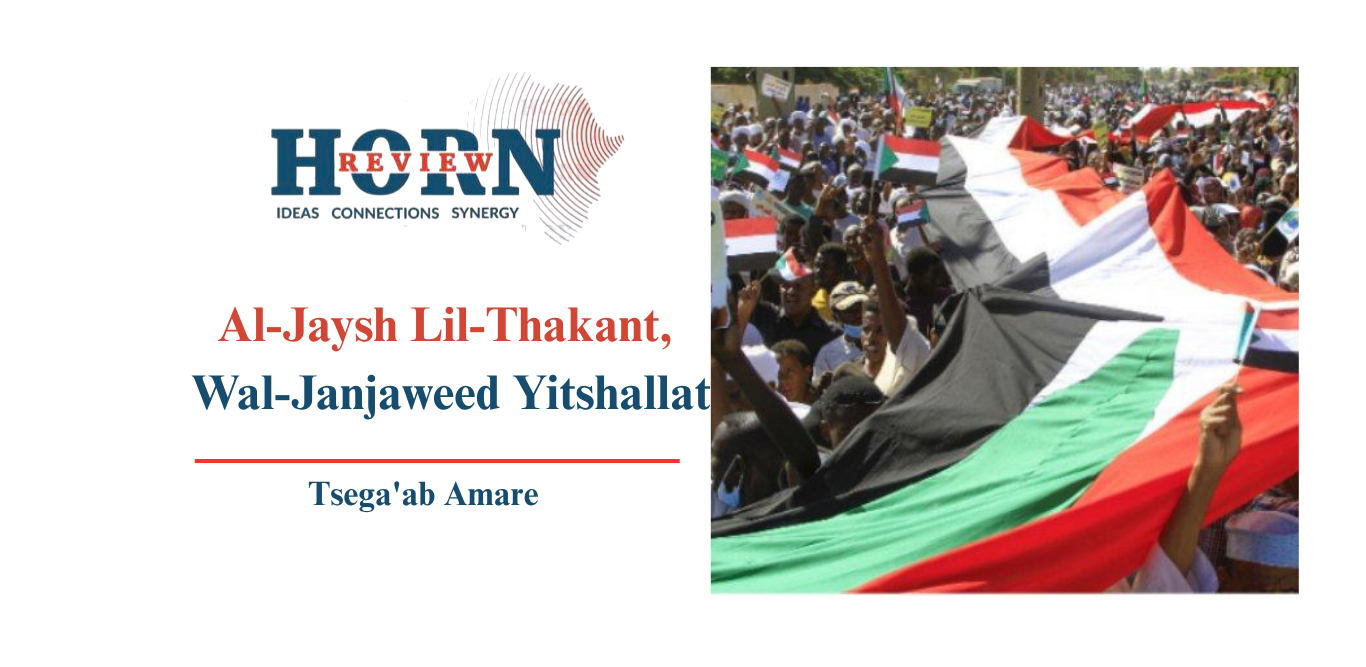
The slogan chanted across Sudan’s streets since 2019, “the army to the barracks, and the Janjaweed must be dissolved,” is a real diagnosis to Sudan’s structural failure not just a revolutionary nostalgia. It names two failures of the Sudanese state and prescribes two remedies: the military must be returned to a constitutional role subordinate to civilian authority, and the paramilitary system descended from the Janjaweed must be dismantled rather than absorbed as a permanent second pillar of the state.
Beneath the slogan lies a constitutional theory of the state, even if the crowds who chanted it might not have used that language. Max Weber argued that modern states are distinguished by their monopoly over the legitimate use of force within a defined territory. Sudan’s repeated crises reflect the gradual erosion of that monopoly, first through military intervention in politics and later through the institutionalization of an autonomous paramilitary alongside the national army. The war underway since 2023 is the evidence and the subject is the Sudanese state itself and what it would take to reconstruct it after the collapse of dual sovereignty over armed force.
Sudan inherited a military that became the ultimate arbiter of elite disputes because civilian institutions never consolidated authority over coercive power. The coups of 1958, 1969, 1989, and 2021 should not be seen as isolated ruptures rather they are symptoms of that condition. The 1989 coup matters most: it fused the officer corps with the National Islamic Front, embedding Muslim Brotherhood-aligned networks inside the army’s command structure for a generation. Those networks did not disappear after Bashir’s fall in 2019; they fragmented into competing factions within the security establishment, some aligned with Burhan, others running parallel channels of their own. A force with that history does not return to the barracks simply because a war ends; it returns only if the ideological structures embedded within it are dismantled too, a harder project than demobilizing an armed group.
Sudan has repeatedly solved its security crises by creating new coercive institutions rather than reforming the ones it already had: the Popular Defense Forces of the 1990s, the Border Intelligence units that followed, the Janjaweed of the Darfur counterinsurgency, and finally the Rapid Support Forces formalized in 2013, each emerging because the state distrusted its own army, or wanted deniable violence its army could not provide. Each was cheaper to build than renovating the old one, and more loyal, in the short term, to whoever at the time created it. That pattern is the real institutional memory behind the RSF, a standing habit of manufacturing rivals to the army whenever its loyalty seemed uncertain.
None of this makes the demand to return the army to the barracks unrealistic. Every functioning state needs an army; the question is whether that army governs society or defends it. Egypt shows what happens when a military establishment completely absorbs a state, stability becomes a measure of regime survival rather than public welfare. The resulting system protects elite economic monopolies and security networks through heavy repression, while leaving the civilian population to bear the consequences of systemic debt, inflation, and public disinvestment. Indonesia after Suharto shows the alternative, a gradual, negotiated withdrawal of the armed forces from political life, carried out through law. Civilian supremacy in practice means a defense minister accountable to parliament, an audited military budget, and a clear bar on active officers holding political office.
An uncomfortable question follows. Suppose the SAF wins outright: does victory produce constitutionalism on its own? History says no. Sudan has had victorious armies before, and none voluntarily withdrew from politics once the battlefield fell silent; each treated victory as a mandate to govern. Defeating the RSF would hand the SAF a plausible claim to have saved the nation, the same claim that has justified every authoritarian consolidation in Sudan’s modern history. Little incentivizes the SAF to return to the barracks after victory, which is why the slogan’s first half cannot be assumed to follow from the second.
The second half of the slogan remains the harder project, where the case for dissolution over accommodation has to be made carefully. Sudanese elites treated militias as disposable tools for decades: useful in Darfur, on the border, and for managing the gold trade. What made the RSF different, and dangerous, is that it developed its own recruitment, financing through gold exports and extortion, territorial administration, and external patrons in the Gulf. A militia stops being a militia not when it receives uniforms and a line in the state budget, but when it loses independent command, finance, and recruitment. Sudan has since watched this militia seize Khartoum, lose it back to the army in March 2025, overrun El Fasher by October, face United Nations findings of conduct amounting to genocide, and establish a rival government in Nyala while its former field commander sits under an International Criminal Court conviction for earlier Darfur-era crimes. It is now pressing its offensive on El Obeid: a Defacto semi-state within the state, its leadership uninterested in surrendering that position voluntarily.
Underneath the territorial contest sits a question of legitimacy. Both the SAF and RSF claim to embody the Sudanese state. The war is fundamentally a contest over legitimacy, where the RSF’s parallel state agenda in Nyala challenges the SAF’s claim to institutional continuity, further fracturing the country’s geometry. For millions of Sudanese, neither the army’s legacy nor the militia’s violence holds authority, meaning true legitimacy resides only within grassroots civilian networks that refuse compliance to an autocratic dual-military structure.
The standard diplomatic formula, integrating the RSF into the national army, deserves scrutiny rather than automatic endorsement. Disarmament and reintegration programs were designed for rebel organizations entering an existing state hierarchy after a civil war ends. Sudan presents the reverse: the RSF was built inside the state and then evolved into a competing sovereign military institution with its own foreign relationships and revenue base. The task is not integrating an external insurgency but dismantling an internal rival that still wears a government’s old uniform. Power-sharing produces dual sovereignty under a single flag. An elite merger of commands produces a future factional war with the delay already built in. Dissolution paired with individual vetting, frozen recruitment, severed financial networks, and cantoned forces is the only path toward a genuine monopoly of legitimate force. Every round of mediation so far, Jeddah, Geneva, the Quad talks in Washington, has focused on ceasefire mechanics rather than this deeper question: what armed actors will legally exist once the guns fall silent. If the answer is both SAF and RSF as parallel institutions, the war has only been paused.
A constitutional settlement cannot survive in isolation from the region around it. Egypt and Saudi Arabia have backed the SAF on their own terms, while UAE backing for the RSF has helped sustain the RSF and the gold networks financing it. Chad, Libya, and South Sudan add further pressure, since the war spills across borders that were porous long before 2023. Any credible postwar framework has to address this external patronage directly, not as an afterthought to domestic security.
Several objections deserve direct answers rather than dismissal. The RSF’s ranks draw heavily on communities in Darfur and Kordofan marginalized by successive Khartoum governments, and critics will argue that dissolving the RSF silences that constituency again. The marginalization is real and predates the RSF by decades, but an armed patronage network is not political representation, and durable inclusion requires fiscal and political institutions those communities can actually hold accountable, not a militia commander bargaining on their behalf. Critics will also note the national army’s own record of atrocities, including aerial bombardment of civilian areas.
That record does not weaken the case for dissolving the RSF; it strengthens the case for applying the same accountability standard to both, since an abusive institution earns no permanent autonomy by pointing to another’s abuses. Sceptics will call dissolution impossible given how entrenched the RSF now is, but dissolution has never happened anywhere as a single overnight act. Colombia’s paramilitary demobilization and Liberia’s disarmament process were slow and imperfect, yet still reduced autonomous armed power meaningfully over years, not months. A final argument, that civilian rule should wait until security stabilizes, is the oldest excuse in Sudanese politics: Sudan postponed civilian governance in the name of stability after 1989 and again after 2021, and both postponements generated the instability they claimed to prevent.
Read together, the two halves of the slogan amount to a constitutional doctrine rather than a wartime grievance. Ending the fighting is a battlefield outcome; reconstructing a state that will not produce the next war is an institutional project, and that project is this piece’s real subject. A ceasefire regulates violence. A constitution regulates who may lawfully wield it. Until military power is subordinated to civilian authority and autonomous armed organizations cease to exist as competing centers of sovereignty, Sudan will not be entering a postwar era. It will merely be postponing the next one.
By Tsega’ab Amare, Researcher, Horn Review