What Somalia Should Have Learned from 2003
The Turkish brokered talks proceeding in Somalia replicate a structural error with documented consequences. Preparatory sessions held over two days have concluded. A meeting is scheduled and will include the Federal Government, three opposition factions, Turkey and with Western facilitation for the main talks. The official framing shows this as a mechanism for political resolution. The overriding concern is whether any party to the process can establish through legal criteria or a verifiable political mandate, the identity and representative standing of those who will sign it.
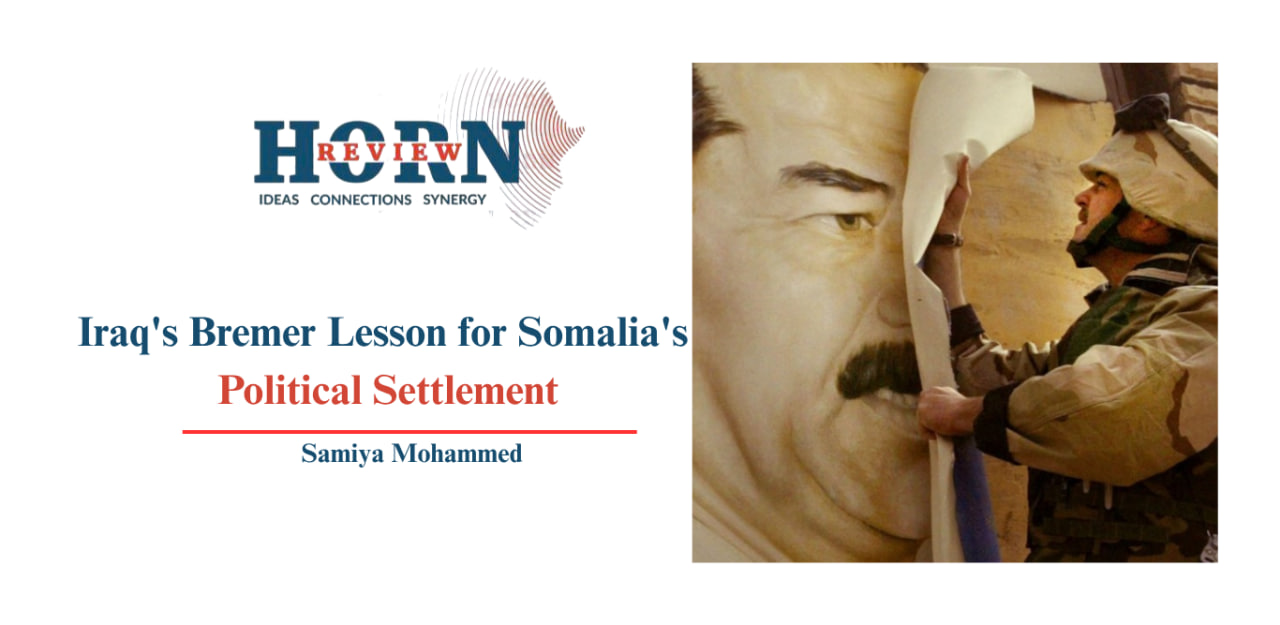
What is happening in Mogadishu right now is a near perfect replication of the Coalition Provisional Authority in Baghdad between 2003 and 2004 when Ambassador Paul Bremer and his international partners attempted to construct a post Saddam political order from a competing claimants which none of whom had clear legal standing and all of whom could mobilize some combination of territory, weapons or international support to demand a seat at the table. The parallel is and the consequences Iraq suffered from that procedural vagueness, sectarianized power sharing, perpetual contestation and an insurgency are now being quietly reassembled on Somali under the banner of dialogue.
To see why this moment is so dangerous there are by any honest count at least three distinct platforms claiming the mantle of opposition. The Somali Future Council brings together the sitting presidents of Puntland and Jubaland which are two federal member states that have severed ties with Mogadishu alongside the Somali Salvation Forum which includes former President Sharif Sheikh Ahmed, three former prime ministers and a former minister. The Nabad iyo Nolol party is former President Mohamed Abdullahi Farmaajo standing alone on the weight of his former presidency. The National Union Forum is led by former Prime Minister Omar Abdirashid Ali Sharmarke joined by a former South West State president and former Speaker of Parliament and a former minister and ambassador. These are not three branches of a coherent political movement and are three clusters of former office holders, sitting state presidents and personal political machines united by nothing more durable than shared exclusion from the current administration and deep mutual suspicion about the electoral model.
This is precisely what Bremer faced in the spring and summer of 2003. The Iraqi opposition was not a political category defined by law and It was an ecosystem of exiled parties like the Iraqi National Congress and the Supreme Council for the Islamic Revolution in Iraq, former Baathist military officers who had fallen out with Saddam, Kurdish parties that had governed their own region since 1991, Shia religious factions that had survived underground, tribal sheikhs and technocrats who had served the old regime. None were registered political parties in any meaningful sense, contested elections or could demonstrate a constituency beyond their own organizational networks and the armed capacity of their militias. However all were summoned to the table because the occupation authority needed interlocutors and the only available criterion for selecting them was the fact of their existence.
The Turkish diplomats leading the process are confronting the identical structural void. Somalia has no legal definition of an opposition. The political party law exists but remains unimplemented and contested and none of the platforms currently being treated as opposition have registered as opposition parties. Puntland and Jubaland are not opposition movements by any definition known to constitutional law. They are constituent federal units whose governments have chosen political confrontation with the center. To seat their presidents as opposition leaders is to concede that territorial control and institutional rupture confer negotiating status equal to or greater than legal standing. That is recognition of disintegration as a permanent feature of the political order.
The Iraqi version of this concession came with the inclusion of the Kurdish parties, the Kurdistan Democratic Party and the Patriotic Union of Kurdistan as autonomous negotiating blocs whose territorial control in the north gave them leverage entirely disproportionate to their demographic weight. The result was institutionalization as a permanent bargaining one that would shape every subsequent constitutional negotiation, budget dispute and security arrangement. Somalia is now to replicate that with Puntland and Jubaland transforming what should be a federal dispute between levels of government into a quasi diplomatic negotiation between entities treated as sovereign enough to warrant a separate chair at an internationally mediated table.
The talks are implicitly relying on a hierarchy of former high office to determine who matters. Former presidents and prime ministers dominate the opposition platforms but this brings a question that Bremer’s team also faced and never resolved in what is the political weight of a former office holder, and how is it measured? Somalia has two former presidents and four former prime ministers active in these factions. A Somali prime minister is an appointed official, selected and dismissed at the discretion of the president. Is a former prime minister politically equivalent to a former president elected by parliament? The Iraqi Governing Council granting seats to exiled politicians who had held no office for decades alongside tribal leaders whose authority was local and religious figures whose constituencies were sectarian. The allocation of seats became a function of American and UN assessments of influence not any objective or legal standard. The outcome was a body whose legitimacy was contested from its first meeting because no one could explain why these twenty five Iraqis represented Iraq and others did not. Somalia faces the identical legitimacy gap with former high office is the ticket.
The most dangerous parallel between Somalia today and Iraq two decades ago is the legitimization of confrontation as a qualification for negotiation. In Iraq the parties that had fought Saddam, those with armed wings, those that had demonstrated a capacity for violence against the regime or against each other were automatically granted standing and it taught every faction that the path to the table ran through the barrel of a gun. Militias that were supposed to be disbanded became political parties in all but name. Somalia is not Iraq in the scale of its violence but the logic is the same. Some of those seated as opposition have clashed with the government politically and, in recent memory, militarily. Clan loyalty and access to weapons have become what makes an opposition faction strong enough to warrant a chair. This does not build a state and it rewards those most capable of destabilizing one.
The Iraqi Governing Council’s composition produced an agreement in July 2003. It produced an interim constitution in March 2004. It produced a sovereign interim government in June 2004. And none of it held. The sectarian quota system called muhasasa that came from those negotiations embedded identity based allocation of power into the structure of the state. It created ministries as fiefdoms, security forces as party militias in uniform and a political culture in which elections just confirmed the distribution of spoils rather than expressing the will of citizens.
The excluded Sunnis many of whom had been senior Baathists purged by Bremer’s de Baathification order had no political path back and every incentive to fight. The agreements signed in 2003 and 2004 were contested the morning after each signing by those left outside the room and they had a point because no criteria had excluded them in the first place. Somalia is not destined to follow this path into sectarianized breakdown. Its fractures are primarily clan based and federal rather than sectarian and its partners are mediating rather than occupying. But the structural vulnerability is identical with Whatever agreement emerges from the talks on will be contested immediately by whoever was not in the room. And because no definition of opposition was established before the talks began no one will be able to say with legal force that the contestation is invalid.
The Turkish mediators to their credit have managed to bring factions into a structured conversation at a moment when Somalia’s electoral path is uncertain. But the process risks becoming an end in itself with a performance of progress that papers over the foundational question of who is negotiating with whom and by what right. The presence of the partners as observers lends the proceedings the aura of international legitimacy but it also means that these actors will be implicated in whatever structure comes. They will be asked to underwrite an agreement whose signatories cannot demonstrate representative authority.
The Bremer era in Iraq is remembered for many failures but the most instructive for Somalia today is the failure to define the political field before populating it. The Coalition Provisional Authority needed an Iraqi face for its authority and it built one from whatever materials were at hand which are in exiles, tribal elders and religious figures. The materials did not cohere and the structure collapsed the moment troops withdrew and the sectarian logic embedded in the founding negotiations kept Iraqi politics for a generation. The talks will produce an outcome. However Agreements whose parties cannot be defined produce commitments that cannot be enforced. They produce political orders that look like resolutions for as long as the international pressure holds and then collapse into the patterns of fragmentation and violence that the negotiations were supposed to resolve.
The differences between Somalia and Iraq are real and should not be minimized. The conflict drivers, the role of clan, the regional environment and the historical context all diverge. What they share is the procedural vulnerability. When a negotiation proceeds without defining its most basic term it becomes a dialogue of structurally incapable of binding those it claims to represent. The outcome is a fresh appeal to mediators who return only to face the same question in which Who has been given a chair, and by what right do they purport to speak for a nation no one has ever asked.
By Samiya Mohammed, Researcher, Horn Review