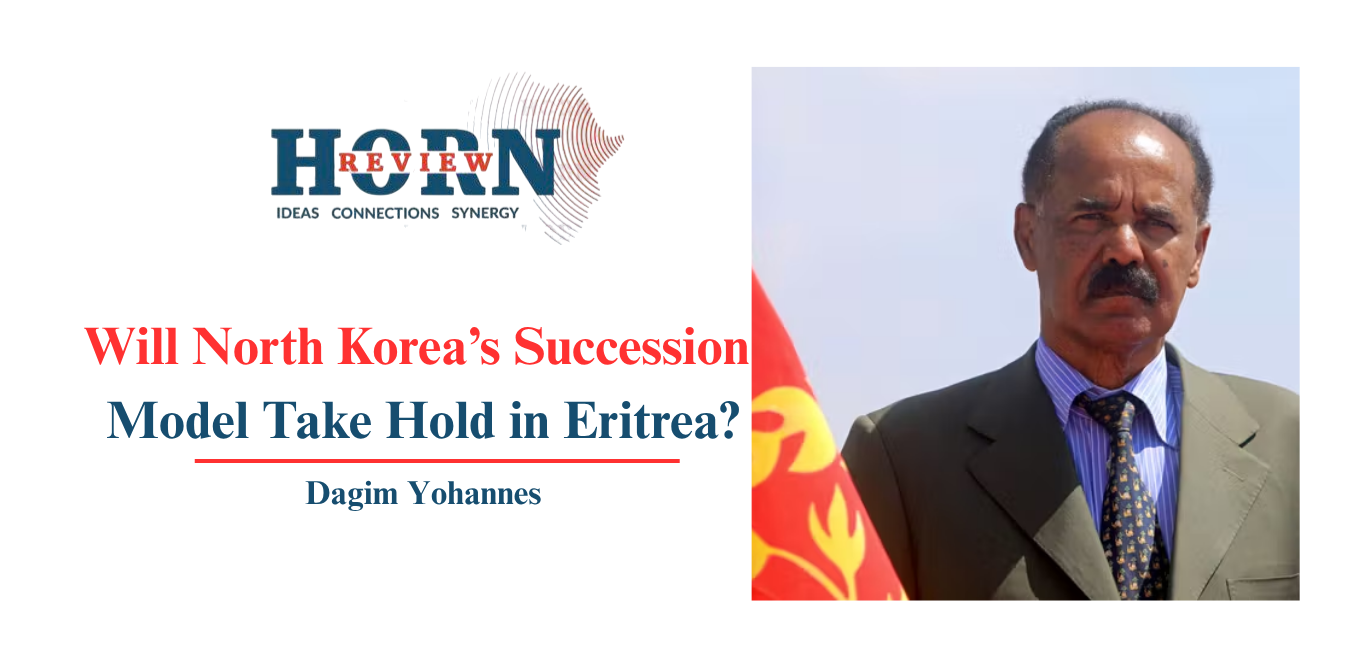
Isaias Afwerki turned 80 in February 2026, and a question that has circulated for close to a decade in diaspora networks and Western intelligence assessments has acquired new urgency: not whether Eritrea will face a succession, but whether that succession will resemble North Korea’s, where the Kim family has now passed power across three generations inside a party-state built explicitly to receive a bloodline. The honest answer, weighing the available evidence, is that a Kim-style hereditary transfer is structurally improbable in Eritrea. This is not chiefly because the generation that fought for independence will rise up to stop it. It is because the machinery North Korea spent seventy-five years constructing to make dynasty possible does not exist in Asmara, and because that same independence generation has already been tested on the question of standing against Isaias’s will, and lost decisively.
North Korea’s succession rests on doctrine as much as force: a constitutionally embedded Paektu bloodline myth, a Confucian-Stalinist hybrid ideology cultivated since Kim Il Sung’s era, and a party apparatus whose institutional purpose is to receive an anointed heir. The PFDJ possesses none of this. Its legitimacy is transactional rather than sacral, flowing from the shared sacrifice of the thirty-year liberation war and from Isaias’s own standing as the senior surviving tegadalai holding supreme office, not from any claim that his bloodline carries a mandate to rule. This distinction matters more than surface-level comparisons of repression suggest: a system without a succession theology has no ready mechanism for legitimizing an untested heir, however loyal the security services around him may be.
Since 2018, Isaias has visibly elevated his eldest son, Abraham Isaias Afwerki, appointing him special advisor on strategic studies and folding him into diplomatic delegations, including a 2021 mission to Saudi Arabia, one of the regime’s few remaining foreign patrons. This has been widely read as dynastic preparation. But Abraham’s central liability is generational and experiential: he did not fight, and holds none of the revolutionary credentials that carry weight inside the PFDJ’s upper ranks. Multiple accounts describe a 2018 pushback from cabinet ministers against his advancement, after which formal cabinet meetings effectively ceased. That claim, long treated as diaspora rumor, now finds independent corroboration: the Bertelsmann Transformation Index’s 2026 Eritrea assessment finds no evidence of a formal cabinet meeting having occurred in years, with ministers governing in relative isolation under presidential decree.
PFDJ ideologue Yemane Gebreab is seen as the most institutionally credible successor, ahead of security chief Abraha “Wedi Kassa” Kassa and defense chief of staff General Filipos Woldeyohannes, precisely because Yemane, unlike Abraham, carries the armed-struggle credential the party structure demands. The same BTI 2026 report finds that Yemane went unmentioned in state media and was not seen in public throughout the review period, his whereabouts and health unknown for reasons the government has not explained. If Eritrea’s most plausible non-hereditary continuity figure has himself vanished from view, the succession field is more contested and more opaque than any single-heir narrative, dynastic or institutional, can capture.
This is where the remaining two questions collapse into one. The independence generation is not a unified body capable of collectively allowing or blocking a succession. Isaias fragmented it deliberately after 1991, engineering a two-tier social hierarchy that privileged veteran fighters through patronage and a spoils system, binding their material interests to his continued rule rather than to the principles they fought for. When a genuine elite challenge did emerge, the G-15 ministers’ 2001 open letter demanding constitutional reform, Isaias shut down the independent press within days and jailed eleven of the fifteen signatories, who remain imprisoned without trial or public accounting a quarter-century later. That episode is the only real-world test of whether Eritrea’s revolutionary generation can stand against Isaias’s will, and it ended in total, swift defeat. The generation is also simply aging out: most surviving tegadelti are now in their seventies and eighties, thinning by mortality rather than positioned to mount organized resistance to a succession decided while Isaias is alive and enforcing it himself.
The more consequential uncertainty is not whether the old guard will resist Isaias now, but what happens in the vacuum after he is no longer the system’s sole arbiter, when no single figure holds the coercive and ideological legitimacy he has combined for three decades. In that scenario, Abraham’s most realistic path to power is not autonomous rule in the Kim Jong Un mold but installation as a legitimizing figurehead by whichever security or military faction, Wedi Kassa’s National Security Office or Filipos’s Defense Forces, controls events when the moment arrives. Comparisons to other African family dynasties, such as the Sassou Nguesso succession apparatus in the Republic of Congo, actually understate Eritrea’s fragility: those regimes rest on oil patronage that can be inherited administratively, whereas the PFDJ’s legitimacy rests on a collective-sacrifice narrative that an untested son’s ascension directly contradicts.
The stakes are no longer purely domestic. In May 2026, Washington moved toward lifting aspects of sanctions on Asmara, originally imposed in 2021 over Eritrea’s role in the Tigray conflict. This shift was framed explicitly around Eritrea’s strategic weight in the Red Sea, especially in the aftermath of the Iran war, amid Ethiopia’s renewed push for sea access and Egypt’s deepening interest in securing influence along the southern Red Sea flank. External actors, particularly Cairo, now have live stakes in the stability of any transition, significantly raising the costs of a chaotic succession for the entire Horn of Africa.
One can argue that Isaias’s near-total personal control, the loyalty of key security organs, and the absence of any functioning alternative institutions could still enable a hereditary outcome by default. These factors are real and give Abraham Isaias, a non-trivial foothold if a powerful patron within the National Security Office or Defense Forces chooses to elevate him as a controllable figurehead. Yet even here the North Korean parallel breaks down: Pyongyang’s system rests on decades of deliberate ideological engineering and bloodline sacralization, whereas Eritrea’s power structure remains a personalized patronage network without a ready-made hereditary transmission mechanism. Any “succession” would thus likely remain contested and conditional rather than institutionalized and dynastic.
So: can a North Korea-style hereditary succession happen in Eritrea? Not in its full Pyongyang form. The doctrinal and institutional scaffolding is absent, and none of it can be built in whatever time Isaias has left. Will the generation that fought for thirty years prevent it? No, not because they support it, but because they were structurally disarmed decades ago through co-optation and are now too old and too fragmented to act as an organized force. Can they stand against Isaias’s will while he lives? History already answered that question in 2001, and the fighters lost. The real contest over Eritrea’s future will not be fought over Abraham’s legitimacy at all. It will be fought, opaquely and likely violently, among the security, military, and party factions who inherit the vacuum Isaias leaves behind.
By Dagim Yohannes, Researcher, Horn Review