
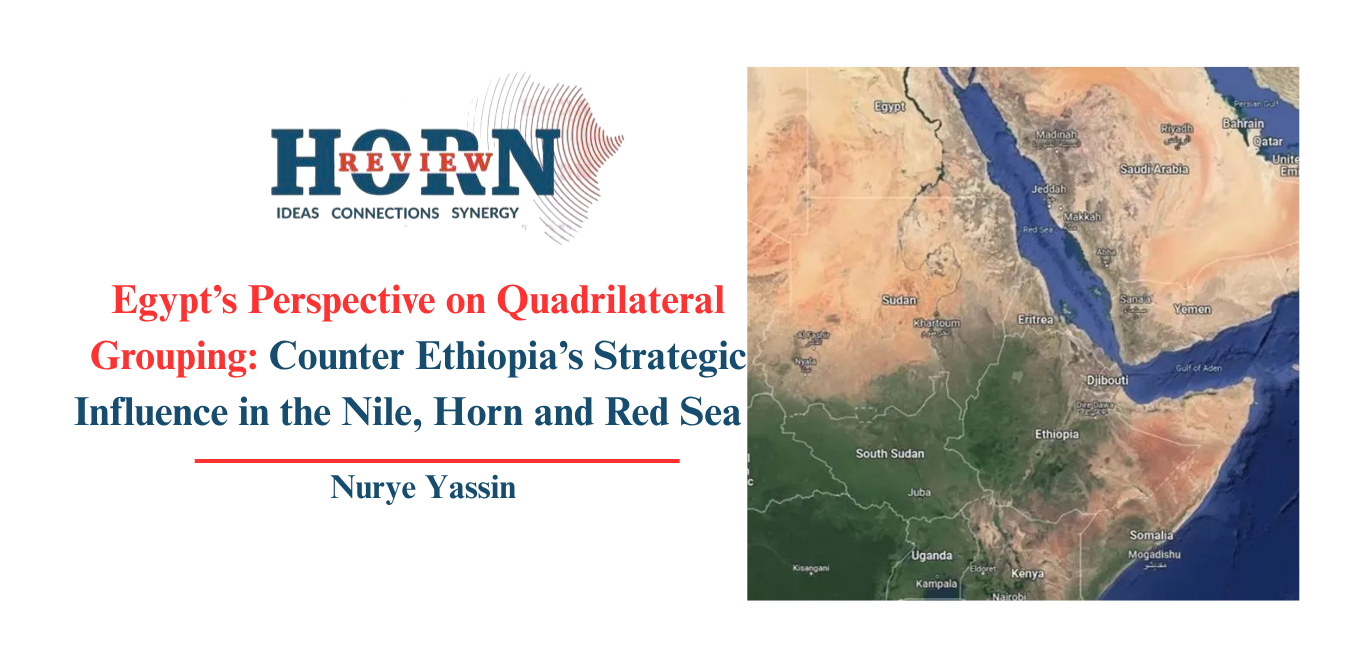
Egypt’s Perspective on Quadrilateral Grouping: Counter Ethiopia’s Strategic Influence in the Nile, Horn and Red Sea
The Middle East undergoes structural shifts with global implications significantly impacting the geopolitics and geo-economics of the world. This war along with a myriad of peace initiatives scripted by various competing actors shows that regional countries are contesting to draw a new regional power map. The war again displays that middle powers are standing up to major powers while demonstrating their sovereign resilience. Medium-sized powers are investing on their strategic independence while diversifying their security, economic and diplomatic partnerships to reduce dependency. Regional powers are also creating platforms which are so fluid to refashion the post-war regional order according to their respective geostrategic designs.
As the regional powers of this vital region are competing to design their alternative regional security architecture, a new quadrilateral consultative mechanism emerges in the broader Middle East comprising Pakistan, Saudi Arabia, Türkiye and Egypt. These regional powers held their fourth round of meeting in Cairo on 21 June, 2026 seeking to manage regional crises and back regional negotiations. The consultative meeting signals the fact that these four regional powers are eager at forming and consolidating this quadrilateral consultative format.
This quadrilateral grouping seems to originate from the signing of a Saudi-Pakistan strategic mutual defense pact inked in September, 2025, which makes nuclear deterrence central to the partnership between the two countries and merges the security systems of the Middle East with that of South Asia. This was followed by Egyptian-Turkish joint naval drills and military cooperation deal inked in 2026; and Turkish engagement with Saudi Arabia and Pakistan, putting a premium on joint drone and missile production for greater strategic autonomy. These moves are indications that this consultative front is likely to establish a coordinated defense and diplomatic grouping that responds to the panoramic geopolitical changes complicating the developments of the Middle East and adjacent regions, including the Horn of Africa.
These four countries have brought their own respective competences to the quadrilateral table aimed at crafting a new regional security arrangement. The alignment of Saudi Arabia’s capital with that of Turkey’s defense industries, Pakistan’s nuclear arsenal, and Egypt’s control of the Suez Canal does have a financial, military, industrial, political, security and strategic implication to the Middle East, Red Sea and Horn of Africa. This quadrilateral front creating common ground and aligning the regional visions of these regional heavyweights emerges as one of the major regional groupings that is contesting for power projection to “graph” the “geo” of the Middle East and mint its own geopolitical concepts, initiatives and projects. These four regional countries continue to coordinate their regional visions in association with the international partners with influence in the remaking of the post-war regional order.
Ethiopia, as a voice of sanity, stability and balance in the North East Africa, encourages and supports any consultative mechanisms and governance arrangements that do not target any third party and avoid rules by few while privileging diplomacy and dialogue as the only options over the military one. Ethiopia’s paradigm regarding governance arrangement prioritizing multilateral security dialogues enables security autonomy and non-hegemonic stability. Contrary to Ethiopia’s strategic outlook, Egypt continues to leveraging geopolitical shifts, coordination platforms, international partnerships, regional peace plans, mediation efforts, and multilateral settings to sustain its hydro, maritime and regional hegemony at the expense of Ethiopia as well as all Horn and Nile Basin nations.
Egypt does not hesitate to use any means, including this emerging consultative mechanism, to stop Ethiopia from developing and rising. Egypt does not shy away from using this quadrilateral grouping as a counterweight to the geopolitical and geo-economic rise of Ethiopia. Egypt is bluntly honest in exhibiting its hostile policy towards Ethiopia as Addis Ababa has created a new regional hydro-political reality that geo-economically bonds the countries of the North East Africa through the Grand Ethiopian Renaissance Dam (GERD).
The completion of the GERD as a regional integrationist project, formation of a new normative order on the Nile Basin anchored on the Cooperative Framework Agreement (CFA), and renewed effort for Ethiopia’s unfettered access to the sea are the new mega-trends geo-economically remaking the Nile and Red Sea politics for integration. These geo-economic developments informed by Afro-centric economic and normative agenda have unsettled the Egyptian foreign policy establishment which clings to colonial and hegemonic arrangement.
Egypt encountering these game-changing developments in the Horn, Nile and Red Sea continues to militarily and diplomatically attempt to limit Ethiopia’s geopolitical space in the North East Africa in collaboration with regional proxies. In this respect, Egypt is now stressing the urgency to transform the consultative mechanism into a structured and institutionalized bloc. President Sisi reiterated the immense importance of institutionalizing the coordination mechanism during the ministerial meeting held in June 21 in Cairo. The institutionalization of this quadrilateral grouping is a continuation of Egypt’s geopolitical plot to make full use of the cumulative hard power of this emerging mechanism to place Ethiopia at a disadvantage. Egypt, under the pretext of stabilizing regional crises through this grouping, seeks to make good use of the financial, military, and industrial wherewithal of the grouping to maintain its regional hegemonism in the North East Africa.
Egypt, which views the Horn of Africa, Nile and Red Sea regions as direct extensions of its national security and promotes bloc mentality regarding coordination platforms, regards the quadrilateral grouping as a useful vehicle for advancing its interests over these strategic regions. That means Egypt will not stop from instrumentalizing this quadrilateral framework to advance its long-term geopolitical project in the North East Africa, aimed at frustrating Ethiopia’s efforts to utilize the resources of its sovereign water resources and access the Red Sea.
There are reports that indicate that Egypt is trying to market its initiative for a new regional security and cooperation architecture to the quadrilateral grouping entwining the Nile Basin and Red Sea with the Middle East. The former assistant foreign minister of Egypt, Mohamed Hegazy, made it clear in Al Ahram on June 12, 2026 that “the Nile Basin water security, Red Sea security, Gulf security, and Eastern Mediterranean security” are pillars of Egypt’s regional and cooperation architecture initiative. This Egyptian diplomat states that the “Nile Basin water security” and “Red Sea maritime security” are critical “components of any future regional security and cooperation architecture.” This Egyptian initiative which is presented in this quadrilateral grouping and other multilateral settings omits and blanks Ethiopia’s ontological density, historicity and geography grounded on the waters of the Nile and Red Sea.
Moreover, Egypt’s expansionist posture is now expressed in various forms in the Horn of Africa turning the littoral states of the African coast as pliant collaborators in an effort to corner Ethiopia. Egypt continues to deploy troops in the Horn, secure naval basing rights, inks pacts to develop ports and logistical zones, create a rival regional maritime governance architecture, extends military support to raging internal conflicts, recruit regional proxies, court neighboring countries, stoke division in the region, and derail regional integration agenda in order to thwart Ethiopia’s increased geopolitical relevance, geo-diplomatic centrality, geo-economic dynamism, and geo-technological potential. These Egyptian machinations are not limited to the Horn.
Furthermore, Egypt is now trying to turn the members of the quadrilateral grouping into partners in its project to make Ethiopia landlocked, insecure and under-developed. Egypt’s Red Sea strategy amounts to blocking Ethiopia’s trade arteries, energy lines, supply chains, and physical and digital corridors in addition to undermining Ethiopia’s military, intelligence, security and maritime interests across the Red Sea corridor. In other words, Egypt seeks to ensure a supportive quadrilateral grouping to re-organize the Nile, Horn and Red Sea regions according to its hydro, regional and maritime supremacy. Egypt’s full spectrum military and diplomatic operations launched against Ethiopia are so disruptive to the maritime security, connectivity processes and trade as well as regional stability and regional development.
Unlike Egypt which exerts efforts to weaponize this consultative grouping against Ethiopia, Saudi Arabia, Türkiye and Pakistan do not see this coordination mechanism as a tool that targets Ethiopia. As Ethiopia’s relations with Saudi Arabia, Türkiye and Pakistan are mature, practical and historic, these three countries as core members of this quadrilateral grouping are cognizant of Ethiopia’s concerns and core interests. These three countries continue to partner and work with Ethiopia instead of joining Egypt’s regional project in alienating and containing Ethiopia. It is not in the best interest of Saudi Arabia, Türkiye and Pakistan to isolate Ethiopia which has the civilizational, strategic, material and demographic depth that contributes for cross-regional development and stabilization initiatives that covers the Med-Red-Indo-Pacific domains.
Saudi Arabia, which invests on strategic autonomy and geo-economic centrality between Africa, Europe and Asia, partners with Ethiopia in various platforms, including Saudi-Africa summit. Ethiopia and Saudi Arabia continue to cooperate for economic diversification and coordinate efforts for regional stability. Likewise, frequent high-level visits and mutual respect define Ethiopia-Türkiye relations. President Erdoğan who visited Ethiopia in February underscored Türkiye stays committed to supporting Ethiopia’s development initiatives. On the same day, Premier Abiy raising Ethiopia’s pursuit of access to the sea requested the support of President Erdoğan in applying diplomatic efforts to assist Ethiopia’s peaceful quest for reliable access. Such discussions and coordination on economic and regional security matters illustrates that Türkiye, Saudi Arabia and Pakistan are active and committed partners to Ethiopia. Saudi Arabia, Türkiye and Pakistan are also encouraged to objectively and impartially approach strategic issues related to these vital regions.
Ethiopia as a major responsible country in Africa demonstrates that strategic autonomy, geo-economic openness, strategic neutrality, open regionalism, and integrated regional development are the organizing principles of the Horn, Nile, Red Sea and the rest of Africa.
Firstly, strategic autonomy. Ethiopia as an enabling regional power welcomes international and regional partners that respect the strategic autonomy of the Horn, Nile, Red Sea and Africa. Ethiopia continues to deepen its ties with its neighbors and collaborate with genuine international partners and multilateral groupings to make the region a self-organizing, self-regulating and self-managing one that cannot be used as a site of contestation for primacy. As the region is located along the critical sea lanes and endowed with strategic resources, this vital region cannot be used against any regional or extra-regional actor.
Secondly, geo-economic openness. Ethiopia calls on international partners to explore opportunities from the geo-economic openness of the region and Africa and contribute for the integrated regional and continental flourishing. As the region is geopolitically exhausted, geo-economics is central to re-order the region. That means geo-economics is an enabling paradigm that outweighs geopolitical considerations. Ethiopia championing regional geo-economic openness avoids bloc politics, zero-sum rivalry, geopolitical side-taking and closed regionalism. This is opposed to Egypt’s bloc mentality that weaponizes every consultative or coordinating platform against Ethiopia.
Thirdly, strategic neutrality. Ethiopia will not be neutral in the exploitation of the water, marine and land resources of the Nile, Horn and Red Sea. But the neutral buffer allows Ethiopia and neighboring countries to have a balanced relationship with all, overcome the middle power maneuvering and major power contest, seize the geo-economic momentum, and thrive in the emerging world order. The countries of the Horn should distance themselves from being extensions of external geopolitical ambitions and rival security arrangements that take the region again to ruins.
Lastly, an open and inclusive regional architecture. Ethiopia, lauding the role of Saudi Arabia, Turkey, and Pakistan in mediating regional crises in the broader Middle East, calls on these essential countries to form and promote a cooperative, open and inclusive security and cooperation architecture that enables the broader Middle East and surrounding regions to stabilize and grow together. Such emerging consultative format should discipline spoilers like Egypt that seeks to utilize the grouping for its monocentric geopolitical ambitions—decoupling Ethiopia from the sea as well as solely controlling the resources of the Nile.
By Nurye Yassin, Horn Review, Researcher

RELATED
Posts
8
Oct
The Houthi-al-Shabaab Nexus and the Emerging Security Architecture of the Gulf of Aden
The growing relationship between Yemen’s Houthi movement and Somalia’s al-Shabaab...
7
Oct
“Decaffeinated Sovereignty”: Eritrea’s One-Way Street with Ethiopia
There is a peculiar contradiction at the heart of Eritrea’s...

7
Oct
Leaked Documents Allege Sudanese Army Weapons Pipeline to TPLF-Aligned Forces as Tigray War Reignites
Leaked documents alleging a Sudanese army weapons pipeline to TPLF-aligned...
7
Oct
Eritrea Has Officially Invaded Ethiopia, Says Government Communication
Ethiopian Government Formally Condemns Eritrean Territorial Incursion as Its Forces...
7
Oct
Turkey, Somalia and the Transactional Reading of Alamein
The Alamein Declaration functions less as a coherent framework...
7
Oct
Somalia's Alamein Signature and the Costs of Diplomatic Alignment
The Alamein Declaration between Egypt, Sudan, Eritrea and Somalia...
6
Oct
Egypt's Nile for All, the Red Sea for Some - Except Ethiopia
The contradiction was laid out almost perfectly at El Alamein....
6
Oct
Isaias Afwerki has Long Wanted to Rule Ethiopia, Why He will Never
President Isaias Afwerki is among the most enduring figures in...
6
Oct
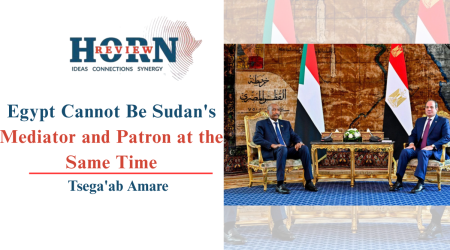
Egypt Cannot Be Sudan's Mediator and Patron at the Same Time
Abdel Fattah el-Sisi received Abdel Fattah al-Burhan in New...
6
Oct
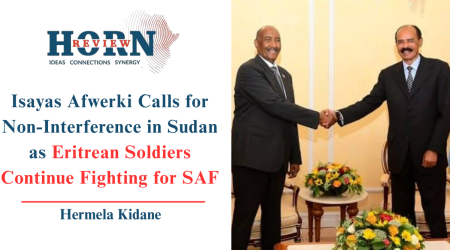
Afwerki Calls for Non-Interference in Sudan as Eritrean Soldiers Continue Fighting for SAF
At the New Alamein summit in October 2026 Eritrean...